
Salame di Sant'Olcese
Sant'Olcese, Liguria, Italy
Coarse and savoury, a pork-and-beef Ligurian salame from the Genoese hills.
Overview
Salame di Sant'Olcese is coarse and savoury, a pork-and-beef ligurian salame from the genoese hills. A coarse red sausage with visible white fat, both pork and beef character and a light clean smoke over pepper, garlic and wine.
Where it's from
Climate. The humid hills behind Genoa in Liguria.
Altitude. Ligurian hills
The cut
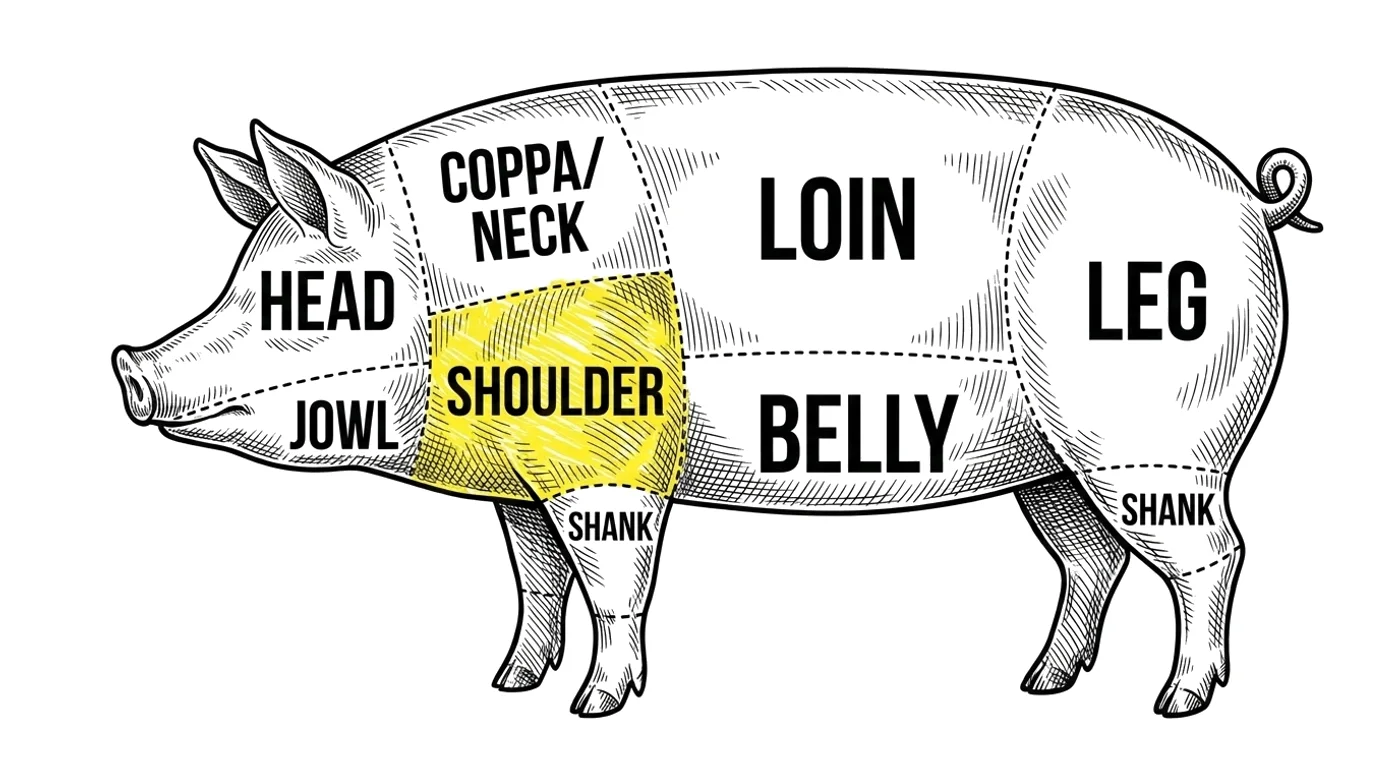
How to recognise it
A coarse red sausage with visible white fat, both pork and beef character and a light clean smoke over pepper, garlic and wine. The beef-and-pork mosaic must stay distinct; harsh smoke, smear or a damp centre is defective.
- Shape and size
- Cylindrical, medium grain
- Lean colour
- Red
- Fat and marbling
- White
- Casing
- Natural casing, tied by hand, 60 mm
- Surface bloom
- Natural mould
Origins and history
This is a salame of the Genoese hinterland, from the hill villages of the Val Polcevera behind the city. It grew up as a farmhouse cure that leaned on beef as much as pork, a mark of a countryside where cattle were kept and pork alone ran short. Commercial production took hold in the nineteenth century, and the salame held on to its old habit of a light hardwood smoke, uncommon among Italian salumi. Only a small number of makers still work to the old method today.
Cattle were important in the hills behind Genoa, so farmhouse sausage makers supplemented pork with beef. Commercial production developed during the nineteenth century while retaining the mixed-meat block and restrained smoke. The verified production area is Sant'Olcese and Val Polcevera, Liguria, Italy. Stories and etymologies are retained when they help explain the tradition, but legends are not used as evidence for the modern specification.
Name. Named for the town of Sant'Olcese.
- Production today
- Producers around Sant'Olcese.
- Protection
- Not EU-protected as a general name.
- Tradition vs modern
- Traditional pork-and-beef mix.
- Seasonality
- Year-round.
Compare with. Salame Piemonte
Serving and cultural significance
Slice thinly and serve with Ligurian bread, focaccia, fresh cheese, olives and red wine. The unusual beef-and-pork balance and light smoke work well before richer all-pork salami. Let the sausage warm slightly so the smoke and beef aroma open without becoming greasy.
Recipe and cure
This is not a finished recipe. It is a window into how this meat is traditionally cured. Before you follow any process, please run it through one of our curing calculators, so the salt, cure and timings are right and safe for your own batch.
Make this — the measured Curesmith version →The cure below is the traditional reference. “Make this” opens the measured Curesmith home recipe, scaled to your batch.
Traditional or protected production
Salame di Sant'Olcese is unusual among Italian salami because it combines pork and beef in broadly comparable proportions. It is seasoned with pepper, garlic and wine and traditionally receives a light hardwood smoke.
- Meat
- pork and beef
- Salt (%)
- 2.5
- Curing salt
- Not included in the base recipe below
- Fermented
- Yes
- Target pH
- 4.9
- Starter or mould
- Natural surface mould
- Smoked
- Yes
- Target aW or weight loss
- ~30% weight loss
- Temperature (°C)
- ferment 22 to 24, then dry 13 to 15
- Humidity (%)
- ferment ~90, then 75 to 80
- Maturation
- 3 to 6 weeks
- Basis
- per 1000 g green meat
- Style
- Traditional fermented and dried salame
Ingredients
- Pork lean (base)100% · 1000 g/kg
- Beef lean100% · 1000 g/kg
- Pork belly64.98% · 650 g/kg
- Dextrose0.5% · 5 g/kg
- Black pepper, cracked/whole0.25% · 2 g/kg
- Black pepper, ground0.1% · 1 g/kg
- Garlic powder0.1% · 1 g/kg
Method
- Mince pork and fat and mix with all ingredients to green meat weight.
- Stuff into casing.
- Ferment to the target pH.
- Dry to the target weight loss.
Notes
- This traditional recipe uses no nitrite. For safety we recommend adding Cure #2: in a low-oxygen, slow-dried product nitrite is the specific guard against Clostridium botulinum, while salt, acidity and drying control Salmonella, E. coli, Listeria and Staphylococcus.
In the Codex
What this product teaches, and where to read more.
Temple. Roof, Water Activity