
Overview
Salame Friulano is a traditional salami of Friuli Venezia Giulia in north-eastern Italy. It is made from selected pork mixed with lard and spices and matured to a firm sliceable texture. The regional identity is stable even though household and producer formulas vary.
Where it's from
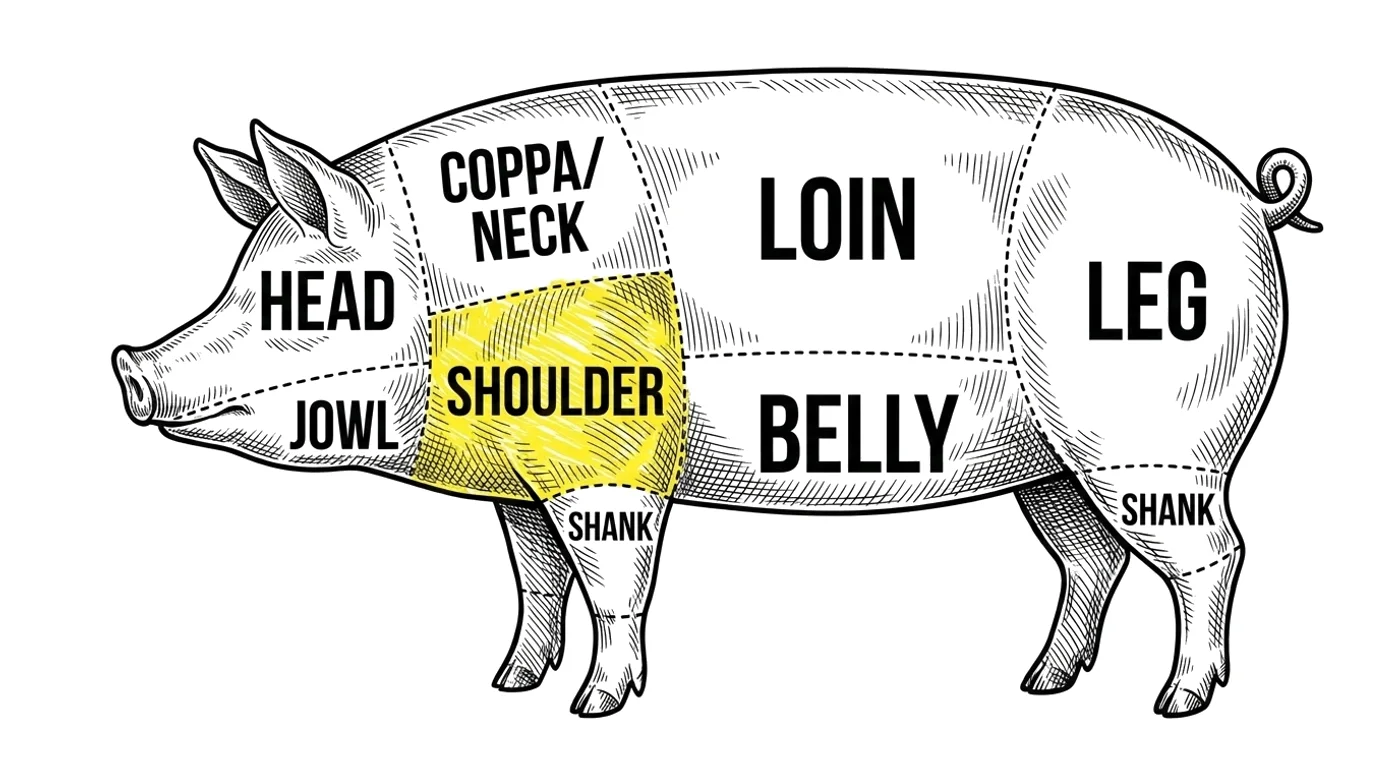
The cut
Identity and terminology
Official regional food records recognise Salame friulano as a traditional product made across Friuli Venezia Giulia. This status supports the name and cultural context but does not create an EU protected designation or one mandatory formulation. Producer and local variants should therefore remain visible.
Composition and characteristics
The sausage uses selected lean pork and visible lard or firm fat. Garlic, pepper, wine and other regional seasonings may appear, but no single spice mixture defines the whole family. The finished salami is red, aromatic and evenly matured, with distinct white fat particles.
Texture varies from relatively coarse farmhouse styles to more regular commercial forms. The expected result is nevertheless a clean cured-red matrix with distinct fat, balanced garlic or wine notes where used and no greasy smearing or wet centre.
Production and process
Pork and lard are chilled, cut or ground, cured and seasoned, then stuffed into natural casing. Fermentation or acidification, drying and optional smoking vary by producer. Modern technical descriptions must record culture, pH, temperature, humidity, airflow, weight loss and final aw rather than relying only on traditional time.
History and regional forms
Friuli Venezia Giulia sits at a cultural crossroads between Italian, Austrian, Slovenian and Adriatic traditions. Local pork butchery reflects this setting. Salame Friulano developed as a household and farm-preserved sausage and remains part of regional hospitality and antipasto service.
The regional family can accommodate genuine producer variation without losing identity. A strong Codex entry should document several sourced practices while avoiding a fabricated single 'official' recipe.
Use, storage and related products
The salami is sliced thin and served with bread, cheese, polenta and regional wine. Storage depends on the verified maturity and packaging. Individual producer styles and local subregional forms may be linked beneath the family without implying PDO or PGI protection.
Recipe and cure
This is not a finished recipe. It is a window into how this meat is traditionally cured. Before you follow any process, run it through one of our curing calculators so the salt, cure and timings are right and safe for your own batch.
Make this — the measured Curesmith version →“Make this” opens the same cure as a measured recipe, scaled to your batch.
- Meat
- Pork shoulder
- Cut
- Pork shoulder
- Salt (%)
- 2.5
- Curing salt
- Cure #1/#2 as specified
- Fermented
- Yes
- Target pH
- 5.3 or lower
- Smoked
- No
- Basis
- per 1,000 g pork shoulder
- Style
- Friuli-inspired fermented salami; no PDO or PGI claim.
Ingredients
- Pork shoulder100% · 1000 g
- Pork back fat45% · 450 g
- Fine salt2.5% · 35.5 g
- Cure #2 containing 6.25% sodium nitrite0.25% · 3.5 g
- Dextrose0.39% · 5.5 g
- Black pepper0.3% · 4.5 g
- Garlic0.3% · 4.5 g
- Dry white wine3% · 43 g
- Flora Italia LC or equivalent starter culture0.03% · 0.4 g
Safety. Regional identity does not provide a universal formula or validated process. Production requires correct cure, starter or acidification control where used, measured drying and a final release endpoint. No protected-designation claim should be made unless future registration changes.