
Salame Milano
Milan, Lombardy, Italy
Smooth, fine-grained and mild, the familiar everyday salame of the north.
Overview
Salame Milano is smooth, fine-grained and mild, the familiar everyday salame of the north. A broad sausage with a very fine, even red-and-white grain, a controlled white bloom and a mild, sweet flavour with little visible spice.
Where it's from
Climate. Lombardy and the wider north.
Altitude. Po plain
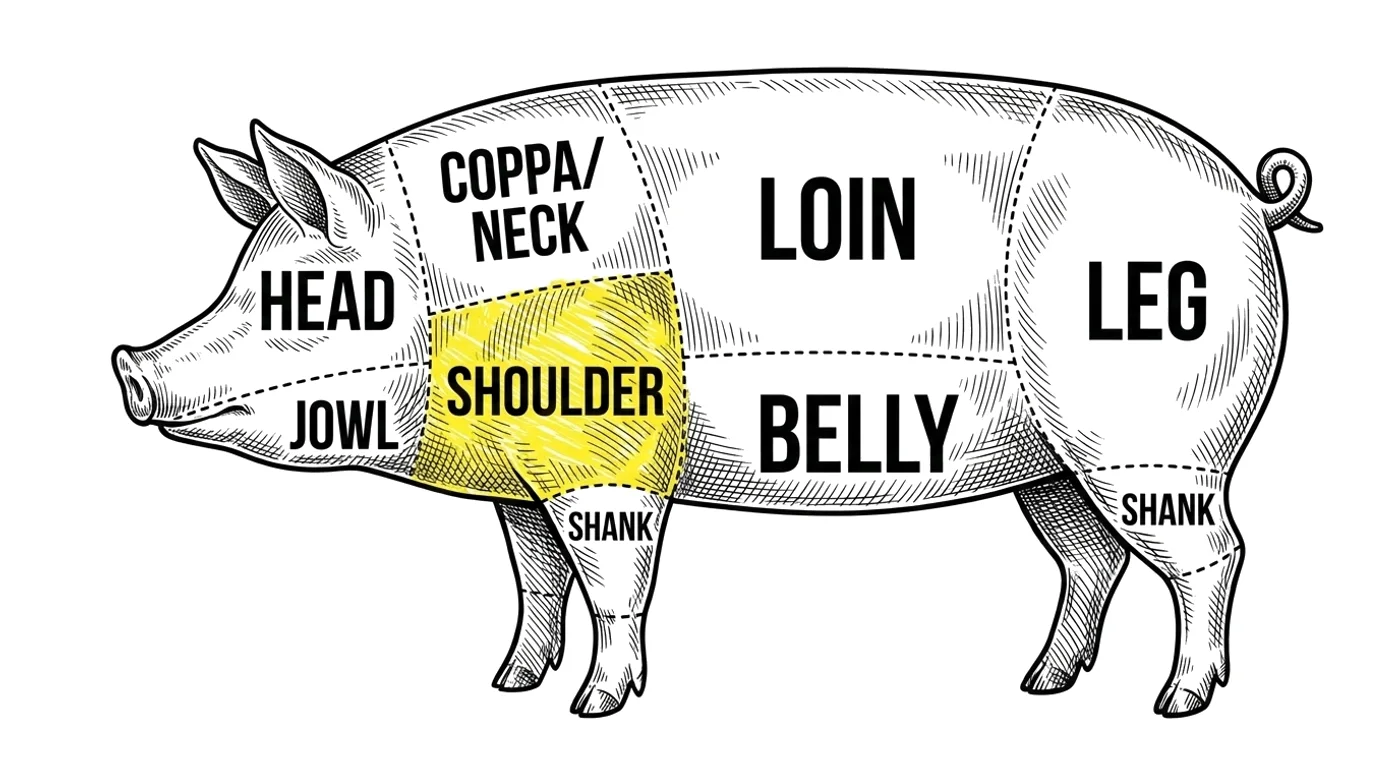
The cut
How to recognise it
A broad sausage with a very fine, even red-and-white grain, a controlled white bloom and a mild, sweet flavour with little visible spice. The fine mosaic should remain sharply defined; paste-like smear, voids or a wet centre are faults.
- Shape and size
- Cylindrical, fine grain
- Lean colour
- Uniform red
- Fat and marbling
- Fine white specks
- Casing
- Fibrous, protein-lined, 80 mm
- Surface bloom
- White mould
Origins and history
This is among the most familiar cured sausages of northern Italy, taking its name from the Lombard capital and long made across the surrounding plains. It belongs to a family of finely worked salami in which lean pork, beef and fat are chopped to the size of a rice grain, giving the smooth mosaic that defines the style. Once the everyday sausage of Milanese households, it spread widely through the twentieth century to become one of the most produced salami in the country. Its seasoning stays deliberately gentle, built on little more than salt, pepper, garlic and a touch of wine.
Milan's commercial charcuterie trade favoured a regular, elegant salame that sliced cleanly and travelled well. Fine grinding and long drying distinguished it from the coarser farmhouse salami of nearby provinces. The verified production area is Milan and Lombardy, Italy. Stories and etymologies are retained when they help explain the tradition, but legends are not used as evidence for the modern specification.
Name. Named for Milan.
- Production today
- Made across the north, artisan and industrial.
- Protection
- Not EU-protected as a general name.
- Tradition vs modern
- A large-scale everyday salame as well as an artisan one.
- Seasonality
- Year-round.
Compare with. Salame Brianza, Salame Cremona
Serving and cultural significance
Slice the salame very thinly so its fine rice-grain mosaic becomes visible. Serve with bread, mild cheese, olives and sparkling wine, or use it in sandwiches. Its gentle seasoning makes it a useful reference salami on a mixed board before stronger fennel, chilli or smoke flavours.
Recipe and cure
This is not a finished recipe. It is a window into how this meat is traditionally cured. Before you follow any process, please run it through one of our curing calculators, so the salt, cure and timings are right and safe for your own batch.
Make this — the measured Curesmith version →The cure below is the traditional reference. “Make this” opens the measured Curesmith home recipe, scaled to your batch.
Traditional or protected production
Salame Milano is a finely grained Lombard salame traditionally made from pork, with some technical formulas also using beef. The small, even particles and large casing create a uniform mosaic and long, gentle maturation. The generic name is not protected by an EU geographical indication.
- Meat
- pork
- Salt (%)
- 2.8
- Curing salt
- Not included in the base recipe below
- Fermented
- Yes
- Target pH
- 4.9
- Starter or mould
- Natural surface mould
- Smoked
- No
- Target aW or weight loss
- ~30% weight loss
- Temperature (°C)
- ferment 22 to 24, then dry 13 to 15
- Humidity (%)
- ferment ~90, then 75 to 80
- Maturation
- 3 to 6 weeks
- Basis
- per 1000 g green meat
- Style
- Traditional fermented and dried salame
Ingredients
- Lean pork trimmings (base)100% · 1000 g/kg
- Beef60% · 600 g/kg
- Pork back fat or fat trimmings40% · 400 g/kg
- Dextrose (or sugar)0.2% · 2 g/kg, or sugar 0.3% · 3 g/kg
- White pepper0.3% · 3 g/kg
- Garlic powder0.1% · 1 g/kg
Method
- Mince or hand-cut pork and fat and mix with all ingredients to green meat weight.
- Stuff into casing.
- Ferment to the target pH.
- Dry to the target weight loss.
Notes
- This traditional recipe uses no nitrite. For safety we recommend adding Cure #2: in a low-oxygen, slow-dried product nitrite is the specific guard against Clostridium botulinum, while salt, acidity and drying control Salmonella, E. coli, Listeria and Staphylococcus.
In the Codex
What this product teaches, and where to read more.
Temple. Roof, Water Activity