
Salame S. Angelo
Also known as Salame Sant'Angelo
Sant'Angelo di Brolo, Sicily, Italy
Coarse and full-flavoured, shaped by clean Nebrodi mountain air.
Overview
Salame S. Angelo is Sicily's protected coarse salami from Sant'Angelo di Brolo in the Nebrodi landscape. Prime pork cuts are hand- or coarsely cut, seasoned mainly with salt and pepper and matured in a mild mountain-valley climate. Fat is restrained, keeping the slice red, tender and meat-forward.
Where it's from
Climate. Sant'Angelo di Brolo in the Nebrodi mountains of Sicily.
Altitude. Sicilian mountains
The cut
How to recognise it
The salami is cylindrical with an irregular white-coated surface and may range from small pieces to several kilograms. The slice is ruby red with well-distributed white fat, tender and compact, with a fragrant, sweet and lightly peppery aroma. Fat should remain below the protected limit. Harsh acid, grease smear, black mould or a hard ring are defects.
- Shape and size
- Cylindrical, coarse, natural casing
- Lean colour
- Deep red
- Fat and marbling
- White
- Casing
- Hog, 40 to 60 mm
- Surface bloom
- Natural mould
Origins and history
Sant'Angelo di Brolo sits in a fertile Nebrodi valley of olives, citrus and hazelnuts. Local tradition connects the expansion of pork eating with the Norman conquest of Sicily in the eleventh century after a period of Muslim rule. That story explains a cultural transition, although it should not be read as a single moment of invention. Over later centuries the town built a specialised reputation for cutting prime pork into coarse salami and curing it in rooms exposed to local air currents. Unlike many southern sausages, S. Angelo does not depend on a heavy paprika or fennel profile. PGI registration in 2008 protected production in the defined area and confirmed its status as Sicily's only geographically protected salume.
Name. Named for the town of Sant'Angelo di Brolo.
- Production today
- Producers in the Sant'Angelo zone.
- Protection
- IGP.
- Tradition vs modern
- Traditional Nebrodi mountain ageing.
- Seasonality
- Year-round.
Compare with. Salame Napoli
Serving and cultural significance
Cut into thin or medium slices and serve with Sicilian bread, olives, mild cheese, citrus preserves or local red wine. It also works beside roasted aubergine, tomatoes and nuts from the Nebrodi area. The simple pepper seasoning makes the quality of the pork especially visible, so strong sauces are unnecessary.
Recipe and cure
This is not a finished recipe. It is a window into how this meat is traditionally cured. Before you follow any process, please run it through one of our curing calculators, so the salt, cure and timings are right and safe for your own batch.
Curesmith home adaptation — not designation-compliant
Make this — the measured Curesmith version →The cure below is the traditional reference. “Make this” opens the measured Curesmith home recipe, scaled to your batch.
Traditional or protected production
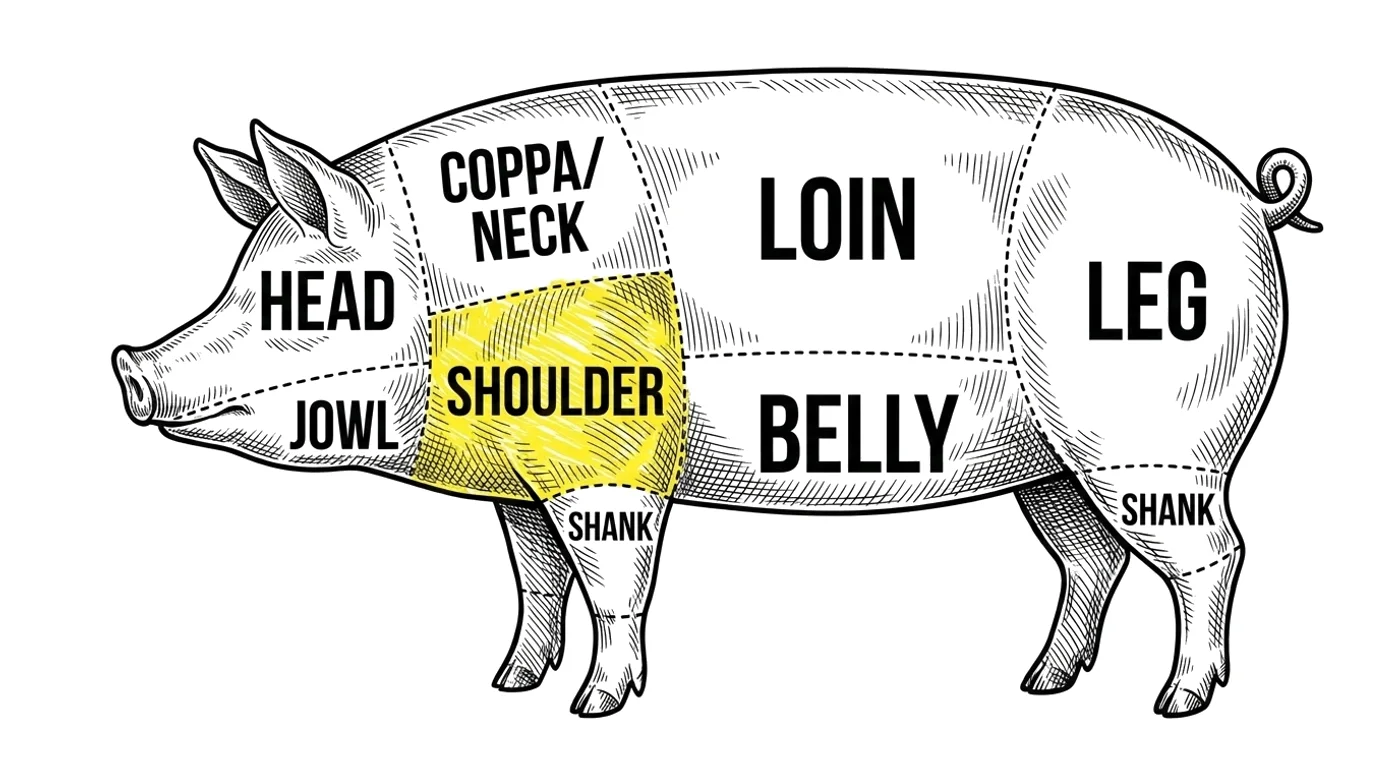
PGI production uses selected pork cuts such as shoulder, loin, neck, ham and belly, with a controlled lean-to-fat ratio. The meat is cut coarsely, seasoned principally with salt and pepper, stuffed and matured in the Sant'Angelo production environment. Different sizes receive different maturation times.
- Meat
- pork
- Salt (%)
- 2.8
- Curing salt
- Not included in the base recipe below
- Fermented
- Yes
- Target pH
- 4.9
- Starter or mould
- Natural white surface mould
- Smoked
- No
- Target aW or weight loss
- ~30% weight loss
- Temperature (°C)
- ferment 22 to 24, then dry 13 to 15
- Humidity (%)
- ferment ~90, then 75 to 80
- Maturation
- a few weeks to months
- Basis
- per 1000 g green meat
- Style
- Traditional fermented and dried salame
Ingredients
- Lean pork, fat kept below 20% and drawn mainly from the belly (base)100% · 1000 g/kg
- Black pepper, coarsely cracked0.1% · 1 g/kg
- Dextrose (or sugar)0.3% · 3 g/kg, or sugar 0.2% · 2 g/kg
Method
- Mince pork and fat and mix with all ingredients to green meat weight.
- Stuff into casing and inoculate the surface mould.
- Ferment warm until the target pH is reached.
- Dry slowly to the target weight loss.
Notes
- The official protected specification controls the named product. Any Curesmith EQ, starter-culture, curing-salt or home-scale adaptation is a separate method and must not be presented as designation-compliant.
- This traditional recipe uses no nitrite. For safety we recommend adding Cure #2: in a low-oxygen, slow-dried product nitrite is the specific guard against Clostridium botulinum, while salt, acidity and drying control Salmonella, E. coli, Listeria and Staphylococcus.
In the Codex
What this product teaches, and where to read more.
Temple. Roof, Water Activity