
Salami Krakowskie Pieczone Suche
Also known as Salami Krakowskie-Baked, Baked Kraków Salami, Salami krakowskie
Lesser Poland, Poland
Overview
Salami krakowskie pieczone suche is a Polish salami-form sausage that is cured, smoked, baked and then dried. It differs from fermented Italian salami because heat treatment supplies the lethality step before maturation. The filling is finely ground pork and firm fat rather than the large, conspicuous lean pieces expected in many Krakowska sausages. Drying concentrates the pepper, garlic and smoke while turning the broad chub from a moist cooked sausage into a dense sliceable product.
Where it's from
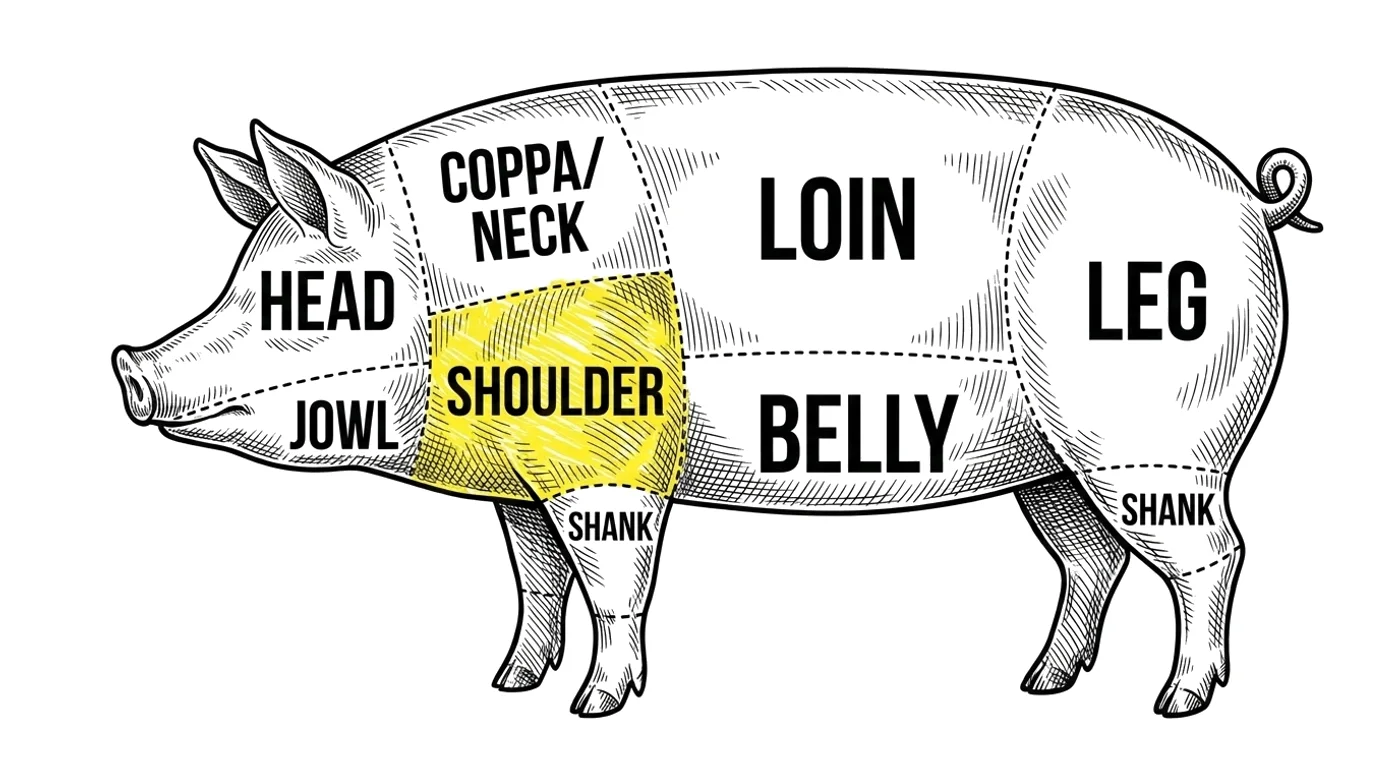
The cut
Identity and terminology
The name combines Krakowskie, associated with Kraków, pieczone, baked, and suche, dry. Salami describes the broad form and service style, but it does not prove fermentation. Historical Polish technical usage included cooked or baked salami alongside fermented raw sausages. The complete name is therefore important. It must not be shortened in a way that suggests Italian-style fermentation, and it must not be confused with Kiełbasa krakowska sucha staropolska, whose registered Traditional Speciality Guaranteed name and specification are different.
Composition and characteristics
Lean pork forms most of the matrix and firm pork fat supplies fine pale flecks. Both fractions are ground small, so the slice is more even than cut-meat Krakowska Krajana or Krakowska Trwała. Black pepper is comparatively assertive and garlic supports the cured pork aroma. No starter culture is required because this branch is deliberately cooked before drying rather than fermented as a raw sausage. The finished casing is dark and dry, while the centre remains cohesive rather than crumbly.
Production and process
Cold pork and fat are ground, mixed with salt, measured nitrite cure, pepper and garlic, and cured under refrigeration. The chub is stuffed tightly, surface-dried and smoked at moderate temperature. Baking continues until the cold point reaches a verified safe temperature. Only after rapid chilling does controlled maturation begin. Weight loss shows drying progress, but calibrated water activity is the stronger release measure. Surface mould may be permitted for flavour, yet colour alone cannot establish safety or completion.
History and regional forms
Kraków became a recognised name in Central European sausage trade, and Polish manufacturing literature developed several products around that reputation. Some preserve large pieces of high-grade pork; others use a finer salami-like matrix. The baked-dry form reflects industrial and craft efforts to produce a firm keeping sausage through curing, smoke, heat and moisture loss rather than through a single process. Official records also show Salami krakowskie in historical storage classifications, supporting the product name without making it a modern protected geographical designation.
Use, storage and related products
Serve the fully matured chub in thin slices with rye bread, mustard, horseradish, pickled vegetables or cheese. Its firm texture suits cold platters and sandwiches. Home batches should remain refrigerated even after reaching target yield and water activity unless a validated commercial process establishes ambient stability. It differs from Kiełbasa Krakowska Krajana through its fine matrix, from Krakowska Trwała through its salami-form architecture, and from the TSG product through name, composition and certification.
The recipe for this product is in preparation and will be published once it has been verified.
Safety. Use Cure #1 for the pre-cook phase, verify the broad cold point, chill before drying, measure water activity and keep the home product refrigerated.