
Overview
Salami sticks are small-diameter meat snacks presented as narrow links or rods and commonly associated with semi-dry or dry sausage. The form is convenient and fast-drying, but calibre does not establish a single product identity. Some sticks are fermented, some directly acidified, some heat-treated and some are merely dried cooked sausages under different rules.
Where it's from
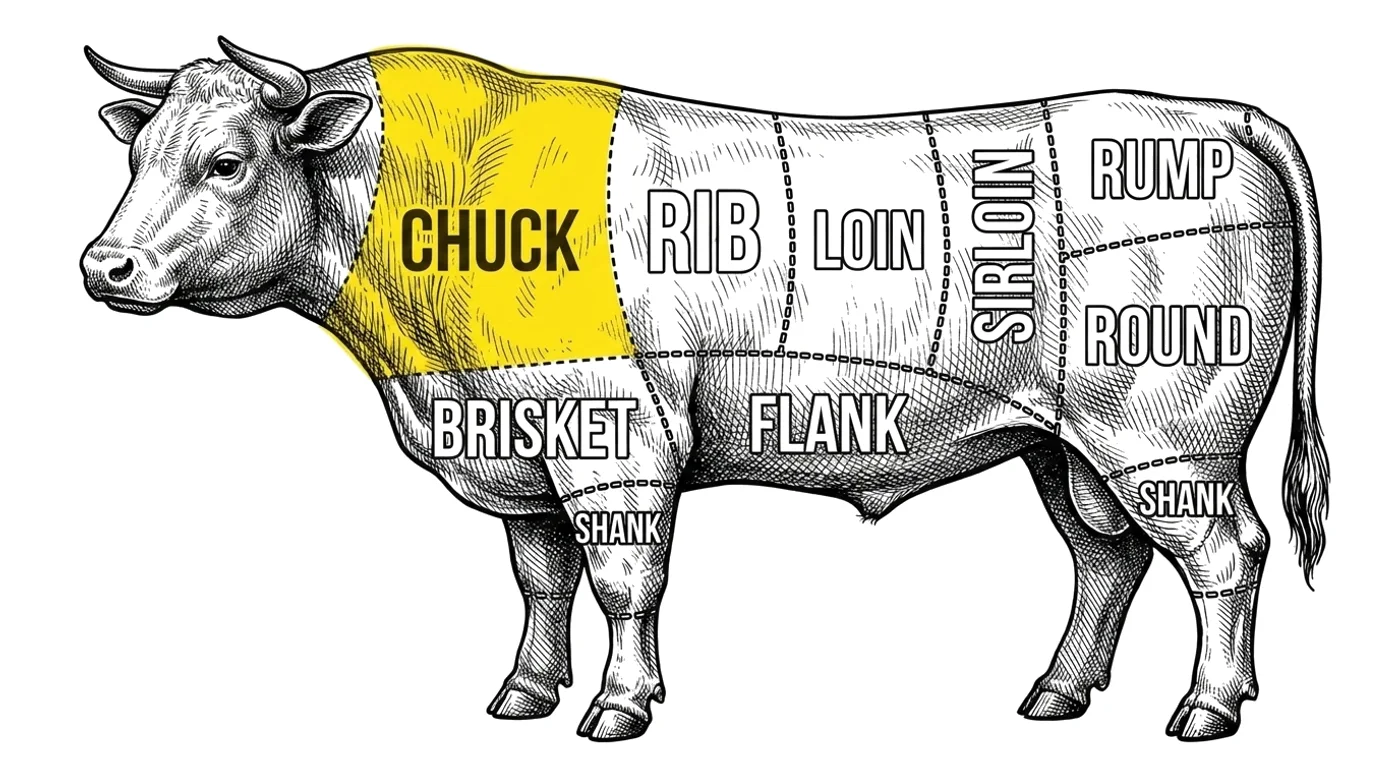
The cut
Identity and boundaries
The word salami should be reserved for products whose composition and process support that identity. A narrow meat stick is not automatically salami, ready-to-eat or shelf-stable. Snack sticks, pepperoni sticks, kabanosy, jerky sticks and extruded meat snacks may resemble one another while differing in grind, casing, fermentation, cooking, drying and legal standard.
Composition and characteristics
The meat block may contain pork, beef, poultry, game or declared mixtures with visible or finely dispersed fat. Cure, sugars, culture, acidulants, spices and smoke vary by route. Finished texture ranges from tender semi-dry to dense dry sausage. The small calibre should be uniform, without case hardening, hollow centres, greasy separation or underdried cores.
Production branches
A fermented route requires controlled culture activity, measured acidification and validated lethality, followed by drying to a verified endpoint. Other products may be directly acidified and cooked, fermented and heat-treated, or cooked before drying. These routes cannot share one generic schedule. Small diameter accelerates heat and moisture movement but also increases the risk of surface overdrying.
History and cultural context
Portable meat sticks developed from older narrow sausages and expanded through twentieth-century snack-food manufacture, convenience retail and vacuum packaging. Their apparent simplicity hides complex process choices. Traditional products such as kabanosy influenced the market, while modern manufacturers created many species, flavour and texture variants that do not necessarily belong to one historic salami tradition.
Culinary use and relationships
Salami sticks are eaten as travel snacks, lunchbox items, bar food and components of grazing boards. They may be served whole or cut into bites. Related entries include kabanosy, pepperoni, jerky, Tourist Sausage and generic meat sticks. Cross-links should guide readers by process and identity rather than treating every narrow sausage as interchangeable.
Recipe and cure
This is not a finished recipe. It is a window into how this meat is traditionally cured. Before you follow any process, run it through one of our curing calculators so the salt, cure and timings are right and safe for your own batch.
Make this — the measured Curesmith version →“Make this” opens the same cure as a measured recipe, scaled to your batch.
- Meat
- Lean beef
- Cut
- Lean beef
- Salt (%)
- 2.2
- Curing salt
- Cure #1/#2 as specified
- Fermented
- Yes
- Target pH
- 5.3 or lower
- Smoked
- Yes
- Basis
- per 1,000 g lean beef
- Style
- Small-calibre fermented, cooked and lightly dried snack sticks.
Ingredients
- Lean beef100% · 1000 g
- Pork shoulder30% · 300 g
- Pork back fat15% · 150 g
- Fine salt2.2% · 31.5 g
- Cure #1 containing 6.25% sodium nitrite0.25% · 3.5 g
- Dextrose0.49% · 7 g
- Black pepper0.3% · 4.5 g
- Garlic0.2% · 3 g
- Sweet paprika0.2% · 3 g
- Flora Italia LC or equivalent starter culture0.03% · 0.4 g
Safety. Use a validated route that explicitly controls pathogens through fermentation, lethality and drying as applicable. Measure pH and water activity where they are safety endpoints, manage small-calibre case hardening and verify storage conditions. Shape, smoke, acidity or weight loss alone does not prove shelf stability.