
Salamini Italiani alla Cacciatora
Also known as Cacciatore, cacciatorini, hunter's salami, Salamini italiani alla cacciatora, salame cacciatore
-, Multi-region (N/central), Italy
Small and handy, mild and sweet, quick-drying by virtue of their size.
Overview
Salamini Italiani alla Cacciatora are small, soft, pork-only salami designed to mature quickly and travel easily. Pepper and garlic remain gentle, and the protected pieces are compact enough for a hunter's bag, picnic or everyday snack.
Where it's from
Climate. Made across northern and central Italy.
Altitude. Various
The cut
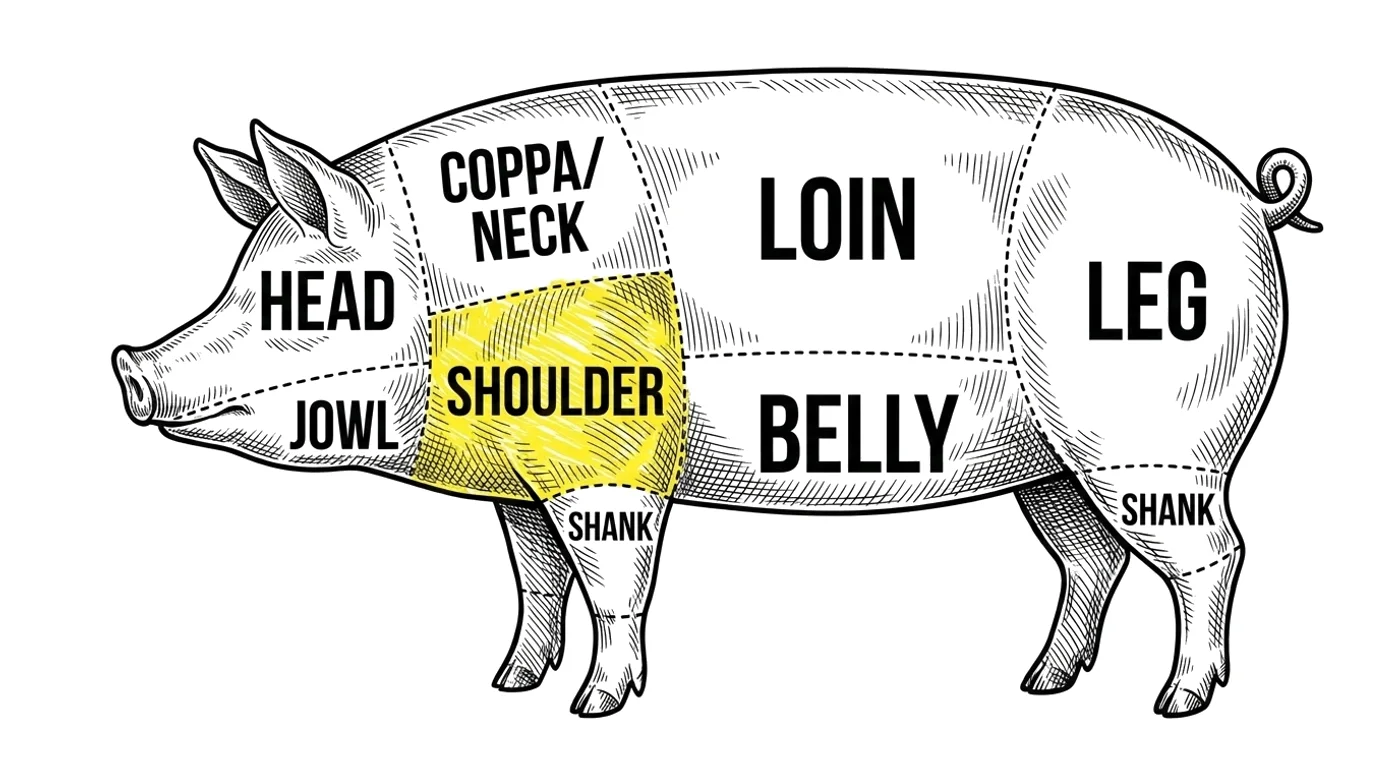
How to recognise it
The sausages are short, small and slightly curved, generally soft rather than rock hard. The cut surface is ruby red with fine white fat and a sweet pork aroma. Pepper and garlic should remain restrained. A wrinkled dry shell around a wet centre, sourness, smeared fat or uncontrolled mould indicates a faulty process.
- Shape and size
- Small, palm-sized cylinders
- Lean colour
- Red
- Fat and marbling
- White
- Casing
- Natural, 65 mm
- Surface bloom
- White mould
Origins and history
The hunter explanation is simple and credible as cultural history: a small salami fit into a saddlebag or pocket and supplied protein without cooking during a day in the field. Similar portable sausages existed across Italy, but the protected Cacciatore standard was built around the heavy-pig pork chain of northern and central regions. The small diameter shortened maturation and made the format accessible sooner after winter slaughter than a large household salami. European PDO registration arrived in 2001, and the protection consortium was formed in 2003. The legal names are Salamini Italiani alla Cacciatora DOP and Salame Cacciatore DOP; not every small cacciatorino made in Italy qualifies.
Name. Cacciatora means 'hunter-style', from the salami being carried on the hunt.
- Production today
- Many producers nationwide.
- Protection
- DOP.
- Tradition vs modern
- Traditional small format.
- Seasonality
- Year-round.
Compare with. Salame Milano
Serving and cultural significance
Serve whole or in thick coins with bread, cheese, fruit and wine. Their small size makes them practical for picnics and travel, but they are still fermented sausage and should be stored according to the validated finished water activity.
Recipe and cure
This is not a finished recipe. It is a window into how this meat is traditionally cured. Before you follow any process, please run it through one of our curing calculators, so the salt, cure and timings are right and safe for your own batch.
Curesmith home adaptation — not designation-compliant
Make this — the measured Curesmith version →The cure below is the traditional reference. “Make this” opens the measured Curesmith home recipe, scaled to your batch.
Traditional or protected production
PDO production uses lean pork from striated muscles, hard pork fat, salt, pepper and garlic. Mechanically separated meat is excluded. Wine, sugars and certain permitted ingredients may be used. The sausage is stuffed in small calibre and matured for at least the protected minimum, often around ten days or more depending on size.
- Meat
- pork
- Salt (%)
- 2.8
- Curing salt
- Not included in the base recipe below
- Fermented
- Yes
- Target pH
- 4.9
- Starter or mould
- Natural white surface mould
- Smoked
- No
- Target aW or weight loss
- ~30% weight loss
- Temperature (°C)
- ferment 22 to 24, then dry 13 to 15
- Humidity (%)
- ferment ~90, then 75 to 80
- Maturation
- a couple of weeks
- Basis
- per 1000 g green meat
- Style
- Traditional fermented and dried salame
Ingredients
- Lean pork (base)100% · 1000 g/kg
- Back fat, jowl or belly fat42.86% · 429 g/kg
- Pepper0.1% · 1 g/kg
- Garlic, minced0.7% · 7 g/kg
- Dextrose (or sugar)0.3% · 3 g/kg, or sugar 0.3% · 3 g/kg
- Red wine1.5% · 15 g/kg
Method
- Mince pork and fat and mix with all ingredients to green meat weight.
- Stuff into casing and inoculate the surface mould.
- Ferment warm until the target pH is reached.
- Dry slowly to the target weight loss.
Notes
- The official protected specification controls the named product. Any Curesmith EQ, starter-culture, curing-salt or home-scale adaptation is a separate method and must not be presented as designation-compliant.
- This traditional recipe uses no nitrite. For safety we recommend adding Cure #2: in a low-oxygen, slow-dried product nitrite is the specific guard against Clostridium botulinum, while salt, acidity and drying control Salmonella, E. coli, Listeria and Staphylococcus.
In the Codex
What this product teaches, and where to read more.
Temple. Roof, Water Activity