
Salchichón de Salamanca
Salamanca, Castile-Leon, Spain
Refined and peppery, often from iberico pork, a Salamancan salchichon.
Overview
Salchichón de Salamanca is refined and peppery, often from iberico pork, a salamancan salchichon. A dark pink-red sausage with clean white fat, whole and ground black pepper and a restrained nutmeg-and-wine aroma.
Where it's from
Climate. The Salamanca highlands, ham country.
Altitude. High plateau
The cut
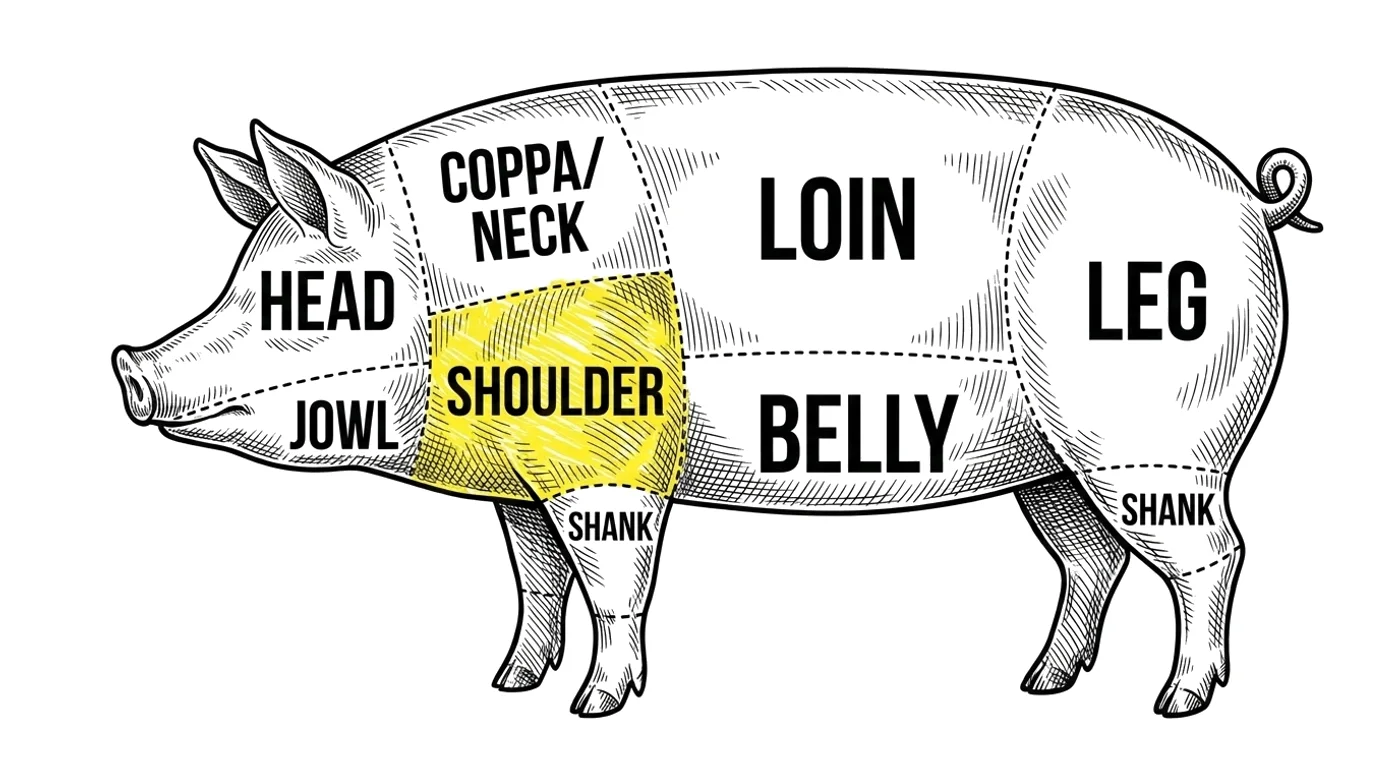
How to recognise it
A dark pink-red sausage with clean white fat, whole and ground black pepper and a restrained nutmeg-and-wine aroma. Shape and size: Cylindrical. Lean colour: Pale red flecked with pepper. Fat and marbling: White marbling. Casing or exterior: Cular, 60 to 90 mm. Surface: White mould. The form is cylindrical. the lean is pale red flecked with pepper. the fat or marbling is white marbling. and the exterior uses cular, 60 to 90 mm. Grease smear, hollow pockets, case hardening, a wet centre, rancidity or uncontrolled dark mould is a production fault.
- Shape and size
- Cylindrical
- Lean colour
- Pale red flecked with pepper
- Fat and marbling
- White marbling
- Casing
- Cular, 60 to 90 mm
- Surface bloom
- White mould
Origins and history
Salchichon is one of Spain's oldest dry sausages, a pepper-led relative of Italian salami that sits second only to chorizo in popularity. The style tied to Salamanca province, and to the Guijuelo area in particular, is built on Iberian pork raised on the oak dehesas of western Spain. Unlike chorizo it takes no pimenton, so its character comes from black pepper, a little nutmeg and the slow work of maturing. Producers around Salamanca rely on the region's cool, dry mountain air, a microclimate long trusted for curing both hams and sausages.
The cool, dry Salamanca highlands became a major centre for Iberian pork. Salchichón provided a non-paprika counterpoint to Chorizo, allowing the flavour and marbling of the meat to remain central.
Name. Salchichon, from salchicha, sausage; Salamanca the province.
- Production today
- Producers across Salamanca, many using iberico pork.
- Protection
- Not EU-protected as a general name.
- Tradition vs modern
- Often from iberico pork.
- Seasonality
- Traditionally the winter matanza.
Compare with. Salchichón, Chorizo de Salamanca
Serving and cultural significance
It is eaten as it is, sliced thinly so each round shows its marbling of fat and studding of pepper. It belongs on a board of Iberian charcuterie beside jamon and lomo, with good bread and a glass of red or a dry sherry. A whole piece keeps well once cured, and is best cut by hand rather than by machine to protect the texture and flavour.
Recipe and cure
This is not a finished recipe. It is a window into how this meat is traditionally cured. Before you follow any process, please run it through one of our curing calculators, so the salt, cure and timings are right and safe for your own batch.
Make this — the measured Curesmith version →The cure below is the traditional reference. “Make this” opens the measured Curesmith home recipe, scaled to your batch.
Traditional or protected production
Salchichón de Salamanca is a pepper-led dry sausage frequently made from Iberian pork in the same curing landscape as Guijuelo ham. It contains no pimentón, relying on black pepper, nutmeg, garlic, oregano and wine.
The reference process can be summarised as follows: No generic EU specification governs the name. Regional producers grind Iberian or quality pork and firm fat, season without pimentón, stuff and mature slowly.
- Meat
- Iberian pig
- Salt (%)
- 2.5
- Curing salt
- Cure #2
- Fermented
- Yes
- Target pH
- 4.9
- Starter or mould
- Natural surface mould
- Smoked
- No
- Target aW or weight loss
- ~30% weight loss
- Temperature (°C)
- ferment 22 to 24, then dry 13 to 15
- Humidity (%)
- ferment ~90, then 75 to 80
- Maturation
- 4 to 8 weeks
- Basis
- per 1000 g green meat
- Style
- Traditional fermented and dried sausage
Ingredients
- lean Iberico pork (base)100% · 1000 g/kg
- back fat25% · 250 g/kg
- black pepper, ground0.3% · 3 g/kg
- black pepper, whole0.1% · 1 g/kg
- nutmeg0.1% · 1 g/kg
- garlic powder0.25% · 2 g/kg
- oregano, dried0.1% · 1 g/kg
- sugar0.3% · 3 g/kg
- dry white wine3% · 30 g/kg
Method
- Mince pork and fat and mix with all ingredients to green meat weight.
- Stuff into casing.
- Ferment to the target pH.
- Dry to the target weight loss.
Notes
- This traditional recipe uses no nitrite. For safety we recommend adding Cure #2: in a low-oxygen, slow-dried product nitrite is the specific guard against Clostridium botulinum, while salt, acidity and drying control Salmonella, E. coli, Listeria and Staphylococcus.
In the Codex
What this product teaches, and where to read more.
Temple. Roof, Water Activity