
Overview
Salt pork is pork preserved with a high concentration of salt, usually from belly or fatback and sometimes from a leaner cut. It is generally unsmoked and sold as a raw ingredient that is cooked with other foods. The product is valued for both its fat and its concentrated savoury contribution.
Where it's from
The cut
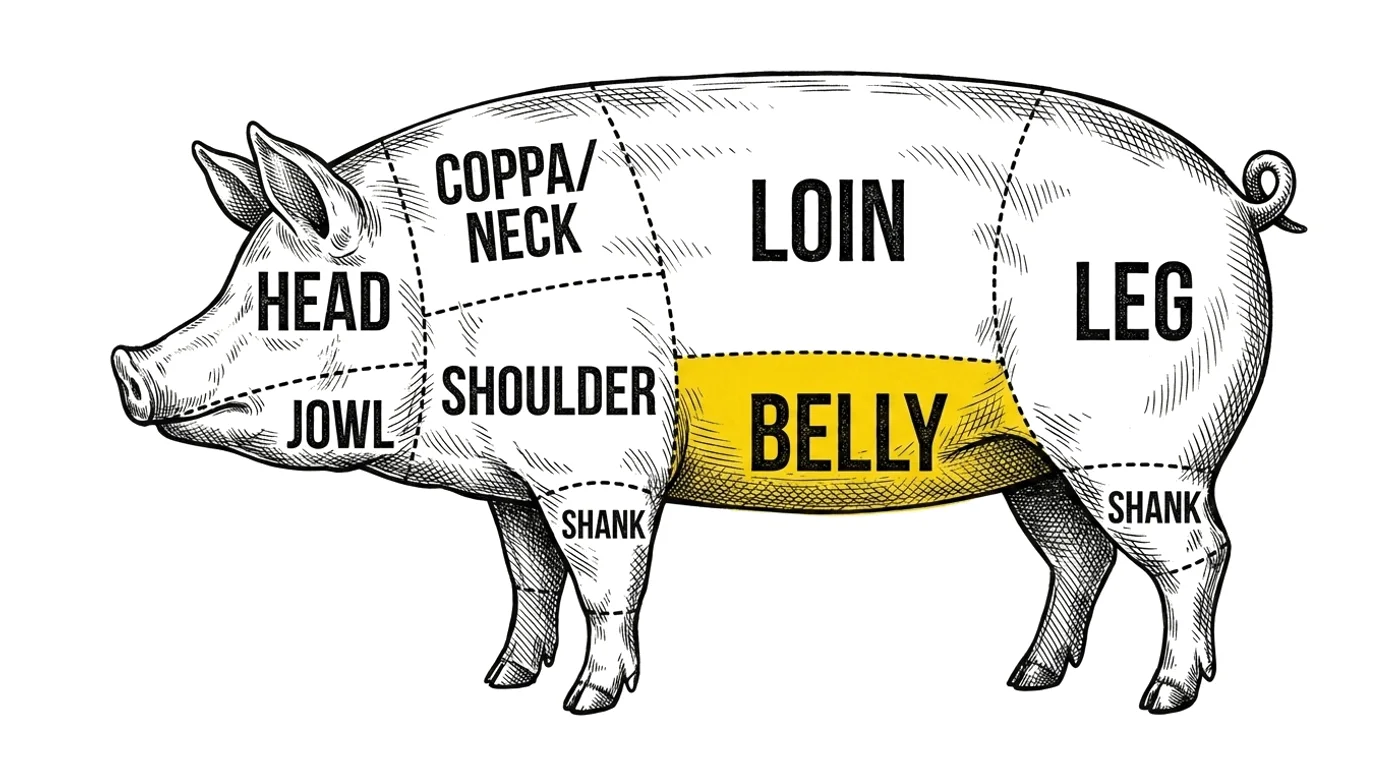
Identity and terminology
The name describes preservation rather than a protected regional style. Salt pork is not automatically bacon: bacon is commonly cured and smoked or otherwise processed as a named product, while salt pork is characteristically heavily salted and unsmoked. Pickled pork may refer to brined meat in some traditions and should not be used as an unrestricted alias.
Composition and characteristics
Typical pieces are thick, pale and fatty, with alternating lean layers when belly is used. Fatback forms are almost entirely white fat; shoulder forms are leaner and need explicit labelling. The surface may carry residual salt. Texture is firm when chilled, becoming soft and rendering readily during cooking. It is not a dry-cured slicing meat.
Production branches
Production may use dry salting or a strong brine, but cut thickness, salt uptake, temperature and time determine the result. Some products are rinsed or soaked before cooking to moderate salinity. The cured-fat category reflects the common belly and fatback form; leaner shoulder salt pork remains a qualified branch rather than redefining the family.
History and cultural context
Salt pork was a practical staple in maritime, military, frontier and rural food systems because heavy salting extended the usefulness of fatty pork before mechanical refrigeration. It became embedded in North American beans, greens, chowders and camp cooking, while related salted-pork traditions developed independently in Europe and elsewhere.
Culinary use and relationships
It is diced, sliced or simmered to season beans, peas, cabbage, greens, chowders and stews. Rendered fat may start a dish, while the meat contributes salt and richness. Related products include bacon, pancetta, lardo, fatback and pickled pork, but none should be treated as interchangeable without checking smoke, cut, cure and eating state.
Recipe and cure
This is not a finished recipe. It is a window into how this meat is traditionally cured. Before you follow any process, run it through one of our curing calculators so the salt, cure and timings are right and safe for your own batch.
Make this — the measured Curesmith version →“Make this” opens the same cure as a measured recipe, scaled to your batch.
- Meat
- Skin-on pork belly
- Cut
- Skin-on pork belly
- Salt (%)
- 2.5
- Curing salt
- Cure #1/#2 as specified
- Fermented
- No
- Smoked
- No
- Basis
- per 1,000 g skin-on pork belly
- Style
- Dry-cured pork belly intended for cooking; not shelf stable.
Ingredients
- Skin-on pork belly100% · 1000 g
- Fine salt2.5% · 25 g
- Cure #1 containing 6.25% sodium nitrite0.25% · 2.5 g
- Brown sugar0.5% · 5 g
- Black pepper0.2% · 2 g
- Bay leaf, crushed0.05% · 0.5 g
Safety. Salt pork should be treated as raw and cook-before-eating unless the manufacturer documents a validated ready-to-eat process. Heavy salting does not by itself prove shelf stability. Keep it refrigerated as labelled, prevent cross-contamination, and account for cut thickness, salt distribution and any desalting step before cooking.