
Saucisse de Morteau
so-SEES duh mor-TOH
Also known as Jésus de Morteau
Morteau (Haut-Doubs), Bourgogne-Franche-Comté, France
Deeply smoky and coarse, a cooked sausage at the heart of Jura cooking.
Overview
Saucisse de Morteau is a coarse raw pork sausage smoked slowly in the tall farmhouse tuyé of Franche-Comté. The straight wooden peg at one end, amber casing and deep smoke make it immediately recognisable. It is sold uncooked and must be cooked before eating.
Where it's from
Climate. The Haut-Doubs of Franche-Comte, where tall tuye chimneys smoke the sausages.
Altitude. Jura uplands
The cut
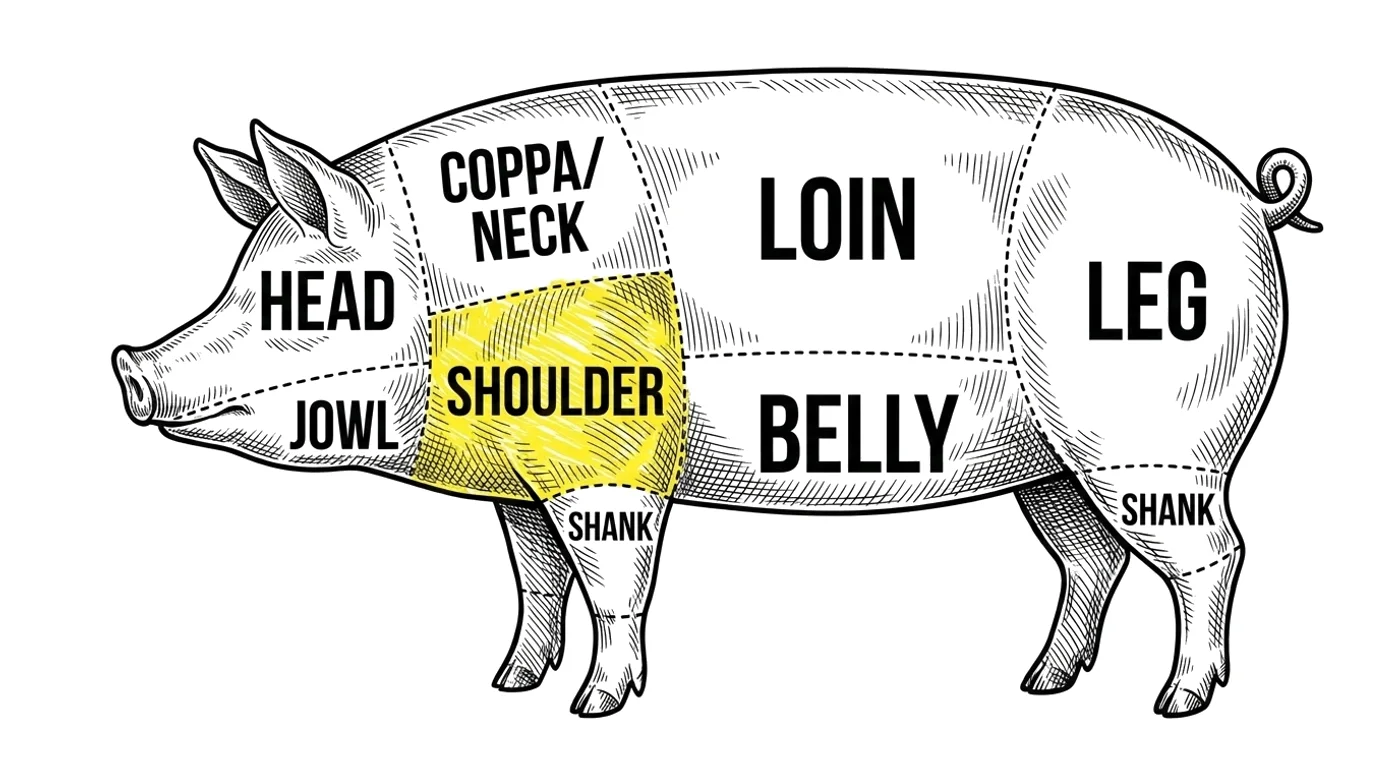
How to recognise it
The sausage is broad, straight or gently curved and amber to dark brown from smoke. One end is closed around a small straight wooden peg and the other with natural fibre string. The filling is coarse, pink and juicy after cooking. Smoke should be deep but clean. A split greasy filling, sour odour, soot bitterness or an undercooked centre is unacceptable.
- Shape and size
- Plump, wooden peg at one end, amber-smoked
- Lean colour
- Coarse pink
- Fat and marbling
- Chunky white
- Casing
- Natural casing
- Surface bloom
- None
Origins and history
Franche-Comté farmhouses developed around the tuyé, a tall central smoke chamber rising above the hearth. After winter slaughter, sausages and hams hung high in the cool smoke from resinous local woods, allowing families to preserve pork through the mountain winter. Morteau became the market name for the largest and most recognisable sausage from this system. Written and material traditions reach back several centuries, and the product later travelled with the reputation of Comté cheese and other Jura foods. Industrial imitation threatened the connection with the region, leading producers to secure PGI protection in 2010. The protected name includes the larger Jésus de Morteau form.
Name. Named for the town of Morteau.
- Production today
- Franche-Comte producers under the IGP, often also Label Rouge.
- Protection
- IGP; smoked at least 48 hours over conifer and juniper in a tuye.
- Tradition vs modern
- The tuye smoking is the protected signature; the sausage is cooked, not eaten raw.
- Seasonality
- Made year-round; the Jesus de Morteau was a Christmas form.
Compare with. Saucisse de Montbéliard
Serving and cultural significance
Poach the sausage gently and serve it with potatoes, lentils, cabbage, cancoillotte or Comté. It can also be baked into gratins and rustic pies. The casing should remain intact during cooking so the smoke and juices stay inside.
Recipe and cure
This is not a finished recipe. It is a window into how this meat is traditionally cured. Before you follow any process, please run it through one of our curing calculators, so the salt, cure and timings are right and safe for your own batch.
Curesmith home adaptation — not designation-compliant
Make this — the measured Curesmith version →The cure below is the traditional reference. “Make this” opens the measured Curesmith home recipe, scaled to your batch.
Traditional or protected production
PGI production uses pork and natural casing within the Franche-Comté area. The sausage is coarsely chopped, stuffed, closed with the characteristic peg and smoked in the regional tuyé tradition using approved conifer wood and sawdust. It remains a raw smoked sausage for cooking, not a dry ready-to-eat salami.
- Meat
- pork
- Cut
- coarse pork
- Salt (%)
- 1.9
- Curing salt
- Cure #1 at 2.5 g/kg (0.25%); it is smoked and cooked
- Other agents
- salt and pepper only under the IGP
- Fermented
- No
- Smoked
- Yes
- Target aW or weight loss
- not dried; smoked then cooked
- Temperature (°C)
- cold smoke, then poach ~80 to serve
- Humidity (%)
- n/a
- Maturation
- smoked 48 hours and up over conifer and juniper
- Basis
- per 1000 g green meat
- Style
- Traditional smoked, then cooked (not dry-cured)
Ingredients
- coarse pork100% · 1000 g/kg
- sea salt1.9% · 19 g/kg
- Cure #10.25% · 2.5 g/kg
- black pepper0.3% · 3 g/kg
- garlic0.2% · 2 g/kg
- caraway (optional)0.1% · 1 g/kg
Method
- Mix coarse pork with salt, Cure #1 and seasoning to green weight.
- Stuff and peg the casing.
- Cold-smoke at least 48 hours in a tuye over conifer and juniper.
- Poach before eating; this is a cooked sausage, not an air-dried one.
Notes
- The official protected specification controls the named product. Any Curesmith EQ, starter-culture, curing-salt or home-scale adaptation is a separate method and must not be presented as designation-compliant.
Safety. A cooked, smoked sausage rather than a dry-cured one. Cure #1 (not #2) suits the shorter, cooked process. Cook thoroughly before eating. Verify before serving.
In the Codex
What this product teaches, and where to read more.
Temple. Roof, Microclimate