
Saucisson de Lacaune / Saucisse de Lacaune
Also known as Saucisson et saucisse de Lacaune, Saucisson de Lacaune, Saucisse de Lacaune
Lacaune (Tarn), Occitanie, France
Firm, lean and peppery, a well-made mountain saucisson.
Overview
Saucisson et saucisse de Lacaune is firm, lean and peppery, a well-made mountain saucisson. A straight natural-cased sausage with a dry white-grey bloom, a red cohesive interior and clearly defined white fat. The larger saucisson matures more slowly; the smaller saucisse is narrower and dries sooner.
Where it's from
Climate. The Monts de Lacaune, cool and ventilated.
Altitude. Monts de Lacaune
The cut
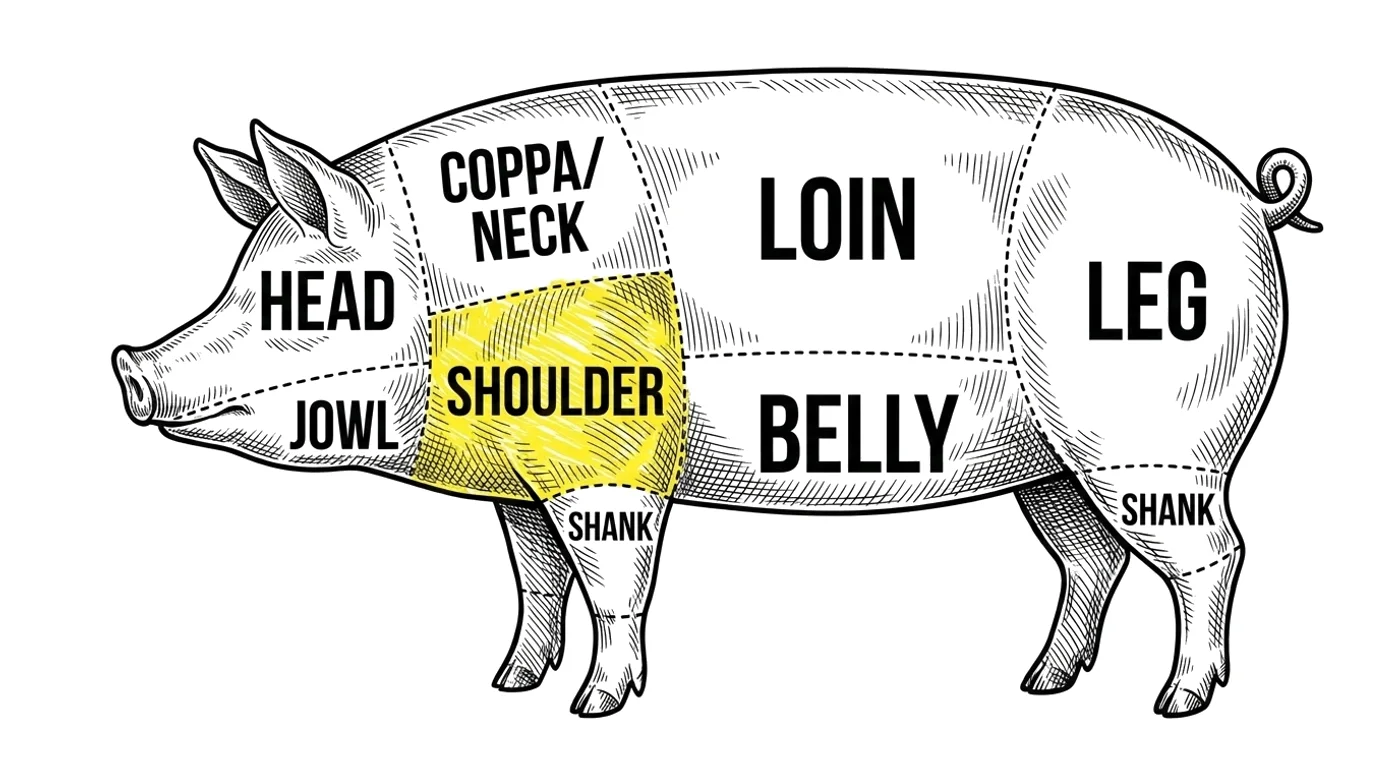
How to recognise it
A straight natural-cased sausage with a dry white-grey bloom, a red cohesive interior and clearly defined white fat. The larger saucisson matures more slowly; the smaller saucisse is narrower and dries sooner. A hard outer ring, wet centre, smeared fat or aggressive ammonia from the bloom indicates faulty drying.
- Shape and size
- Cylindrical, lean
- Lean colour
- Deep red
- Fat and marbling
- White
- Casing
- Natural casing
- Surface bloom
- Natural mould
Origins and history
The dry saucisson and sausage of Lacaune in the Tarn, from the same famous charcuterie uplands as the ham. Made largely from lean pork and seasoned with pepper, they are cured in the cool mountain air to a firm, savoury sausage. Lacaune's name carries weight on a French charcuterie board.
Lacaune became one of France's major salting centres because the upland town combines cold winters, steady mountain air and generations of specialist charcuterie businesses. The same environment supports the protected ham and dry-sausage traditions, but the two products are governed separately. The verified production area is Monts de Lacaune, Tarn, Occitanie, France. Stories and etymologies are retained when they help explain the tradition, but legends are not used as evidence for the modern specification.
Name. Named for the town of Lacaune.
- Production today
- Lacaune producers.
- Protection
- IGP.
- Tradition vs modern
- Cool mountain-air curing.
- Seasonality
- Year-round.
Compare with. Saucisson sec d’Auvergne / Saucisse sèche d’Auvergne, Jambon de Lacaune
Serving and cultural significance
Slice the larger saucisson thinly and the narrower saucisse on a slight diagonal. Serve with country bread, cornichons, Roquefort or other cheeses of the Tarn, and local red wine. Let the sausage lose its refrigerator chill so the simple pork and pepper aromas become clear.
Recipe and cure
This is not a finished recipe. It is a window into how this meat is traditionally cured. Before you follow any process, please run it through one of our curing calculators, so the salt, cure and timings are right and safe for your own batch.
Curesmith home adaptation — not designation-compliant
Make this — the measured Curesmith version →The cure below is the traditional reference. “Make this” opens the measured Curesmith home recipe, scaled to your batch.
Traditional or protected production
Saucisson de Lacaune and Saucisse de Lacaune are protected dry pork sausages made in the Monts de Lacaune. The specification distinguishes the larger saucisson from the narrower saucisse by casing diameter, product weight and minimum maturation. The meat block is pork with firm fat, seasoned principally with salt and pepper. Permitted curing agents, sugars and starter cultures may be used within the specification.
- Meat
- pork
- Salt (%)
- 2.5
- Curing salt
- Not included in the base recipe below
- Fermented
- Yes
- Target pH
- 4.9
- Starter or mould
- Natural surface mould
- Smoked
- No
- Target aW or weight loss
- ~30% weight loss
- Temperature (°C)
- ferment 22 to 24, then dry 13 to 15
- Humidity (%)
- ferment ~90, then 75 to 80
- Maturation
- 4 to 8 weeks
- Basis
- per 1000 g green meat
- Style
- Traditional fermented and dried sausage
Ingredients
- pork (base)100% · 1000 g/kg
- sea salt2.5% · 25 g/kg
- black pepper0.4% · 4 g/kg
- garlic0.2% · 2 g/kg
- dextrose0.2% · 2 g/kg
Method
- Mince pork and fat and mix with all ingredients to green meat weight.
- Stuff into casing.
- Ferment to the target pH.
- Dry to the target weight loss.
Notes
- The official protected specification controls the named product. Any Curesmith EQ, starter-culture, curing-salt or home-scale adaptation is a separate method and must not be presented as designation-compliant.
- This traditional recipe uses no nitrite. For safety we recommend adding Cure #2: in a low-oxygen, slow-dried product nitrite is the specific guard against Clostridium botulinum, while salt, acidity and drying control Salmonella, E. coli, Listeria and Staphylococcus.
In the Codex
What this product teaches, and where to read more.
Temple. Roof, Water Activity