
Saumaise
Also known as Saumeise, Schweinsmaise, Saumas'n, Saumoasn, Waldviertler Saumaise
Waldviertel, Lower Austria, Austria
Overview
Saumaise is an Austrian portion of coarsely minced pork shaped like a large meatball and enclosed in pork caul fat. It is associated especially with the Waldviertel in Lower Austria and also has documented Carinthian forms. The net-like caul holds a filling that would otherwise spread during smoking, poaching or roasting. The result is served hot rather than sliced as a cold sausage, although commercial butchers also produce a more regular cured meat-sausage interpretation.
Where it's from
The cut
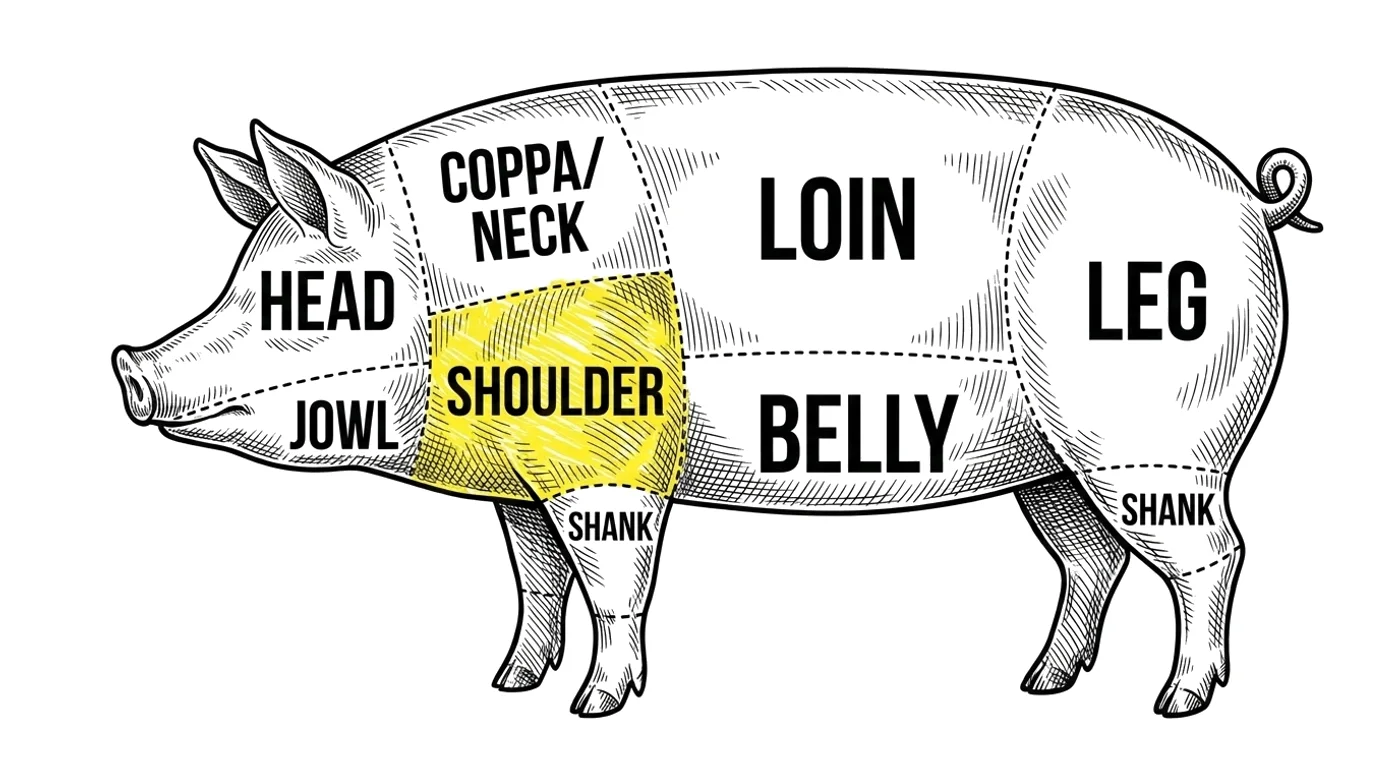
Identity and terminology
The name appears as Saumaise, Saumeise, Schweinsmaise and dialect forms including Saumas'n and Saumoasn. Austria's Traditional Foods register discusses an etymological connection with an older word for small cuts rather than the modern bird name Meise. Regional words have travelled between German and Slovenian speech in Carinthia, producing further forms. The identity rests on the caul-wrapped portion and coarse filling, not on one spelling or a conventional tubular casing.
Composition and characteristics
A Waldviertel branch uses lean and fatty pork, often already cured or smoked, seasoned with onion, garlic, pepper and paprika. Other household forms may incorporate cooked head meat, heart or lungs, and Carinthian relatives can add barley or bread. The registered description therefore recognises a family rather than a single formula. In the slice, or when a portion is cut open, the filling is coarse and pink-brown, while the caul becomes translucent and lightly crisp when roasted.
Production and process
Pork and onion are minced coarsely, seasoned and worked until cohesive. When raw meat is used, the mixture may be cured before shaping; when smoked pork supplies the filling, a second smoking step may be unnecessary. Equal portions are wrapped completely in food-grade caul and tied. Some regions smoke them before cooking. Poaching or roasting must heat the centre fully, because the caul is a wrapper rather than a preservation barrier.
History and regional forms
The Austrian register links Saumaise with rural household slaughter and the Sautanz, the communal work and meal surrounding pig killing. It records generations of use in farm kitchens, direct marketing, butchers and local restaurants. The register also notes that the product never entered the Austrian Food Codex as a named speciality, although a commercial version can be classified by analogy with a medium-grade meat sausage. This distinction matters: official traditional-food documentation is not PDO or PGI protection.
Use, storage and related products
Saumaise is served hot with sauerkraut, boiled potatoes, mash or Waldviertel potato dumplings. A cooked portion should remain refrigerated if it is not eaten immediately. It differs from a conventional Fleischwurst through its caul wrapper and individual ball form, from Carinthian Maischerln through cereal and offal composition, and from French crépinette through its Austrian cultural history and typical cured or smoked pork filling.
The recipe for this product is in preparation and will be published once it has been verified.
Safety. Use food-grade caul, calculate cure on the animal block, smoke only as flavouring, cook the centre fully and refrigerate leftovers.