
Overview
Schinkenmettwurst is a German coarse raw sausage within the broader Mettwurst family. It is sliceable rather than spreadable and uses lean pork with bacon to create a firm, visibly structured cut surface. German guidance groups it with Feldkieker or Feldgicker in a defined quality class.
Where it's from
The cut
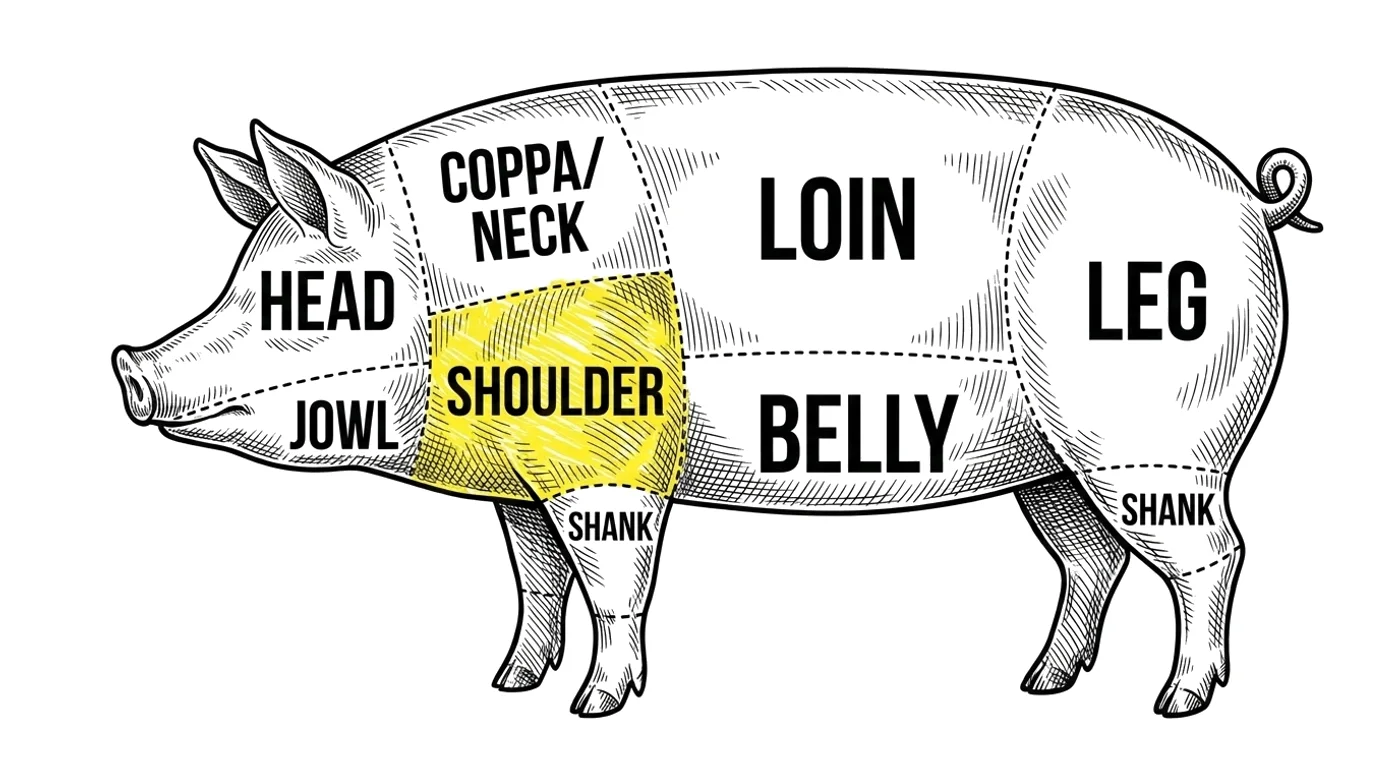
Identity and boundaries
The product must not be confused with spreadable Mettwurst, fresh Mettwurst or cooked Schinkenwurst. The Schinken element describes a lean-meat quality branch, not a whole-muscle ham ingredient. Parentage under Mettwurst is useful, but the coarse sliceable identity deserves its own entry. Its placement under Mettwurst is important because the English translation ham sausage can otherwise suggest the wrong anatomical cut and production method.
Composition and characteristics
Lean pork provides the dominant red matrix and bacon forms visible pale inclusions. The texture is coarse, dense and sliceable after maturation. Seasoning varies regionally, often using pepper, garlic or warm spices, but composition and raw-sausage quality standards are more important identifiers than one spice profile.
Production and maturation
Meat and bacon are kept cold, coarsely ground, cured and mixed carefully to retain definition. Culture is used where required by the selected fermented route. Stuffed sausages are matured, smoked where traditional and dried to verified endpoints. Excessive heat or mixing can smear fat and destroy the characteristic grain. The finished sausage should remain recognisably coarse, with a clean cured aroma and no greasiness, cavities or uneven surface drying.
History and context
Mettwurst developed into many German regional forms ranging from fresh and spreadable to hard, sliceable sausages. Schinkenmettwurst represents the leaner coarse branch. Its relationship to Feldkieker reflects overlapping traditional classifications, but protected or regional children must retain their own rules.
Culinary use and relationships
It is sliced for bread, breakfast, cold platters and travel food. Schinkenmettwurst relates to Mettwurst, Feldkieker and Schinkenplockwurst. It differs from Schmierwurst through firmness and grain, and from cooked ham sausage through its raw curing, maturation and drying process. Parent-child navigation should lead readers from the broad Mettwurst family to this specific lean, sliceable branch without collapsing regional synonyms automatically.
Recipe and cure
This is not a finished recipe. It is a window into how this meat is traditionally cured. Before you follow any process, run it through one of our curing calculators so the salt, cure and timings are right and safe for your own batch.
Make this — the measured Curesmith version →“Make this” opens the same cure as a measured recipe, scaled to your batch.
- Meat
- Lean pork ham
- Cut
- Lean pork ham
- Salt (%)
- 2.5
- Curing salt
- Cure #1/#2 as specified
- Fermented
- Yes
- Target pH
- 5.3 or lower
- Smoked
- Yes
- Basis
- per 1,000 g lean pork ham
- Style
- Ham-style Mettwurst child with a lean meat profile.
Ingredients
- Lean pork ham100% · 1000 g
- Lean beef30% · 300 g
- Pork back fat25% · 250 g
- Fine salt2.5% · 38.5 g
- Cure #2 containing 6.25% sodium nitrite0.25% · 4 g
- Dextrose0.4% · 6 g
- Black pepper0.3% · 4.5 g
- Garlic0.2% · 3 g
- Ground coriander0.1% · 1.5 g
- Flora Italia LC or equivalent starter culture0.03% · 0.4 g
Safety. Schinkenmettwurst is a raw ready-to-eat sausage only after a validated cure, fermentation or maturation and drying programme. Coarse texture, smoke and a firm casing are not substitutes for measured pH, water activity, pathogen reduction and controlled storage.