
Overview
Schinkenplockwurst, also called Rohe Schinkenwurst in the German Food Book, is a coarse sliceable raw sausage. It occupies a high-quality position within German raw sausage classification and is defined by lean meat selection, analytical quality values and a clearly coarse cut surface.
Where it's from
The cut
Identity and boundaries
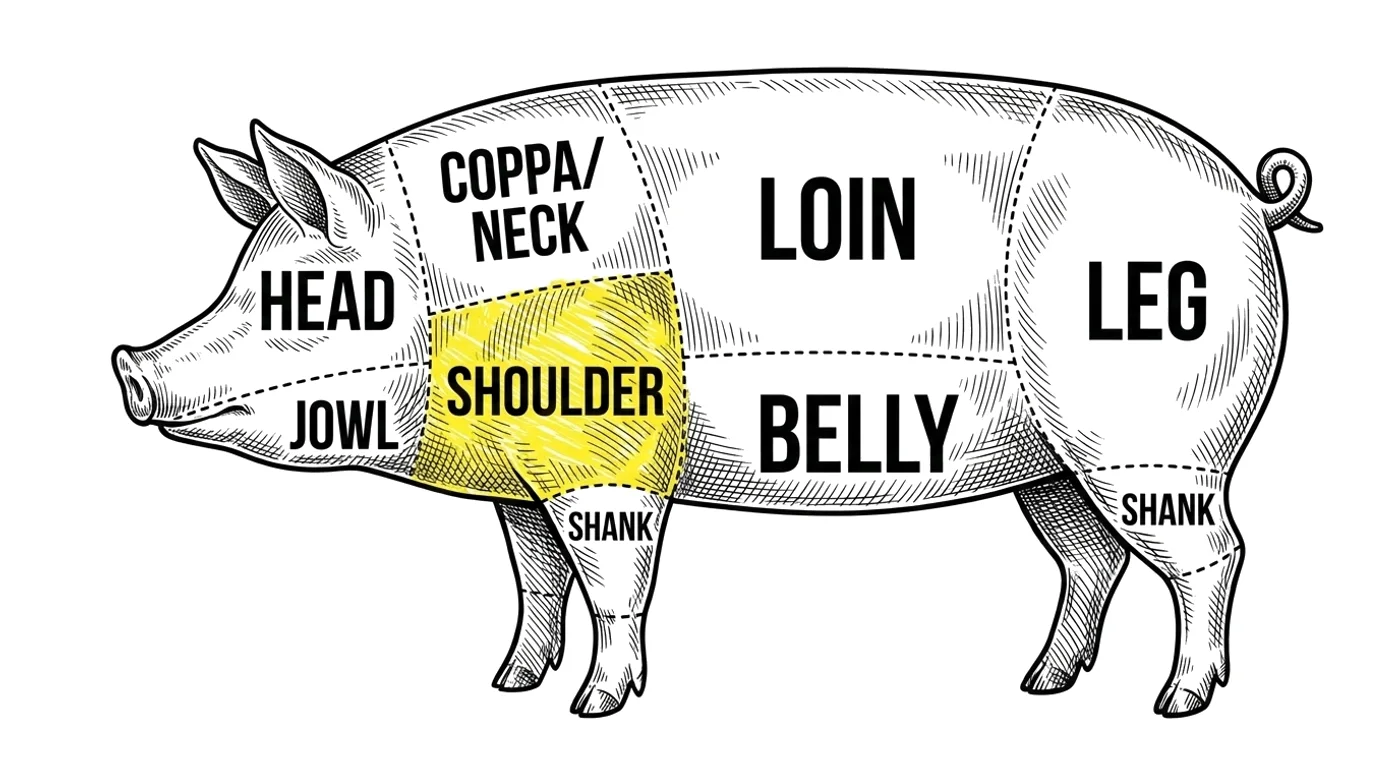
The Schinken prefix does not mean that the product is a whole ham or a cooked ham sausage. In this context it signals a high lean-meat quality category. Schinkenplockwurst must therefore remain separate from Plockwurst, cooked Schinkenwurst and whole-muscle Rohschinken. The name therefore communicates both product class and expected meat quality, while the visible coarse structure differentiates it from finely comminuted raw sausages.
Composition and characteristics
German guidance specifies lean pork as the leading material, together with lean beef and bacon. The sausage is coarse-grained and should show distinct lean meat and fat particles in a stable matrix. Its protein-quality thresholds are higher than those of many neighbouring raw-sausage classes.
Production and maturation
Chilled lean meats and bacon are cut or ground coarsely, combined with cure, seasoning and culture where used, and stuffed without smearing the visible structure. Fermentation or maturation, optional smoking and controlled drying produce the final sliceability. Release depends on validated safety and moisture endpoints, not appearance alone. Particle definition is an identification feature as well as a processing concern: smeared fat and indistinct lean pieces undermine the expected appearance.
History and context
German naming traditions used Schinken in several sausages to communicate a premium meat selection rather than anatomical ham. The modern Food Book retained this quality language and analytical differentiation, helping distinguish Schinkenplockwurst from lower-grade or more finely comminuted raw sausages.
Culinary use and relationships
Schinkenplockwurst is served thinly sliced on bread, cold platters or sandwiches. It relates to Plockwurst, salami and Schinkenmettwurst, but differs in meat selection and quality definition. It should not be marketed as ham, cooked sausage or a generic coarse salami without qualification. It should be cross-referenced to Plockwurst and premium German Rohwurst, while whole-muscle and cooked-ham searches should not route to this article.
Recipe and cure
This is not a finished recipe. It is a window into how this meat is traditionally cured. Before you follow any process, run it through one of our curing calculators so the salt, cure and timings are right and safe for your own batch.
Make this — the measured Curesmith version →“Make this” opens the same cure as a measured recipe, scaled to your batch.
- Meat
- Lean pork ham
- Cut
- Lean pork ham
- Salt (%)
- 2.5
- Curing salt
- Cure #1/#2 as specified
- Fermented
- Yes
- Target pH
- 5.3 or lower
- Smoked
- Yes
- Basis
- per 1,000 g lean pork ham
- Style
- Lean, sliceable fermented raw sausage.
Ingredients
- Lean pork ham100% · 1000 g
- Lean beef40% · 400 g
- Pork back fat25% · 250 g
- Fine salt2.5% · 41.5 g
- Cure #2 containing 6.25% sodium nitrite0.24% · 4 g
- Dextrose0.41% · 6.5 g
- Black pepper0.3% · 5 g
- Garlic0.2% · 3.5 g
- Flora Italia LC or equivalent starter culture0.02% · 0.4 g
Safety. Schinkenplockwurst is a ready-to-eat raw sausage only after validated curing, fermentation or maturation, drying and endpoint verification. Its premium lean-meat identity does not reduce the need for pathogen controls, measured pH and water activity, and hygienic slicing.