
Schinkenwurst (German Ham Sausage)
Also known as German ham sausage, Feine Schinkenwurst, Ham Sausage-German
Germany
Overview
Schinkenwurst is a German cooked sausage whose name translates literally as ham sausage. In the current German meat guidelines, the fine form appears in the same assessment group as Lyoner, North German Mortadella and related finely comminuted Brühwürste. The product is therefore a sausage identity, not simply chopped finished ham in a casing. The batch source uses pork, beef, back fat, potato flour and a large water addition; the Curesmith branch removes the starch extension to present a cleaner guideline-informed home formula.
Where it's from
The cut
Identity and terminology
The word Schinken means ham and Wurst means sausage, but the compound name does not require a cured whole-muscle ham to be folded into the batter. German guidance distinguishes fine Schinkenwurst from Grobe Schinkenwurst, which has a fine base with pea-sized and sometimes cherry-sized pieces. It also distinguishes both from Bierschinken, where coarse lean meat inclusions are defining. These differences matter because English translations often collapse three separate cut-face structures into ham sausage.
Composition and characteristics
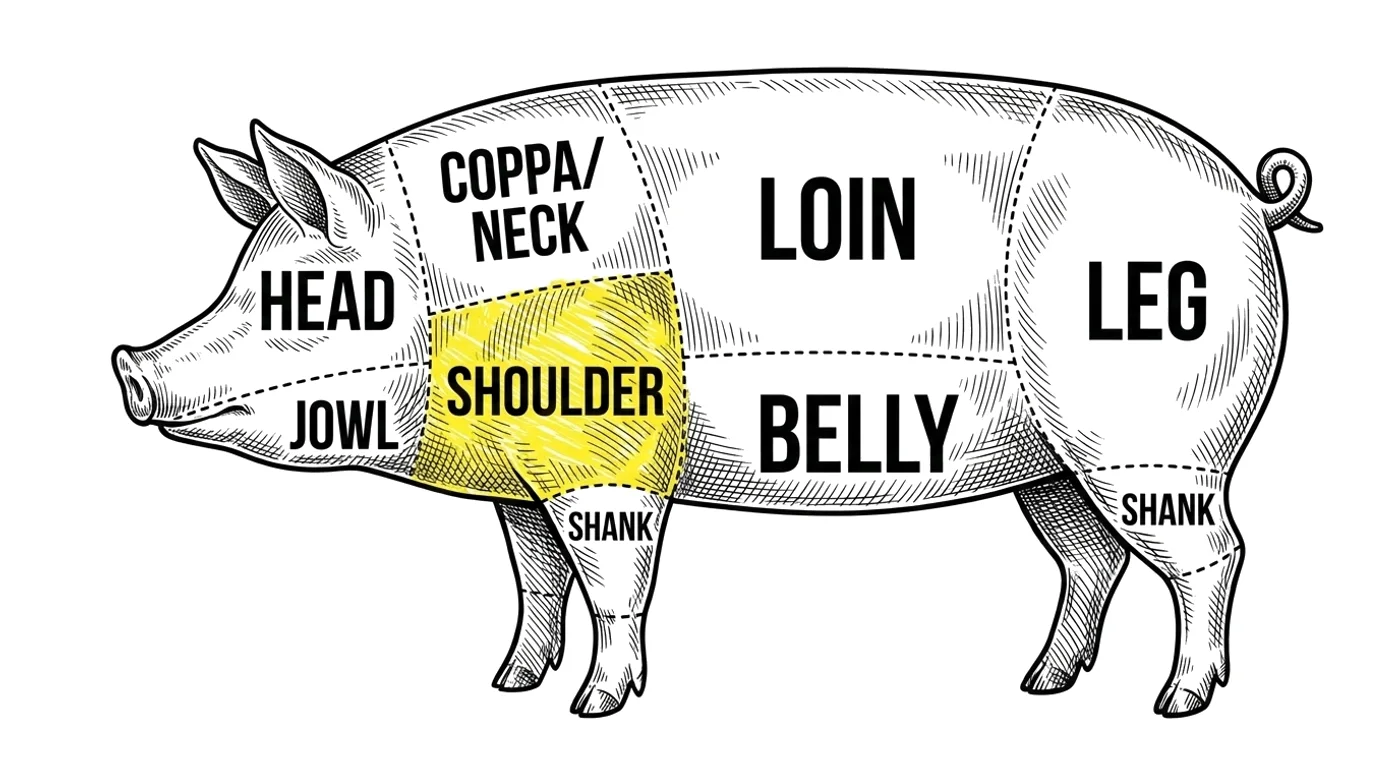
The fine branch combines lean pork shoulder and beef with a small proportion of firm back fat. White pepper, paprika, allspice and coriander give a warm but restrained seasoning. Thorough fine-cutting produces a smooth cured-pink slice with no visible ham cubes. A broad cooking casing creates the luncheon-sausage format. Potato flour and extra water may appear in commercial or source-derived formulations, but they alter texture and labelling and are not treated here as the essence of the product.
Production and process
Cold meat is ground, salted and mixed with measured Cure #1 until the proteins begin to bind. Ice water and fat are incorporated during fine-cutting while the batter remains below 10°C. The filled casing cures in refrigeration, receives gentle smoke and is poached to a 71°C cold point. Rapid chilling prevents the large diameter from remaining in the danger zone. This route produces a refrigerated cooked sausage; smoke and cured colour do not make it stable at room temperature.
History and regional forms
Ham-sausage terminology developed across several European manufacturing systems and does not identify one cross-border recipe. German Schinkenwurst belongs to the technical history of Brühwurst, where salt-soluble proteins stabilise a fine batter before scalding. Polish kiełbasa szynkowa moved in another direction by displaying large lean pieces, while English and American formulas sometimes added cereal or starch. The German guideline classification provides a firmer identity boundary than a literal translation alone.
Use, storage and related products
Serve thin slices on rye bread with mustard, pickles or radish, or cut thicker pieces for cold platters. Keep the casing and cut face refrigerated and use opened sausage promptly. Fine Schinkenwurst is a different thing from Grobe Schinkenwurst, from Bierschinken and from a whole-muscle ham. The recipe is a home-scale interpretation and carries no protected geographical claim.
Recipe and cure
This is not a finished recipe. It is a window into how this meat is traditionally cured. Before you follow any process, run it through one of our curing calculators so the salt, cure and timings are right and safe for your own batch.
Make this — the measured Curesmith version →“Make this” opens the same cure as a measured recipe, scaled to your batch.
- Meat
- Lean pork shoulder
- Cut
- Lean pork shoulder
- Salt (%)
- 1.8
- Curing salt
- Cure #1 as specified in the recipe
- Fermented
- No
- Starter or mould
- None; this product is not fermented
- Smoked
- Yes
- Maturation
- Refrigerate at 0–4°C; use within 4 days or freeze promptly
- Basis
- per 1,000 g lean pork shoulder
- Style
- cured, smoked and cooked fine German scalded sausage
Ingredients
- Lean pork shoulder100% · 1000 g
- Lean beef chuck75% · 750 g
- Pork back fat10% · 100 g
- Ice water14.7% · 272.5 g
- Fine salt1.8% · 32.5 g
- Cure #1, 6.25% sodium nitrite0.24% · 4.5 g
- White pepper0.19% · 3.5 g
- Sweet paprika0.19% · 3.5 g
- Ground allspice0.19% · 3.5 g
- Ground coriander0.19% · 3.5 g
Method
- Trim and chill meat, fat, water and equipment to 0–2°C.
- Grind pork and beef through 6 mm and back fat through 3 mm.
- Dissolve Cure #1 in part of the ice water, mix it with meat and salt until tacky, then fine-cut with the remaining water, fat and spices.
- Fill the cooking casing firmly, remove air pockets and refrigerate for 8–12 hours.
- Dry the casing surface, then apply clean smoke at 45–55°C for 90–150 minutes.
- Poach at 75–78°C until the cold point reaches 71°C.
Safety. Keep the batter below 10°C, calculate Cure #1 against the full animal block, reach 71°C and cool the large casing rapidly.