
Overview
Schmierwurst is a German spreadable raw-sausage family. The name derives from schmieren, to spread. Unlike firm Mettwurst or salami, it is finely comminuted, fatty and only lightly dried, producing a soft texture that can be spread on bread rather than cut into clean slices.
Where it's from
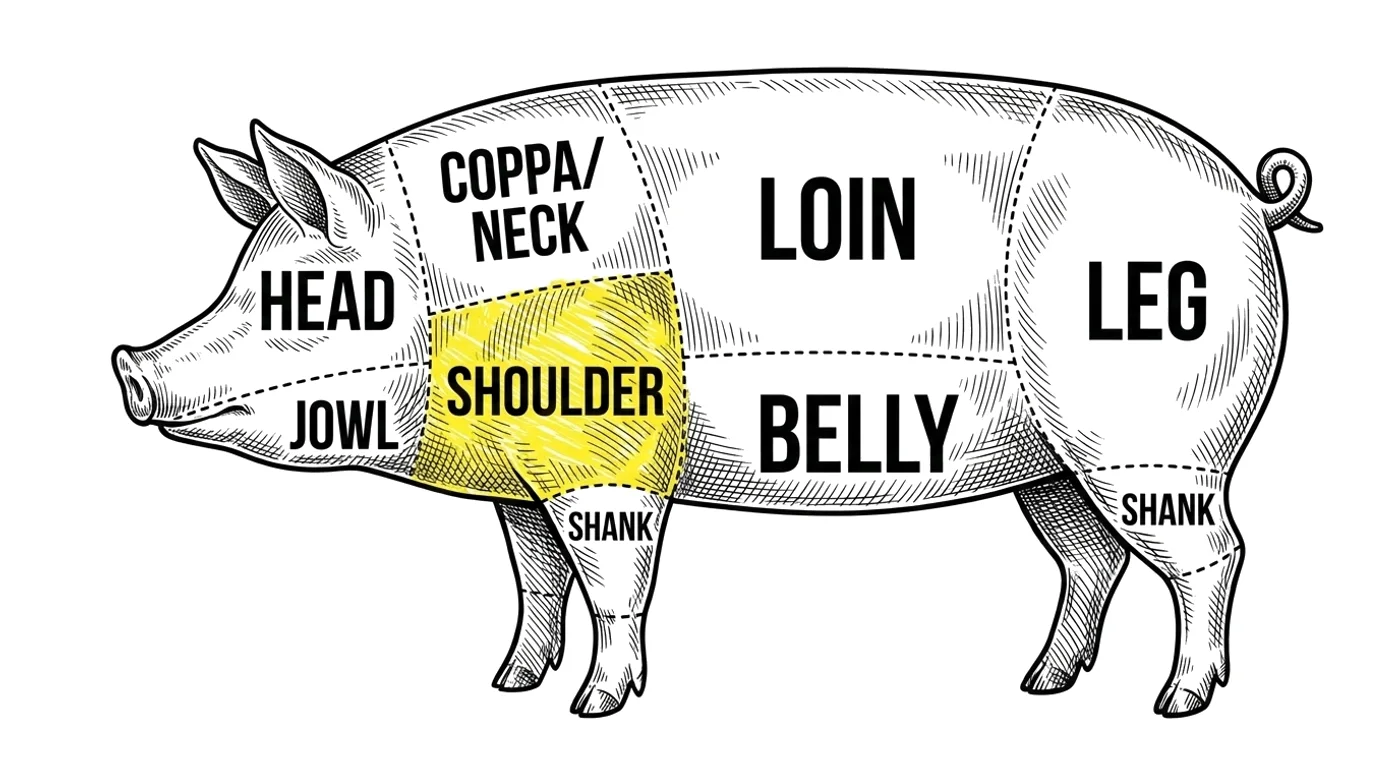
The cut
Identity and boundaries
German guidance places Schmierwurst with fette Mettwurst among spreadable raw sausages. It must remain separate from sliceable dry Mettwurst, cooked liver sausage and industrial meat spreads. A soft texture does not indicate that the product has been cooked or rendered microbiologically stable. Spreadability is created by composition, fine comminution and limited drying, not by cooking the meat into a pâté-like emulsion.
Composition and characteristics
Fatty pork, beef and added fat create the rich, smooth matrix. The meat block is finely comminuted and the finished colour is cured pink to red-brown depending on smoke and maturation. The texture should be spreadable but not oily, separated, sour or watery.
Production and maturation
Raw materials are kept cold, finely minced or chopped, cured, seasoned and stuffed. The sausage undergoes controlled maturation, often with light smoking, but relatively little drying. Because moisture remains higher than in sliceable salami, production hygiene, short storage, refrigeration and packaging control are central to its safety architecture. Its higher moisture and short maturation make time, temperature and hygienic control especially important compared with a hard shelf-stable sausage.
History and context
Spreadable raw sausages developed as fresh or short-aged German butcher products for immediate local sale. They offered a different eating experience from long-keeping hard sausage. Codification preserved distinct classes and quality values, reflecting the practical difference between a local spread and a durable travel sausage.
Culinary use and relationships
Schmierwurst is spread on rye bread or rolls and served with onions, pickles or mustard. It relates to Streichmettwurst and Braunschweiger Mettwurst, but not to cooked American braunschweiger by default. Sliceable Mettwurst, Schinkenmettwurst and liver sausage remain separate families. It is kept refrigerated, and the German raw product should not be confused with cooked spreads sold under similar translated names.
Recipe and cure
This is not a finished recipe. It is a window into how this meat is traditionally cured. Before you follow any process, run it through one of our curing calculators so the salt, cure and timings are right and safe for your own batch.
Make this — the measured Curesmith version →“Make this” opens the same cure as a measured recipe, scaled to your batch.
- Meat
- Pork shoulder
- Cut
- Pork shoulder
- Salt (%)
- 2.2
- Curing salt
- Cure #1/#2 as specified
- Fermented
- Yes
- Target pH
- 5.3 or lower
- Smoked
- Yes
- Basis
- per 1,000 g pork shoulder
- Style
- Spreadable, lightly fermented and smoked raw sausage for short refrigerated storage.
Ingredients
- Pork shoulder100% · 1000 g
- Pork back fat100% · 1000 g
- Fine salt2.2% · 44 g
- Cure #1 containing 6.25% sodium nitrite0.25% · 5 g
- Dextrose0.5% · 10 g
- Black pepper0.25% · 5 g
- Garlic0.2% · 4 g
- Sweet paprika0.15% · 3 g
- Flora Italia LC or equivalent starter culture0.03% · 0.5 g
Safety. Schmierwurst is a lightly dried raw sausage with limited keeping quality. It requires controlled curing and maturation, hygienic production and refrigeration or other verified storage conditions. Spreadability must never be mistaken for a cooked paste or a shelf-stable product.