
Schwarzwälder Schinken
Black Forest, Baden-Wurttemberg, Germany
A PGI boned ham of the Black Forest, spice-cured and cold-smoked over fir.
Overview
Schwarzwälder Schinken is the protected Black Forest ham of Germany: a boneless pork hind-leg product that is dry-cured, cold-smoked and matured to a firm, dark-surfaced, sliceable state. Its name is a geographical indication, not a general flavour description. The registered specification is what defines it, not the generic black-forest-style ham recipes sold under the name.
Where it's from
Climate. The Black Forest of Baden-Wurttemberg; cured and smoked in-region.
Altitude. Black Forest uplands
The cut
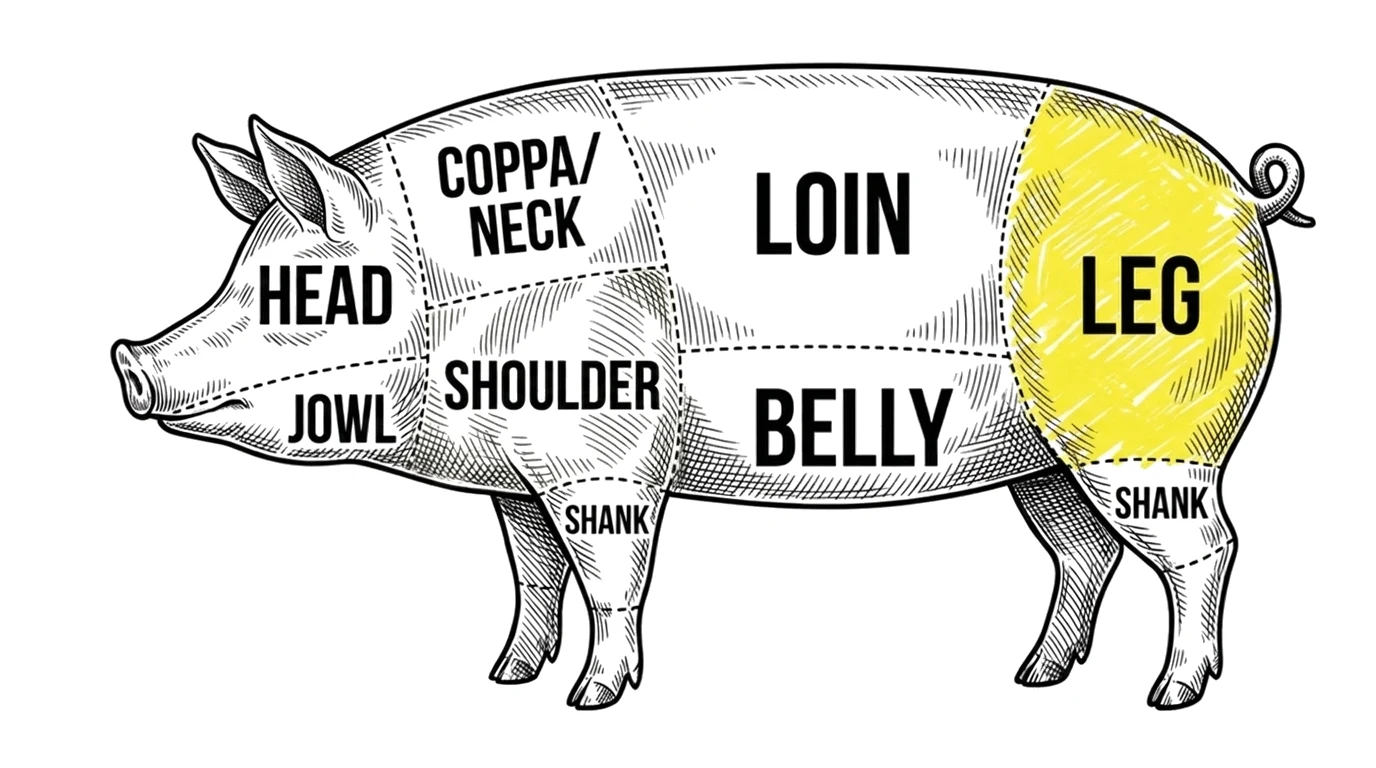
Protected identity
Only product meeting the PGI specification and geographical production requirements may use the protected name. Generic Black Forest-style ham, sweet glazed ham and cooked or brine-injected products are separate. The specification preserves the regional curing and smoking link while allowing producers their own seasoning blends within the protected framework. The characteristic external fat layer is retained.
Composition and characteristics
The raw material is selected boneless hind leg with its fat layer, cured with salt and a producer-specific mixture of spices. The finished ham has a deep red interior, dark smoked exterior, firm but tender texture and a pronounced cured-smoke aroma. It is normally sliced thinly, with lean and fat presented together rather than trimmed into a uniformly lean product.
Production method
The muscle is dry-cured; brine injection into the meat is excluded by the specification. After curing and resting, the ham is cold-smoked with Black Forest fir wood and then matured. Smoke and drying are controlled to develop flavour without cooking the muscle. Release depends on specification compliance, adequate maturation and a stable finished product, not time alone.
History and cultural context
The Black Forest’s climate, wood resources and rural pork tradition created a distinctive smoked ham economy. Regional reputation became commercially important far beyond southwest Germany, which also encouraged imitations. European registration protects the name and codifies the link between the product, Black Forest processing and its characteristic cold-smoked sensory profile.
Culinary use and relationships
Schwarzwälder Schinken is eaten raw as a ready-to-eat cured ham, sliced thinly with bread, cheese, fruit, eggs or salads, and used in warm dishes where its smoke flavours the food. It should link to generic smoked ham, prosciutto and other protected European hams while clearly separating their curing, smoke and geographical rules.
How to recognise it
- Shape and size
- Boned, pressed, squared leg
- Lean colour
- Dark red
- Fat and marbling
- White
- Casing
- None
- Surface bloom
- Smoked exterior
Origins and history
Name. Schwarzwalder Schinken, 'Black Forest ham'.
- Production today
- Producers of the Black Forest region, under a producers' association.
- Protection
- PGI/g.g.A., registered 24 January 1997.
- Tradition vs modern
- Boned, spice-cured, cold conifer-smoked.
- Seasonality
- Year-round.
Compare with. Ammerländer Schinken, Speck Alto Adige
Recipe and cure
This is not a finished recipe. It is a window into how this meat is traditionally cured. Before you follow any process, please run it through one of our curing calculators, so the salt, cure and timings are right and safe for your own batch.
Curesmith home adaptation — not designation-compliant
Make this — the measured Curesmith version →“Make this” opens the same cure as a measured recipe, scaled to your batch.
Sea salt with pepper, garlic, coriander and juniper; cold-smoked over fir and spruce. Salt-box method; no fixed percentage.
- Meat
- Pork
- Salt (%)
- traditional, no fixed %
- Curing salt
- Sea salt with pepper, garlic, coriander and juniper; cold-smoked over fir and spruce.
- Fermented
- No
- Starter or mould
- Possible
- Smoked
- Yes
- Target aW or weight loss
- ~ weight loss
- Temperature (°C)
- cold salting, then 10 to 15
- Humidity (%)
- 70 to 80
- Maturation
- at least 3 months
- Basis
- percentage of green meat weight
- Style
- Traditional dry salting (salt-box), then cold-smoked
Method
- Salt the leg by the traditional method and rest cold.
- Brush off surface salt and rub with the spice mix where used.
- Cold-smoke where traditional, then air-dry.
- Age to the target loss.
Notes
- The official protected specification controls the named product. Any Curesmith EQ, starter-culture, curing-salt or home-scale adaptation is a separate method and must not be presented as designation-compliant.
- A more efficient way of curing this product is using the EQ Method. No more than 2.5% salt to meat weight is required. To follow the EQ method, please use our whole-muscle EQ curing calculator to work out proper ratios and curing times.
In the Codex
What this product teaches, and where to read more.
Temple. Roof, Microclimate