
Schwarzwälder Schinken
Black Forest, Baden-Wurttemberg, Germany
A PGI boned ham of the Black Forest, spice-cured and cold-smoked over fir.
Overview
Schwarzwälder Schinken is a pgi boned ham of the black forest, spice-cured and cold-smoked over fir. A compact boneless ham with a dark brown to nearly black exterior, deep red lean, a clean white fat edge and a distinct but balanced conifer-smoke aroma. The Codex treats it as a complete production system, not merely a familiar name. Raw material, cut or particle size, casing, smoke, fermentation, cooking and maturation all contribute to the identity. The current status is IGP / PGI : Schwarzwälder Schinken. The protected or traditional reference and the Curesmith home method remain separate.
Where it's from
Climate. The Black Forest of Baden-Wurttemberg; cured and smoked in-region.
Altitude. Black Forest uplands
The cut
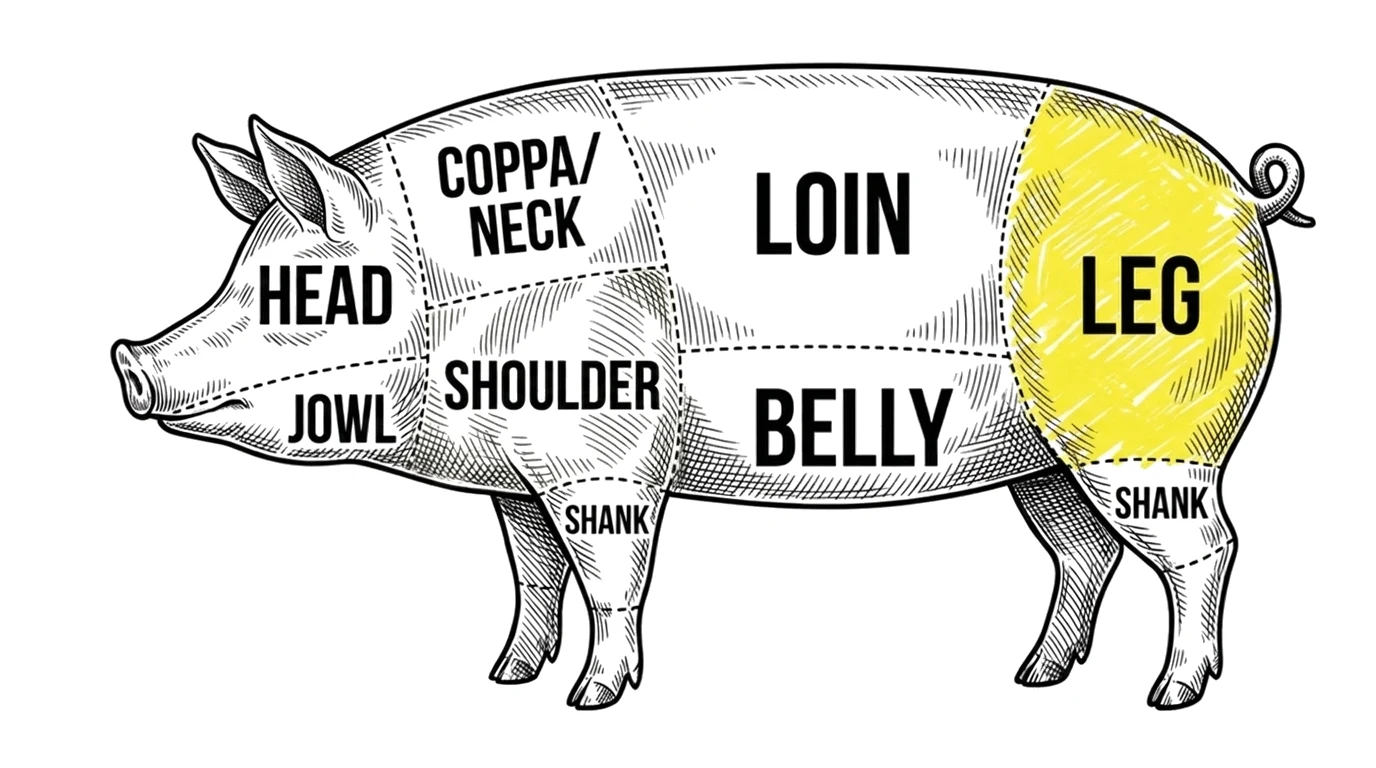
How to recognise it
A compact boneless ham with a dark brown to nearly black exterior, deep red lean, a clean white fat edge and a distinct but balanced conifer-smoke aroma. A hard dry rim, wet grey centre, rancid fat, sourness, insect damage or uncontrolled mould indicates a failed process.
- Shape and size
- Boned, pressed, squared leg
- Lean colour
- Dark red
- Fat and marbling
- White
- Casing
- None
- Surface bloom
- Smoked exterior
Origins and history
Pork was salted and smoked in the Black Forest because cool upland air and abundant conifer wood supported preservation through the year. Farmhouses and village butchers developed a dark, aromatic boneless ham whose smoke distinguished it from the unsmoked hams of southern Europe. Commercial production expanded with tourism and rail links, turning the regional ham into one of Germany's best-known foods. Producers formed a protection association in 1989, and the name received European PGI protection in 1997. The protected link is the Black Forest processing tradition rather than pig farming: raw legs may come from outside the region, but curing, smoking and maturation must occur within the defined area.
Name. Schwarzwalder Schinken, 'Black Forest ham'.
- Production today
- Producers of the Black Forest region, under a producers' association.
- Protection
- PGI/g.g.A., registered 24 January 1997.
- Tradition vs modern
- Boned, spice-cured, cold conifer-smoked.
- Seasonality
- Year-round.
Compare with. Ammerländer Schinken, Speck Alto Adige
Serving and cultural significance
Slice it very thinly so the smoke does not dominate. Serve with dark bread, mild cheese, asparagus, eggs or fruit. Small strips can season salads, potatoes and cream sauces, but prolonged cooking makes the lean salty and tough.
Recipe and cure
This is not a finished recipe. It is a window into how this meat is traditionally cured. Before you follow any process, please run it through one of our curing calculators, so the salt, cure and timings are right and safe for your own batch.
Curesmith home adaptation — not designation-compliant
Make this — the measured Curesmith version →The cure below is the traditional reference. “Make this” opens the measured Curesmith home recipe, scaled to your batch.
Traditional or protected production
The PGI requires the boned ham to be cured, smoked and matured within the defined Black Forest production area. The raw pork legs need not originate in the Black Forest. Producers apply salt and an individual spice blend, then use repeated cold smoke, traditionally associated with fir and spruce, before controlled maturation. Only inspected hams that meet the protected sensory and production requirements may use the name Schwarzwälder Schinken.
Sea salt with pepper, garlic, coriander and juniper; cold-smoked over fir and spruce. Salt-box method; no fixed percentage.
- Meat
- pork
- Salt (%)
- traditional, no fixed %
- Curing salt
- Sea salt with pepper, garlic, coriander and juniper; cold-smoked over fir and spruce.
- Fermented
- No
- Starter or mould
- Possible
- Smoked
- Yes
- Target aW or weight loss
- ~ weight loss
- Temperature (°C)
- cold salting, then 10 to 15
- Humidity (%)
- 70 to 80
- Maturation
- at least 3 months
- Basis
- percentage of green meat weight
- Style
- Traditional dry salting (salt-box), then cold-smoked
Method
- Salt the leg by the traditional method and rest cold.
- Brush off surface salt and rub with the spice mix where used.
- Cold-smoke where traditional, then air-dry.
- Age to the target loss.
Notes
- The official protected specification controls the named product. Any Curesmith EQ, starter-culture, curing-salt or home-scale adaptation is a separate method and must not be presented as designation-compliant.
- A more efficient way of curing this product is using the EQ Method. No more than 2.5% salt to meat weight is required. To follow the EQ method, please use our whole-muscle EQ curing calculator to work out proper ratios and curing times.
In the Codex
What this product teaches, and where to read more.
Temple. Roof, Microclimate