
Overview
Serdelki are short, thick Polish cooked sausages with a fine, even filling and a lightly smoked cured flavour. They are commonly warmed in water and served with bread, mustard, horseradish or ketchup. Their shape is more substantial than a narrow parówka, but they remain individual links rather than one large ring. A well-made serdelka has a smooth cured-pink cut face, a juicy cohesive bite and a casing that holds without becoming tough.
Where it's from
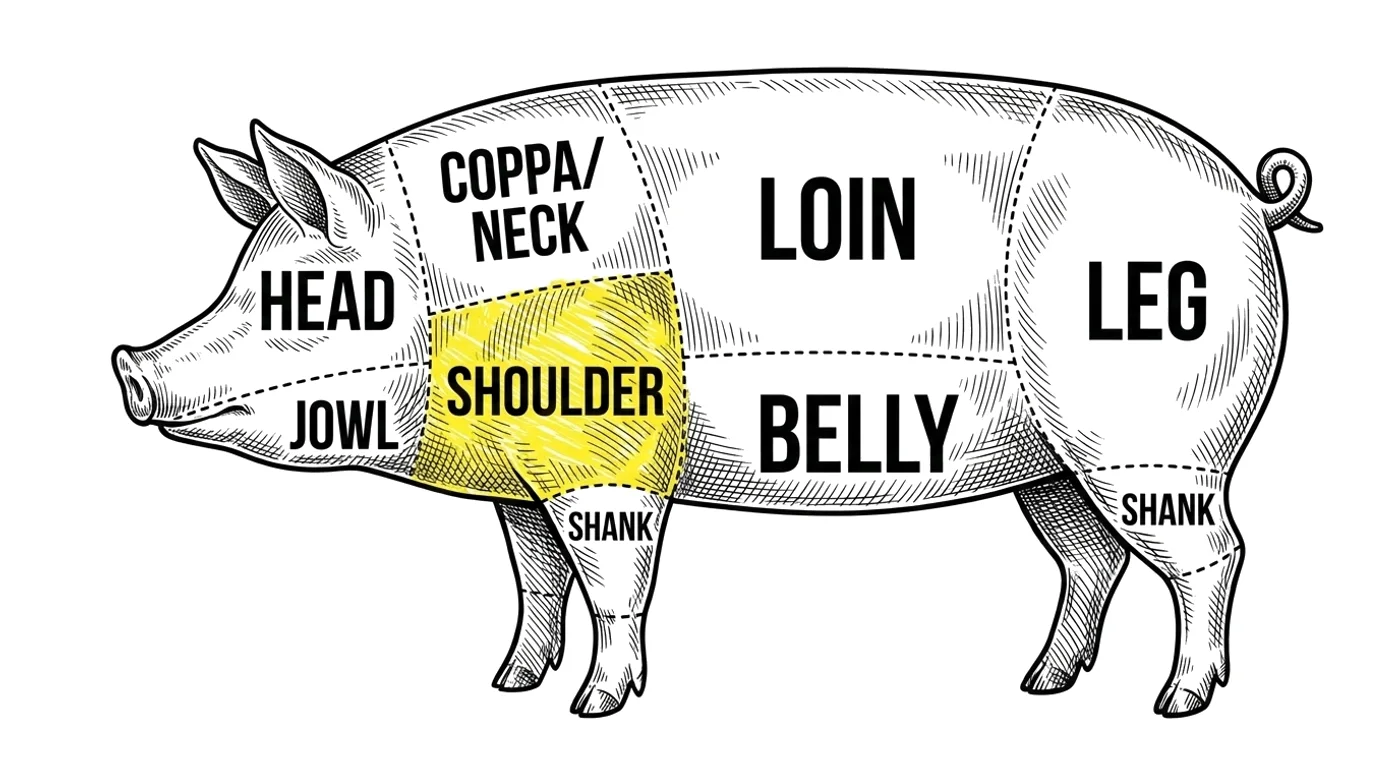
The cut
Identity and terminology
Serdelki is the Polish plural; a single sausage is a serdelek. English descriptions often call them thick frankfurters or Polish wieners, but those are comparisons rather than exact translations. Historical Polish technical material lists serdelki separately from parówki and from kiełbasa serdelowa, confirming that the names should not collapse into one Atlas record. The product is a customary and technical Polish identity, not a protected geographical indication.
Composition and characteristics
Pork supplies flavour and fat, beef strengthens colour and protein bind, and fatty pork trimmings round the texture. The mixture is repeatedly ground and fine-cut with ice, salt and curing salt to create a stable matrix. White pepper, nutmeg and garlic give a restrained warm seasoning. The filling should be uniform rather than coarse, with no visible cereal pockets, smeared fat or jelly separation. Casing diameter and short link length help distinguish serdelki from parówki and ring-shaped serdelowa.
Production and process
All meat and fat are chilled before staged grinding. Fine cutting continues only until the mass becomes smooth and adhesive, because excess heat will break the emulsion. The curing salt must be weighed on the complete animal block. After stuffing into medium-calibre natural casings, the links are dried under controlled cool air, hot-smoked for flavour and colour, scalded to a measured cold point and rapidly cooled. They remain a refrigerated cooked sausage.
History and regional forms
Serdelki belong to the detailed naming system of twentieth-century Polish meat technology and remain familiar in contemporary retail forms, including pork, poultry and mixed-meat products. Modern commercial composition varies, and current inspection guidance makes accurate ingredient and meat-content information important. The Atlas recipe records one high-quality pork-and-beef branch without implying that every product sold under the common name uses the same species or proportion.
Use, storage and related products
Warm serdelki gently in water below a hard boil; aggressive boiling can split the casing and dry the fine filling. Slice lengthwise or into small pieces for children because whole round sausages present a choking hazard. Refrigerate opened packs and use promptly. Parówki are normally narrower, serdelowa is larger and ring-shaped, and frankfurters belong to their own German-Austrian naming histories despite sharing fine comminution.
The recipe for this product is in preparation and will be published once it has been verified.
Safety. Keep the batter below ten degrees Celsius, measure cure on the full animal block, verify the cold point, cool rapidly and refrigerate.