
Overview
Smithfield Ham is a legally defined regional American country ham from Smithfield, Virginia. It is a whole hind-leg product made by long-cure dry salting, smoking and extended ageing. The name carries both a geographical production boundary and a specific minimum maturation period.
Where it's from
The cut
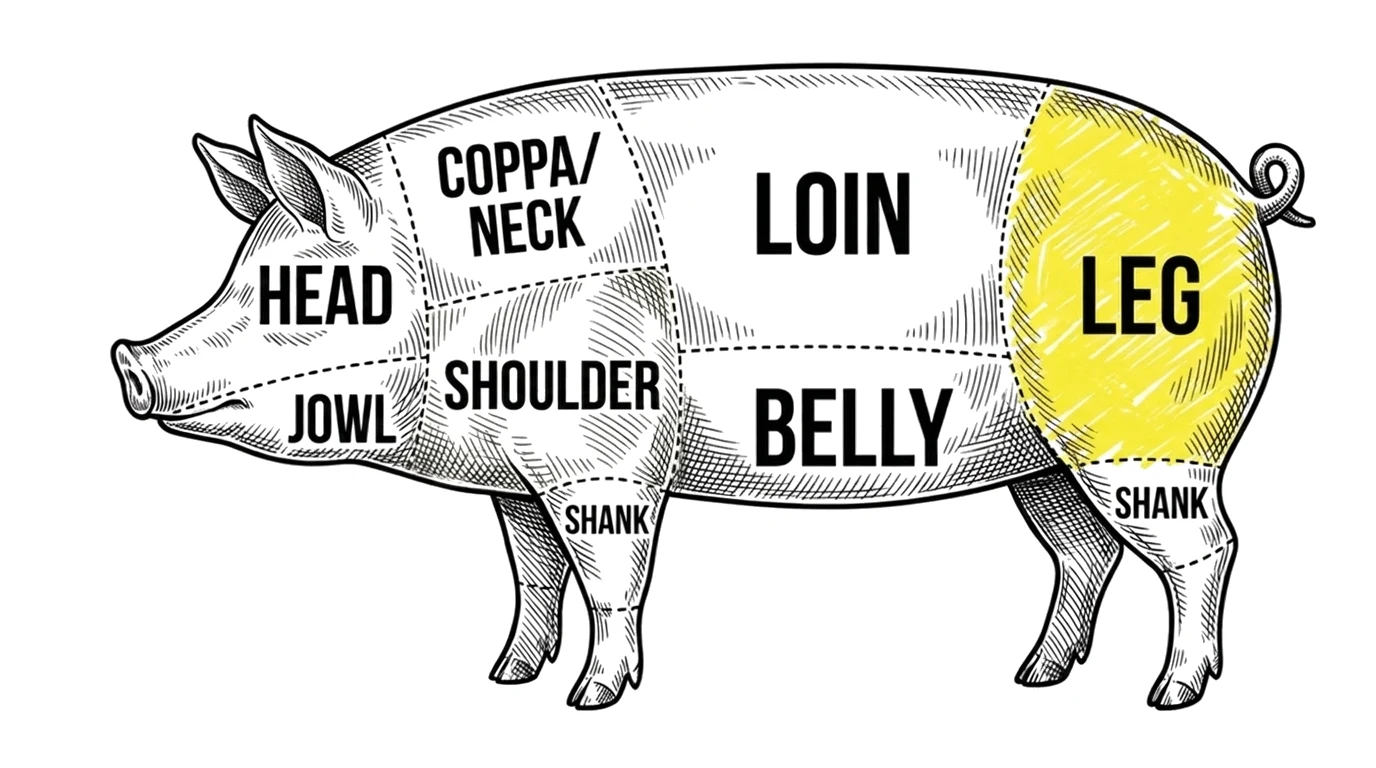
Identity and boundaries
Virginia law requires salting, processing, treating, smoking, curing and ageing within the corporate limits of Smithfield, with at least six months counted from first contact with dry salt. Generic country ham made elsewhere cannot inherit the name, even when its flavour or technique is similar. The legal name therefore combines a defined country-ham process with a tightly bounded place of production, not merely a Virginia-inspired flavour style.
Composition and characteristics
Smithfield Ham begins as a single ham piece and uses dry salt with permitted curing and flavouring ingredients. Long ageing produces a dense texture, dark cured colour and concentrated savoury flavour. Surface mould or bloom may occur during traditional ageing but must be managed under controlled production.
Production and ageing
The ham is dry salted, cured, smoked and aged within Smithfield. Federal country-ham rules additionally prohibit injection and immersion, require full exterior salt application, specify salt or water-activity release conditions and require substantial weight reduction. The Virginia and federal controls operate together rather than as alternatives. The location rule applies throughout the listed operations, so salting or ageing elsewhere cannot be cured by final smoking, packing or sale in Smithfield.
History and context
Smithfield became an important colonial and nineteenth-century pork-curing centre, benefiting from local trade, smokehouses and the reputation of long-aged Virginia hams. State law eventually formalised the name, turning a market reputation into a legally bounded identity rather than a loose style description.
Culinary use and relationships
Smithfield Ham is sliced very thinly for biscuits, breakfast, sandwiches and formal cold service, or cooked after soaking when sold in a cook-before-eating state. It is a child of American Country Ham, not a synonym for all Virginia ham, prosciutto or dry-cured shoulder. Generic country ham remains the parent family, while Smithfield is the legally restricted regional child.
Recipe and cure
This is not a finished recipe. It is a window into how this meat is traditionally cured. Before you follow any process, run it through one of our curing calculators so the salt, cure and timings are right and safe for your own batch.
Make this — the measured Curesmith version →“Make this” opens the same cure as a measured recipe, scaled to your batch.
- Meat
- Boneless pork-leg muscle
- Cut
- Boneless pork-leg muscle
- Salt (%)
- 3
- Curing salt
- Cure #1/#2 as specified
- Fermented
- No
- Smoked
- Yes
- Basis
- per 1,000 g boneless pork-leg muscle
- Style
- Small home dry-cured ham inspired by Smithfield methods.
Ingredients
- Boneless pork-leg muscle100% · 1000 g
- Fine salt3% · 30 g
- Cure #2 containing 6.25% sodium nitrite0.25% · 2.5 g
- Brown sugar1% · 10 g
- Black pepper0.2% · 2 g
Safety. Smithfield Ham is an uncooked dry-cured ham. The legal name depends on the full Smithfield location and ageing process, while safe release also requires compliance with federal country-ham salt, drying and water-activity controls. Preparation must follow the producer’s ready-to-eat or cook-before-eating status.