
Soprèssa Vicentina
Also known as Sopressa Vicentina
Vicenza, Veneto, Italy
Soft, sweet and gently spiced, tender enough to almost melt, a Veneto polenta companion.
Overview
Soprèssa Vicentina is a broad, softly matured salami made from prized pork cuts rather than scraps. Garlic, pepper and gentle maturation produce a sweet, tender sausage traditionally eaten with polenta and local cheese.
Where it's from
Climate. The province of Vicenza in the Veneto.
Altitude. Venetian plain and hills
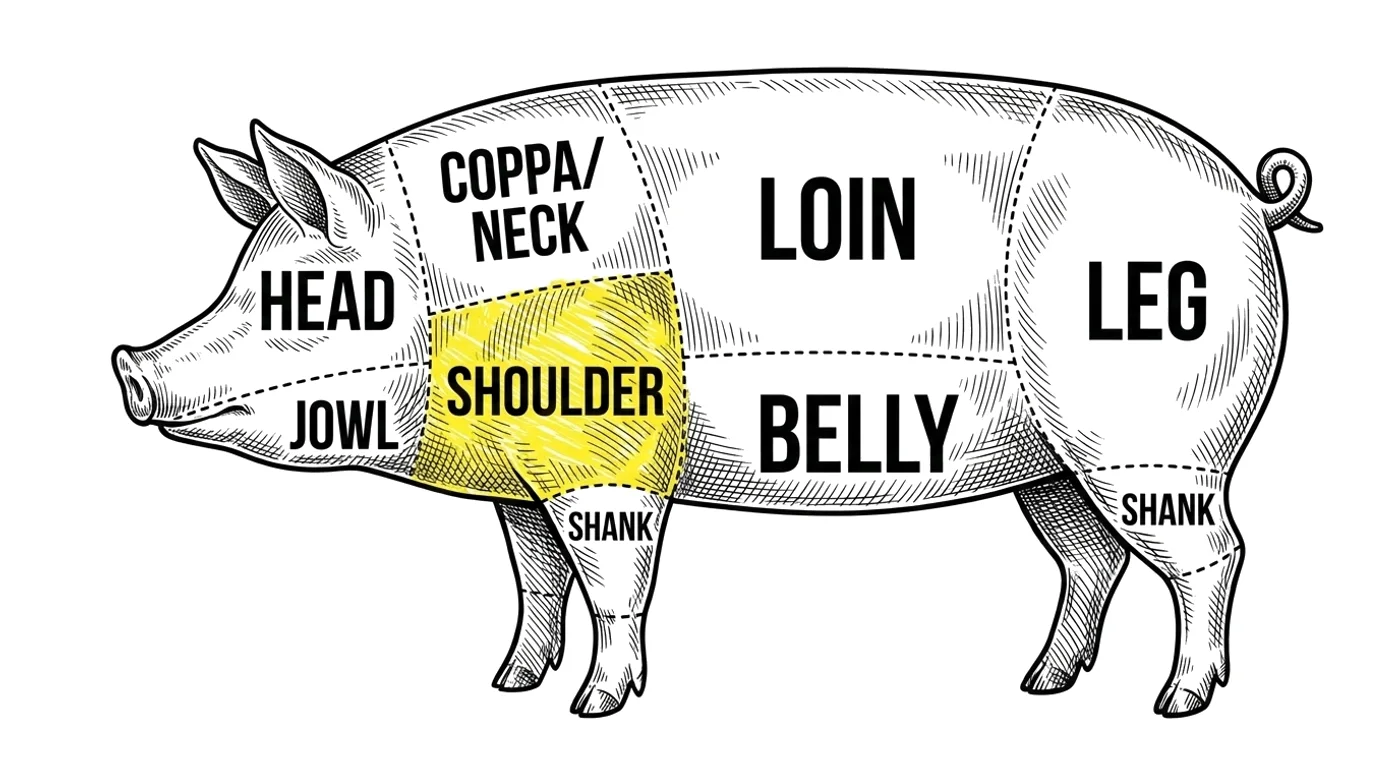
The cut
How to recognise it
The sausage is large, cylindrical or gently curved, often covered by a pale natural bloom. The slice is soft but cohesive, red with evenly distributed white fat. Garlic and pepper should be rounded and sweet. A wet core, case hardening, grease smear, hollow centre or ammonia-heavy mould indicates a failed large-diameter cure.
- Shape and size
- Large, soft cylinder
- Lean colour
- Rosy red
- Fat and marbling
- Soft white
- Casing
- Hog middle or bung, large diameter, 80 mm
- Surface bloom
- White mould
Origins and history
Soprèssa was the great winter salami of Vicenza's farming households. A large casing allowed the family to preserve a substantial share of the pig in one piece, using leg, shoulder, neck, belly and other valued cuts. Its presence in a painting by Jacopo da Ponte from 1576–1577 provides an unusually vivid early cultural reference. The product remained tied to rural feasts, and from the mid-twentieth century village festivals helped preserve its reputation as farm production declined. The protected area stretches between the Piccole Dolomiti, Asiago plateau and Vicenza hills, where cool conditions support slow maturation. PDO registration formalised a product valued for softness and sweetness rather than extreme dryness.
Name. Sopressa, a Veneto form of 'pressed'.
- Production today
- Consortium producers in Vicenza.
- Protection
- DOP.
- Tradition vs modern
- Traditional slow ageing.
- Seasonality
- Year-round.
Compare with. Salame Cremona
Serving and cultural significance
Serve generous slices with grilled or soft polenta, Asiago cheese, pickled vegetables and red wine from the Vicenza hills. It should be allowed to soften slightly before eating. The broad slice also makes a substantial farmhouse sandwich.
Recipe and cure
This is not a finished recipe. It is a window into how this meat is traditionally cured. Before you follow any process, please run it through one of our curing calculators, so the salt, cure and timings are right and safe for your own batch.
Curesmith home adaptation — not designation-compliant
Make this — the measured Curesmith version →The cure below is the traditional reference. “Make this” opens the measured Curesmith home recipe, scaled to your batch.
Traditional or protected production
Sopressa Vicentina is a large pure-pork sausage in broad natural casing. The protected product ranges from about 1 to 8 kg, and minimum maturation increases with weight. It is characterised by a mild, sweet profile and only restrained acidity.
- Meat
- pork
- Salt (%)
- 2.8
- Curing salt
- Not included in the base recipe below
- Fermented
- Yes
- Target pH
- 4.9
- Starter or mould
- Natural surface mould
- Smoked
- No
- Target aW or weight loss
- ~30% weight loss
- Temperature (°C)
- ferment 22 to 24, then dry 13 to 15
- Humidity (%)
- ferment ~90, then 75 to 80
- Maturation
- 2 to 6 months
- Basis
- per 1000 g green meat
- Style
- Traditional fermented and dried sausage
Ingredients
- Lean pork (base)100% · 1000 g/kg
- Back fat and pork belly42.86% · 429 g/kg
- Pepper0.3% · 3 g/kg
- Dextrose (or sugar)0.1% · 1 g/kg, or sugar 0.1% · 1 g/kg
- Cinnamon0.05% · 0 g/kg
- Cloves0.03% · 0 g/kg
- Rosemary, ground0.03% · 0 g/kg
- Garlic0.3% · 3 g/kg
Method
- Mince pork and fat and mix with all ingredients to green meat weight.
- Stuff into casing.
- Ferment to the target pH.
- Dry to the target weight loss.
Notes
- The official protected specification controls the named product. Any Curesmith EQ, starter-culture, curing-salt or home-scale adaptation is a separate method and must not be presented as designation-compliant.
- This traditional recipe uses no nitrite. For safety we recommend adding Cure #2: in a low-oxygen, slow-dried product nitrite is the specific guard against Clostridium botulinum, while salt, acidity and drying control Salmonella, E. coli, Listeria and Staphylococcus.
In the Codex
What this product teaches, and where to read more.
Temple. Roof, Water Activity