
Spalla cruda di Palasone
Also known as Spalla cruda
Palasone di Sissa, Emilia-Romagna, Italy
Rich and rustic, a raw-cured shoulder, the humbler cousin of culatello, beloved of Verdi.
Overview
Spalla cruda is rich and rustic, a raw-cured shoulder, the humbler cousin of culatello, beloved of verdi. A pear-shaped shoulder weighing roughly 2–6 kg, with deep red lean, irregular white marbling and a mature cellar aroma. It should be richer and more muscular than Culatello, but not hard, sour or excessively salty.
Where it's from
Climate. The Bassa Parmense along the Po, culatello country.
Altitude. Po river plain
The cut
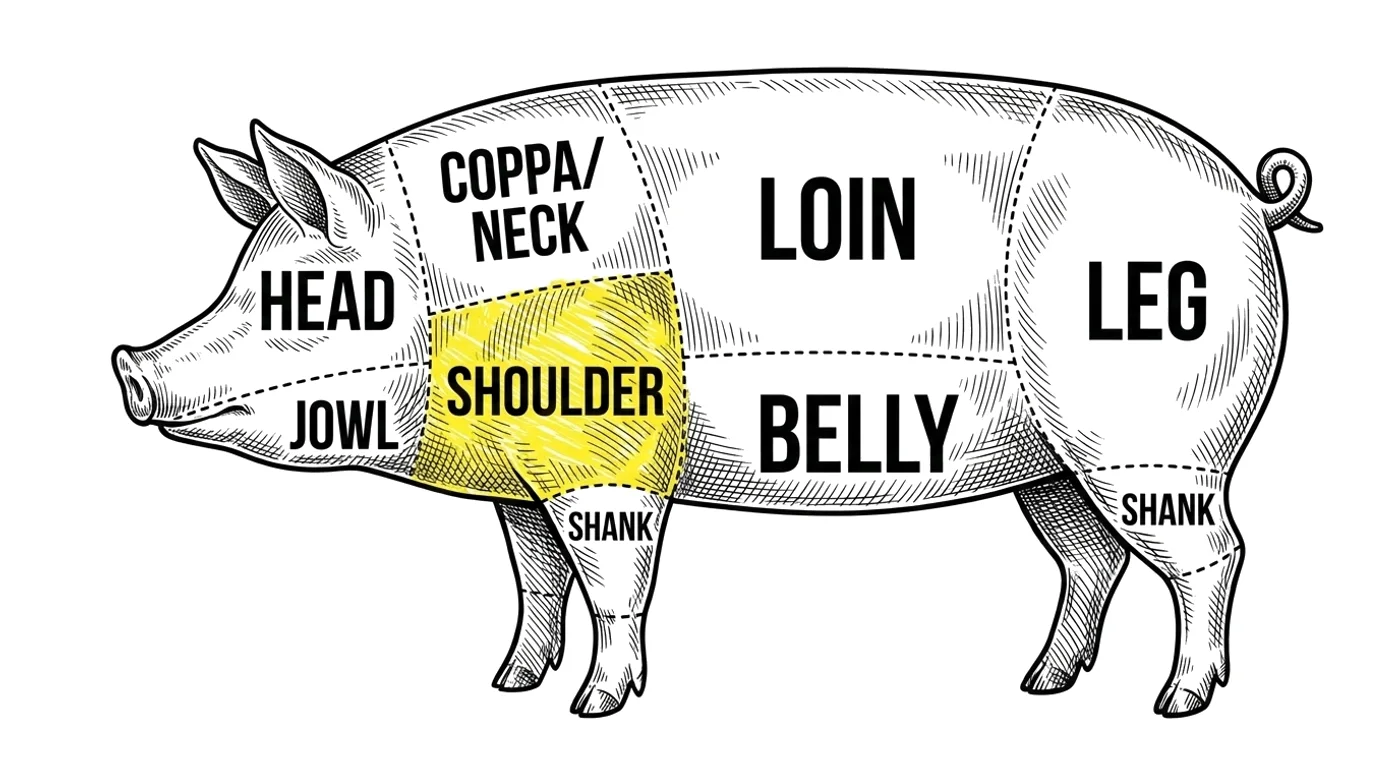
How to recognise it
A pear-shaped shoulder weighing roughly 2–6 kg, with deep red lean, irregular white marbling and a mature cellar aroma. It should be richer and more muscular than Culatello, but not hard, sour or excessively salty. Shape and size: Cured shoulder, boned or bone-in. Lean colour: Deep red. Fat and marbling: Marbled. Casing or exterior: Bladder or natural casing. Surface: Cellar mould. The form is cured shoulder, boned or bone-in. the lean is deep red. the fat or marbling is marbled. and the exterior uses bladder or natural casing. A hard dry rim, wet grey centre, rancid fat, sourness or air beneath a casing indicates an uneven or contaminated cure.
- Shape and size
- Cured shoulder, boned or bone-in
- Lean colour
- Deep red
- Fat and marbling
- Marbled
- Casing
- Bladder or natural casing
- Surface bloom
- Cellar mould
Origins and history
A raw cured shoulder from the Bassa Parmense, the lesser-known cousin of culatello, made from the shoulder rather than the leg. The Palasone di Zibello version, cured on the bone in a bladder, was famously a favourite of the composer Giuseppe Verdi, who was born nearby. It is salted and aged in the same humid river air, richer and more rustic than culatello.
The shoulder is often described as the rustic counterpart to Culatello. It uses a harder-working, more irregular muscle and therefore demands careful salting and a very patient cure. The Palasone tradition survived through a handful of families and was famously appreciated by Giuseppe Verdi, who was born in the same Parma countryside. The Slow Food Presidium limits production to the cold season, traditionally from November to February. Its guidance distinguishes at least ten months for boneless shoulders and fourteen months for bone-in pieces, reflecting the extra difficulty of curing the joint evenly.
Name. Spalla cruda, 'raw shoulder'.
- Production today
- Small producers of the Bassa Parmense.
- Protection
- Not EU-protected (a Slow Food Presidium exists for the Palasone).
- Tradition vs modern
- Bone-in and boned versions; a humid, slow cure.
- Seasonality
- Winter slaughter.
Compare with. Culatello di Zibello, Fiocchetto
Serving and cultural significance
Sliced thin, richer than culatello. Its muscular shoulder texture benefits from a slightly thicker slice than Culatello, and a small amount of cellar aroma should be allowed to open on the plate. Buttered bread, Parmigiano Reggiano and a lightly sparkling local wine support the shoulder without hiding its deeper flavour.
Recipe and cure
This is not a finished recipe. It is a window into how this meat is traditionally cured. Before you follow any process, please run it through one of our curing calculators, so the salt, cure and timings are right and safe for your own batch.
Make this — the measured Curesmith version →The cure below is the traditional reference. “Make this” opens the measured Curesmith home recipe, scaled to your batch.
Traditional or protected production
Spalla Cruda di Palasone is a rare raw-cured pork shoulder from the Parma lowlands. Traditional production removes or trims the rind, salts and drains the shoulder repeatedly for roughly six to eight days, then packs it into pig bladder and matures it in the humid Po Valley environment. Bone-in and boneless forms exist.
The reference process can be summarised as follows: Trim the shoulder, rub forcefully with coarse sea salt and pepper, drain it without allowing it to sit in expressed liquid, repeat the salting cycle, enclose it in pig bladder, tie securely and mature slowly in the humid Parma lowlands.
Sea salt, black pepper, garlic and a little dry white wine, salt-box method; no fixed percentage.
- Meat
- pork
- Salt (%)
- traditional, no fixed %
- Curing salt
- Sea salt with pepper and garlic
- Fermented
- No
- Starter or mould
- Possible
- Smoked
- No
- Target aW or weight loss
- ~ weight loss
- Temperature (°C)
- cold salting, then 12 to 15
- Humidity (%)
- 75 to 80
- Maturation
- a year and up
- Basis
- percentage of green meat weight
- Style
- Traditional dry salting (salt-box)
Method
- Salt and season by the traditional method and rest cold.
- Case in a bladder or hang as the style requires.
- Age in the humid river air.
- Age to the target loss.
Notes
- A more efficient way of curing this product is using the EQ Method. No more than 2.5% salt to meat weight is required. To follow the EQ method, please use our whole-muscle EQ curing calculator to work out proper ratios and curing times.
In the Codex
What this product teaches, and where to read more.
Temple. Pillar, Meat Quality