
Overview
Spekeskinke is the Norwegian generic family of dry-cured pork ham. It is made from the pig’s hind leg and preserved through salting, drying and maturation. Products range from whole bone-in hams intended for gradual slicing to boneless pieces and thin retail packs.
Where it's from
The cut
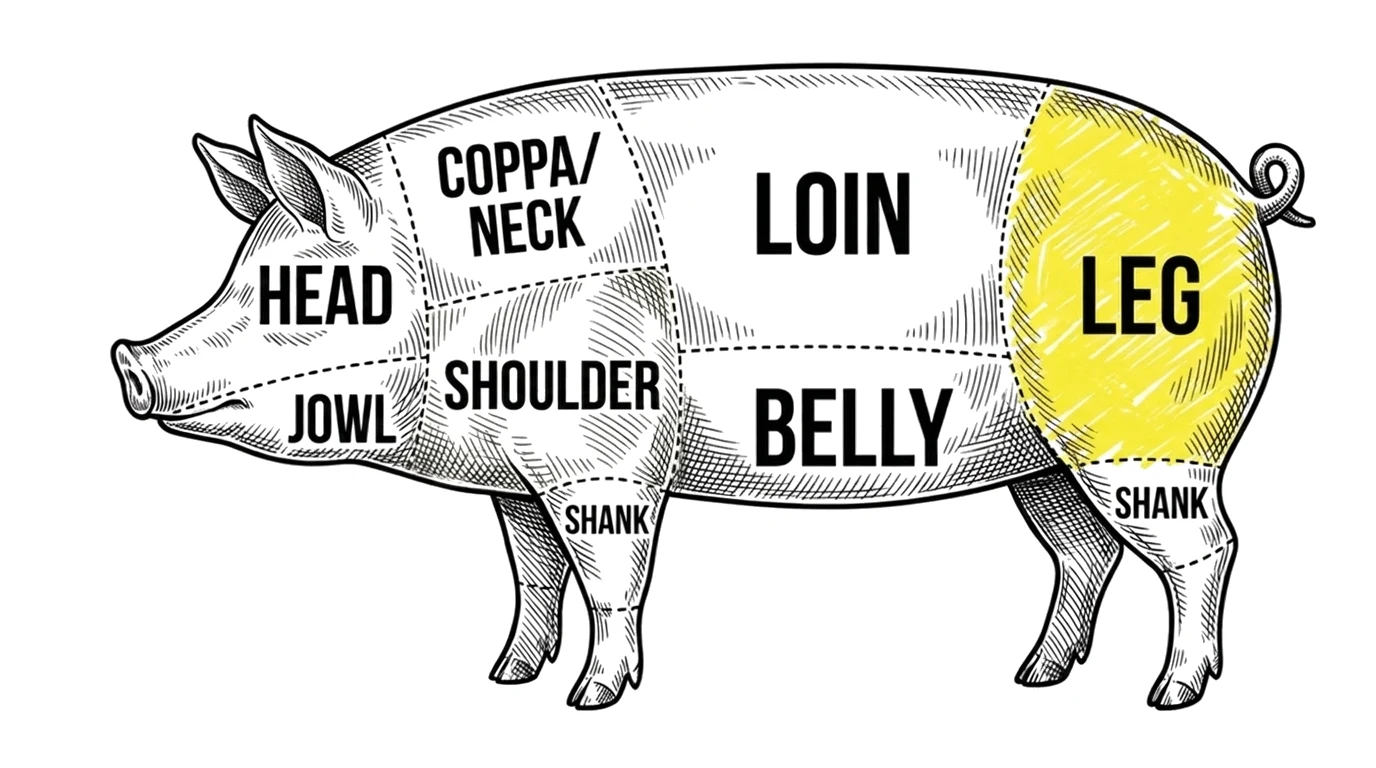
Identity and boundaries
The name describes a Norwegian product family, not one protected specification or one national formula. Bone-in, boneless, smoked and unsmoked forms are valid branches. Foreign protected hams such as Prosciutto di Parma or Jamón de Teruel retain separate identities and cannot be relabelled as generic Spekeskinke equivalents. The family accommodates differences in trimming, bone status, smoke and maturation, but all branches remain pork-leg products preserved by salting and drying.
Composition and characteristics
Pork leg and salt form the core. Cure agents, smoke and seasoning depend on the branch and producer. A mature ham should be firm, evenly cured and aromatic, with concentrated pork flavour and balanced fat. Quality varies with raw material, trimming, salting, ageing time and moisture loss.
Production and maturation
The leg is trimmed, dry salted or otherwise salted within the selected validated process, equalised, dried and matured. Some hams are smoked. Traditional seasonal timing explains the style but cannot replace measurements of cure penetration, weight loss and final stability. Packaging and slicing introduce additional hygiene controls. Measured weight loss, water activity and defect assessment are necessary for modern release because seasonal duration alone does not establish equivalent safety or quality.
History and context
Norwegian spekemat grew from autumn slaughter and the need to preserve meat through winter without refrigeration. Salted pieces were sometimes smoked and hung in storehouses until spring or summer. Modern Spekeskinke continues that tradition in household, artisanal and industrial forms with more controlled production.
Culinary use and relationships
Spekeskinke is served in thin slices with flatbread, sour cream, potatoes, melon or festive cold tables. It relates to other Norwegian spekemat such as fenalår and cured reindeer, but differs by species and cut. Named producers and protected regional children should remain separate entries. Named Norwegian producers or regional products may merit child entries, provided their claims are not generalised to the whole family.
Recipe and cure
This is not a finished recipe. It is a window into how this meat is traditionally cured. Before you follow any process, run it through one of our curing calculators so the salt, cure and timings are right and safe for your own batch.
Make this — the measured Curesmith version →“Make this” opens the same cure as a measured recipe, scaled to your batch.
- Meat
- Boneless pork-leg muscle
- Cut
- Boneless pork-leg muscle
- Salt (%)
- 2.5
- Curing salt
- Cure #1/#2 as specified
- Fermented
- No
- Smoked
- Yes
- Basis
- per 1,000 g boneless pork-leg muscle
- Style
- Boneless dry-cured pork-leg home adaptation.
Ingredients
- Boneless pork-leg muscle100% · 1000 g
- Fine salt2.5% · 25 g
- Cure #2 containing 6.25% sodium nitrite0.25% · 2.5 g
- Sugar0.5% · 5 g
- Black pepper0.2% · 2 g
- Crushed juniper berries0.1% · 1 g
Safety. Spekeskinke is an uncooked salted and dried ham. Historical calendar methods are not sufficient release criteria. Production requires controlled cure penetration, hygienic maturation, measured drying and a verified final endpoint, with storage and slicing controls appropriate to the finished product.