
Sucuk
Also known as soudjouk, sujuk, soujouk
Kayseri, Turkey, the Balkans and the Middle East, Turkey
Overview
Sucuk is a dark red, strongly aromatic sausage with cumin, garlic and pepper, usually cooked in slices. the texture should be dense and fatty enough to fry without becoming dry. A dark red, strongly aromatic sausage with cumin, garlic and pepper, usually cooked in slices. The texture should be dense and fatty enough to fry without becoming dry. The Codex treats it as a complete production system, not merely a familiar name. Raw material, cut or particle size, casing, smoke, fermentation, cooking and maturation all contribute to the identity. The current status is Generic Turkish and regional sausage family : no generic EU GI. The protected or traditional reference and the Curesmith home method remain separate.
Where it's from
The cut
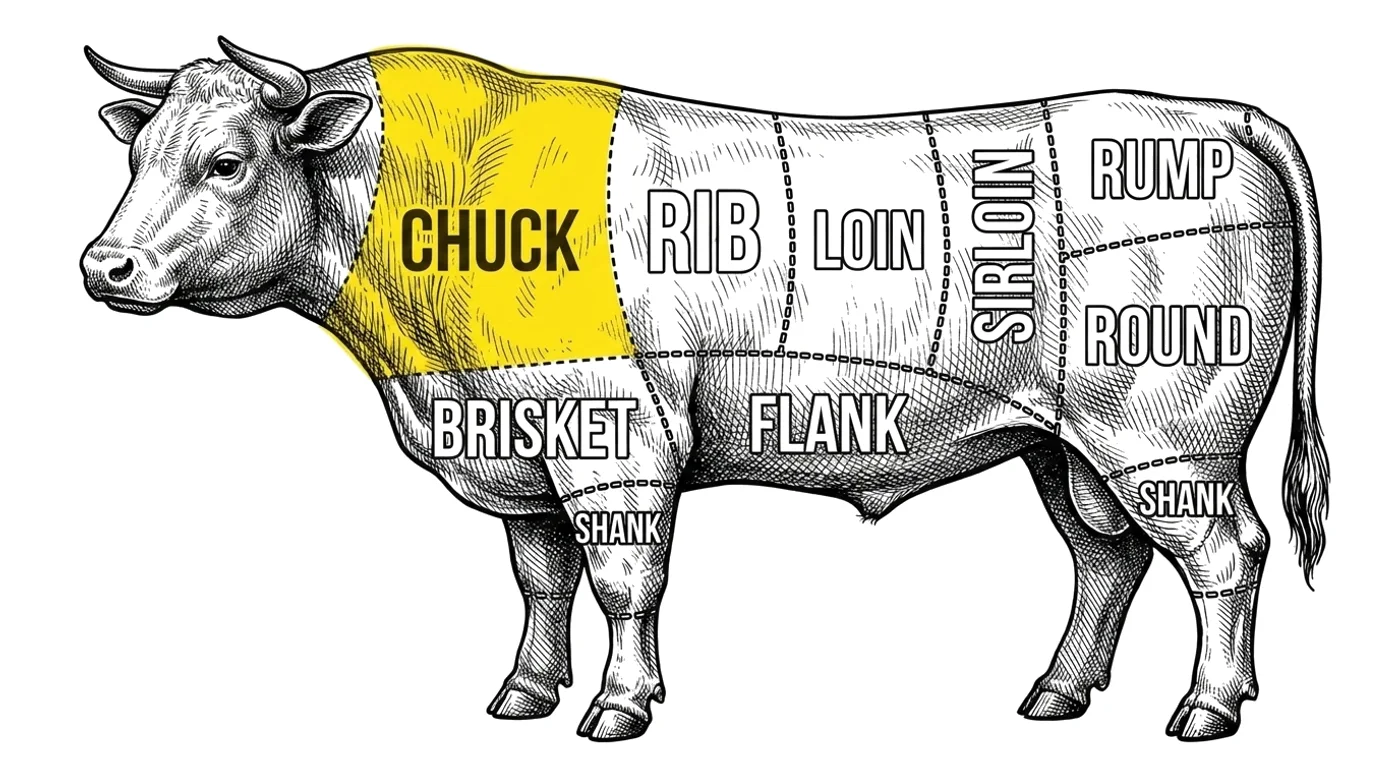
How to recognise it
A dark red, strongly aromatic sausage with cumin, garlic and pepper, usually cooked in slices. The texture should be dense and fatty enough to fry without becoming dry. Grease smear, hollow pockets, case hardening, a wet centre, rancidity or uncontrolled dark mould is a production fault.
Origins and history
The word sucuk is documented in Mahmud al-Kashgari's eleventh-century Dīwān Lughāt al-Turk, showing that the sausage name has deep roots in Turkic food culture. Pastoral communities relied on beef, mutton and tail fat rather than pork, seasoning the mixture heavily with garlic, cumin and red pepper before fermentation and drying. Ottoman trade and migration carried related forms through Anatolia, the Balkans, the Middle East and Central Asia, producing many spellings and regional recipes. Modern Turkish law defines fermented sucuk as a controlled meat product, but the generic word covers a broad family. Individual regional names may be protected separately and should not be merged into this entry.
Serving and cultural significance
Slice and fry it with eggs, beans, tomatoes or bread, allowing the rendered garlic-and-cumin fat to season the dish. A dry validated sausage can be sliced cold, but cooking remains the most common and conservative home service.
Recipe and cure
This is not a finished recipe. It is a window into how this meat is traditionally cured. Before you follow any process, run it through one of our curing calculators so the salt, cure and timings are right and safe for your own batch.
Curesmith home adaptation — not designation-compliant
Make this — the measured Curesmith version →The cure below is the traditional reference. “Make this” opens the measured Curesmith home recipe, scaled to your batch.
Traditional or protected production
Generic Sucuk has no single protected specification. Lean beef, beef with mutton, or other regionally permitted red meat is mixed with fat, salt, garlic, cumin, pepper and red pepper, stuffed and fermented before drying. Traditional recipes may rely on resident flora, pressing and seasonal air, while modern production commonly uses curing salts and selected cultures. Individually protected Turkish regional names must be documented separately.
- Meat
- beef (and beef or lamb tail fat); no pork
- Cut
- minced
- Salt (%)
- 2.5%
- Curing salt
- Cure #1
- Other agents
- dextrose; garlic, cumin, sumac, red pepper, black pepper
- Fermented
- Yes
- Target pH
- ~4.9
- Starter or mould
- lactic acid bacteria starter (or traditional back-slopping)
- Smoked
- No
- Target aW or weight loss
- ~30 to 40% weight loss
- Temperature (°C)
- warm ferment then dry 12 to 14
- Humidity (%)
- 72 to 75
- Maturation
- one to three weeks
- Basis
- percentage of meat weight
- Style
- minced, fermented, dried, often pressed
Ingredients
- beef
- beef or lamb fat
- salt
- dextrose
- garlic
- cumin
- sumac
- red pepper
- black pepper
- Cure #1
Notes
- The official protected specification controls the named product. Any Curesmith EQ, starter-culture, curing-salt or home-scale adaptation is a separate method and must not be presented as designation-compliant.
- Traditionally an all-beef, pork-free (halal) sausage.
- Nitrite at 156 ppm ingoing; target roughly pH 4.9.
- Often pressed to a flattened U-shape during drying.
Safety. A dry fermented sausage: acid drop and drying give the safety. A prompt, confident ferment is essential.
In the Codex
What this product teaches, and where to read more.
Temple. Roof, pH