
Süddeutsche Mortadella
Also known as South German Mortadella, Mortadella Süddeutsch
Southern Germany, Germany
Overview
Süddeutsche Mortadella is a large-format German Brühwurst built from a finely comminuted cured base and conspicuous cubes of cooked tongue, heart, preheated red batter or, in some versions, bacon. The dark red inclusions against the lighter pink matrix are its principal visual signature. Although the name uses mortadella, the product belongs to Germany's own scalded-sausage vocabulary and should not be interpreted as a regional copy entitled to Italy's Mortadella Bologna PGI name.
Where it's from
The cut
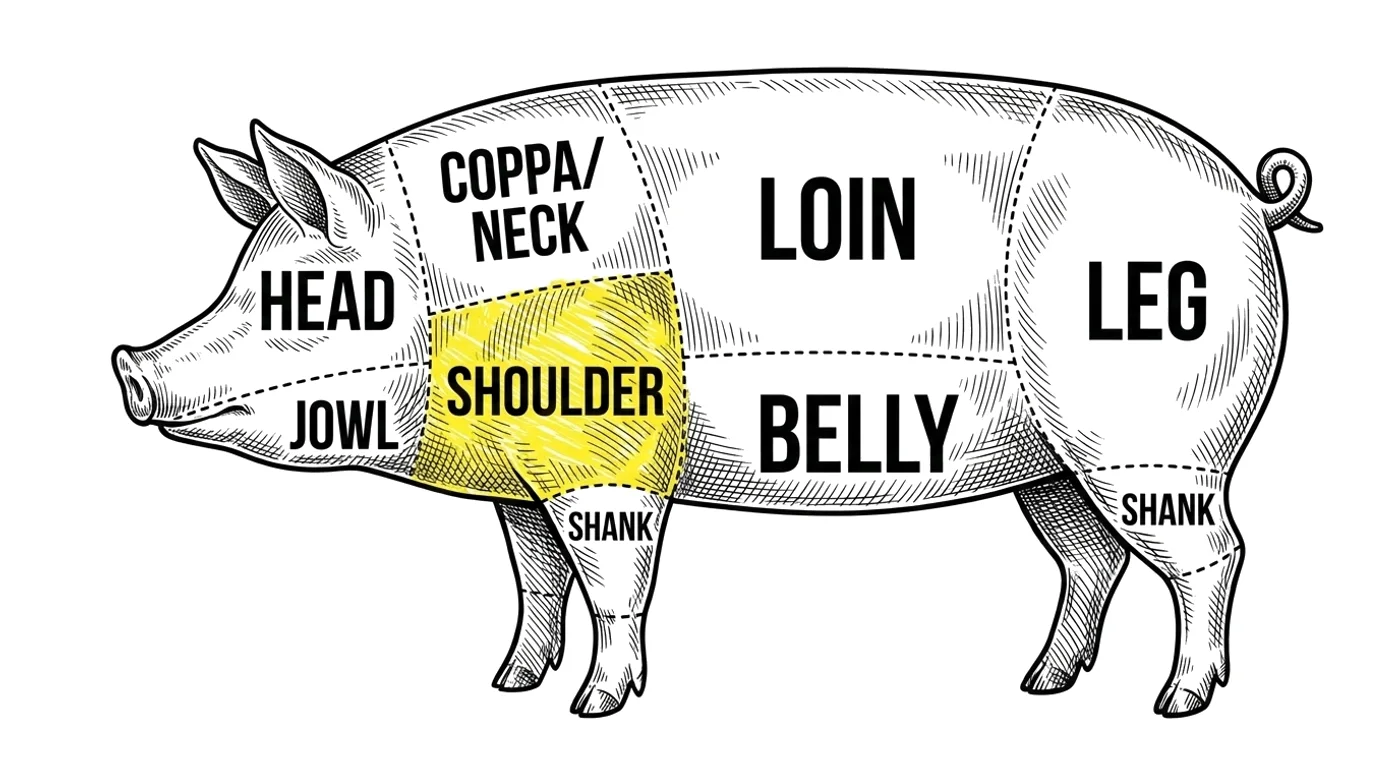
Identity and terminology
The qualifier süddeutsche means South German. It matters because the German guidelines place Norddeutsche Mortadella with Lyoner and fine Fleischwurst, while Süddeutsche Mortadella appears in a separate group for scalded sausages with visible organ or meat inclusions. This formal split resolves an otherwise confusing family of labels. A smooth German mortadella without the required tongue, heart or red-meat mosaic is better treated as North German Mortadella or Lyoner style.
Composition and characteristics
The fine base may combine trimmed beef, lean pork and bacon or fatty pork. Cubes of precooked tongue or heart supply the characteristic red islands; a heated red batter can perform a similar role under the guideline. The slice should be cohesive, evenly cured and free of liquid pockets, with inclusions distributed through the full diameter. Pepper, coriander, mace, cardamom and ginger are compatible seasonings, while pistachio or bell pepper belong to particular formulas rather than the legal core.
Production and process
Production separates the inclusions from the binding matrix. Tongue or heart is cured, cooked, chilled and cut cleanly. The remaining cold meat and fat are ground and fine-cut to extract a stable paste, then the cubes are folded in without breaking them. The broad casing is filled without air and cooked gently so that the centre reaches 74°C without forcing out fat or jelly. Rapid cooling protects both bind and slice definition.
History and regional forms
German meat-guideline records from the late twentieth and early twenty-first centuries preserve the north-south distinction as a matter of customary product identity, not protected geography. The terminology emerged within the industrial and craft classification of Brühwurst, where names describe expected raw materials, fineness and cut surface. The present guidelines still distinguish the South German inclusion sausage even though everyday retail use of mortadella can be looser.
Use, storage and related products
Serve it cold in thin slices on bread, in mixed sausage plates or cut thicker for pan heating. Refrigeration is essential because this is a moist cooked product, not a dry salami. Fleischwurst and Norddeutsche Mortadella are the fine, inclusion-free branch. Zungenwurst is another tongue-bearing German sausage. It must remain separate from Mortadella Bologna PGI and Mortadella di Prato PGI.
Recipe and cure
This is not a finished recipe. It is a window into how this meat is traditionally cured. Before you follow any process, run it through one of our curing calculators so the salt, cure and timings are right and safe for your own batch.
Make this — the measured Curesmith version →“Make this” opens the same cure as a measured recipe, scaled to your batch.
- Meat
- Lean pork shoulder
- Cut
- Lean pork shoulder
- Salt (%)
- 1.8
- Curing salt
- Cure #1 as specified in the recipe
- Fermented
- No
- Starter or mould
- None; this product is not fermented
- Smoked
- No
- Maturation
- Refrigerate at 0–4°C; use within 4 days or freeze promptly
- Basis
- per 1,000 g lean pork shoulder
- Style
- German fine scalded sausage with cured cooked tongue and fat inclusions
Ingredients
- Lean pork shoulder100% · 1000 g
- Medium-fat pork shoulder65% · 650 g
- Skinless pork jowl65% · 650 g
- Fresh pork tongue35% · 350 g
- Pork back fat35% · 350 g
- Crushed ice10.9% · 333.5 g
- Fine salt1.8% · 54 g
- Cure #1, 6.25% sodium nitrite0.25% · 7.5 g
- Ground white pepper0.22% · 6.5 g
- Sweet paprika0.06% · 1.5 g
- Ground coriander0.06% · 1.5 g
- Ground mace0.06% · 1.5 g
- Ground cardamom0.1% · 1 g
- Ground ginger0.03% · 1 g
- Roasted red pepper, peeled, dried and diced1.6% · 50 g
- Shelled pistachios5% · 50 g
Method
- Mix salt and Cure #1 thoroughly, then allocate one ninth to the tongue and eight ninths to the remaining animal block by weight.
- Rub the tongue and remaining animal materials with their allocated cure, cover separately and refrigerate 24–48 hours.
- Poach the cured tongue gently until tender, peel while warm, chill rapidly and cut into 20–25 mm cubes.
- Grind the remaining cured animal materials through 3 mm and fine-cut with spices and crushed ice.
- Fold in tongue cubes, chilled back-fat cubes, pepper and pistachios.
- Fill the broad casing firmly without trapped air.
Safety. Cure inclusions and base as one reconciled system, cook organ meats fully, keep the emulsion cold, verify the centre temperature, chill rapidly and refrigerate.