
Overview
Urutan Bali is a Balinese sausage family traditionally made from chopped pork and fat seasoned with salt, sugar and a complex local spice mixture. Traditional forms ferment during sun drying, but later research and commercial practice also document non-fermented and cooked branches.
Where it's from
The cut
Identity and terminology
Urutan is not one fixed preservation route. The cultural family includes traditional pork sausage, cooked products and species-labelled adaptations such as chicken. The family name alone does not tell you whether a given Urutan is fermented, dried, cooked or fresh, and those keep differently.
Composition and characteristics
Traditional pork Urutan uses lean pork, fat and Balinese spices, often including garlic, chilli, turmeric, galangal or related aromatic ingredients. The sausage is coarse and strongly seasoned. Fermented-dried forms become darker and firmer, while cooked variants remain softer and more perishable. The spice mixture is not simply decorative: it shapes aroma, colour and microbial conditions. However, salt, sugar, spice and tropical warmth cannot be treated as a substitute for controlled fermentation. Traditional identity and modern safety practice are two separate things, and the first does not settle the second.
Production and process
Traditional practice stuffs the seasoned meat into intestine and exposes it to warm drying conditions, allowing spontaneous fermentation. Modern controlled production must replace uncertain sun exposure with measured temperature, humidity, culture or acidification, and final aw. Cooked versions must reach 71°C in the centre and then be cooled quickly.
History and regional forms
Urutan is part of Balinese food culture and household pork preparation. It appears in local meals and ceremonial contexts. Research has documented how modern processors adapt the product for safer, more predictable manufacture while retaining the spice profile and cultural name.
The existence of cooked and alternative-species versions shows active culinary evolution. These variants may be culturally legitimate, but their species, heat treatment and storage status should be stated openly rather than folded into one traditional formula.
Use, storage and related products
Urutan is commonly fried or grilled and served with rice and Balinese accompaniments. Ready-to-eat claims depend on the actual validated process. Traditional pork, chicken and cooked commercial forms are distinct branches of the same family. It is a Balinese product, not a generic fermented sausage.
Recipe and cure
This is not a finished recipe. It is a window into how this meat is traditionally cured. Before you follow any process, run it through one of our curing calculators so the salt, cure and timings are right and safe for your own batch.
Make this — the measured Curesmith version →“Make this” opens the same cure as a measured recipe, scaled to your batch.
- Meat
- Pork shoulder
- Cut
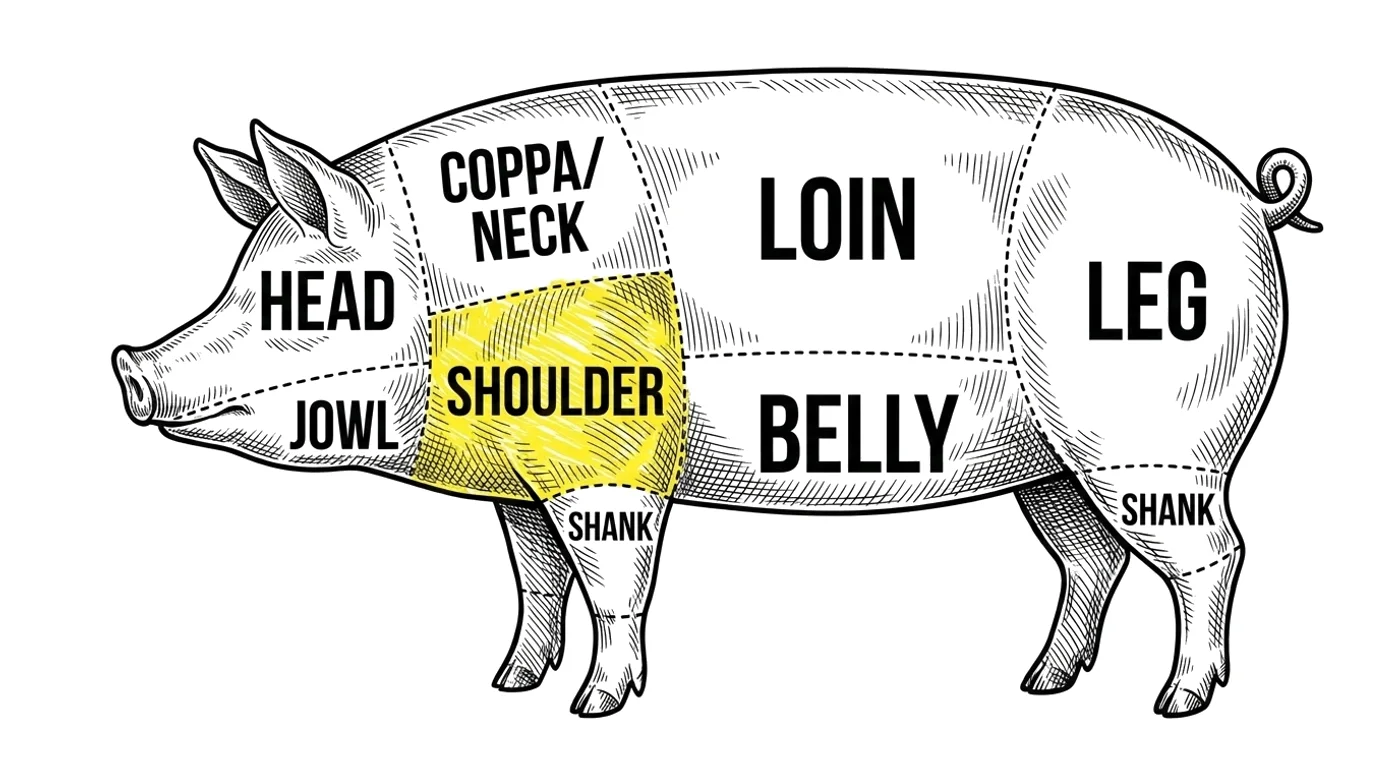
- Pork shoulder
- Salt (%)
- 2.5
- Curing salt
- Cure #1/#2 as specified
- Fermented
- Yes
- Target pH
- 5.3 or lower
- Smoked
- No
- Basis
- per 1,000 g pork shoulder
- Style
- Modern starter-led home adaptation inspired by Balinese Urutan; not the unchanged traditional spontaneous process.
Ingredients
- Pork shoulder100% · 1000 g
- Pork back fat25% · 250 g
- Fine salt2.5% · 31.5 g
- Cure #2 containing 6.25% sodium nitrite0.25% · 3 g
- Dextrose0.5% · 6.5 g
- Garlic0.5% · 6.5 g
- Ground coriander0.2% · 2.5 g
- Ground galangal0.2% · 2 g
- Ground turmeric0.1% · 1.5 g
- Black pepper0.2% · 2.5 g
- Chilli powder0.15% · 2 g
- Flora Italia LC or equivalent starter culture0.02% · 0.3 g
Safety. Traditional spontaneous sun drying must not be presented as a validated home method. Fermented branches require controlled acidification, temperature and drying; cooked branches require measured lethality and cooling. Pork, chicken or other species variants must be labelled accurately and protected from cross-contamination in tropical conditions.