
Waldviertler
Also known as Waldviertler Rauchwurst, Waldviertler Rauchwürstel
Lower Austria, Austria
Overview
Waldviertler is an Austrian smoked cooked sausage associated with the Waldviertel of Lower Austria. Austria's official Traditional Foods register describes it as a Fleischwurst containing fine batter and visible meat cut at three to five millimetres, filled as short sticks or rings, smoked intensively and cooked. It is commonly served hot with mustard or horseradish and bread, or with potatoes and vegetables, and can also be sliced cold after complete cooking and chilling.
Where it's from
The cut
Identity and terminology
The name means a product from the Waldviertel. Waldviertler Rauchwurst and Waldviertler Rauchwürstel are recognised alternative names. The official register links the product to Austrian Codex chapter B14, class 3a Fleischwurst, which gives it a defined national technical position. That traditional-food recognition is not PDO, PGI or TSG protection. The Atlas must therefore report the Codex relationship accurately without attaching an EU protection badge or restricting all lawful production to one town.
Composition and characteristics
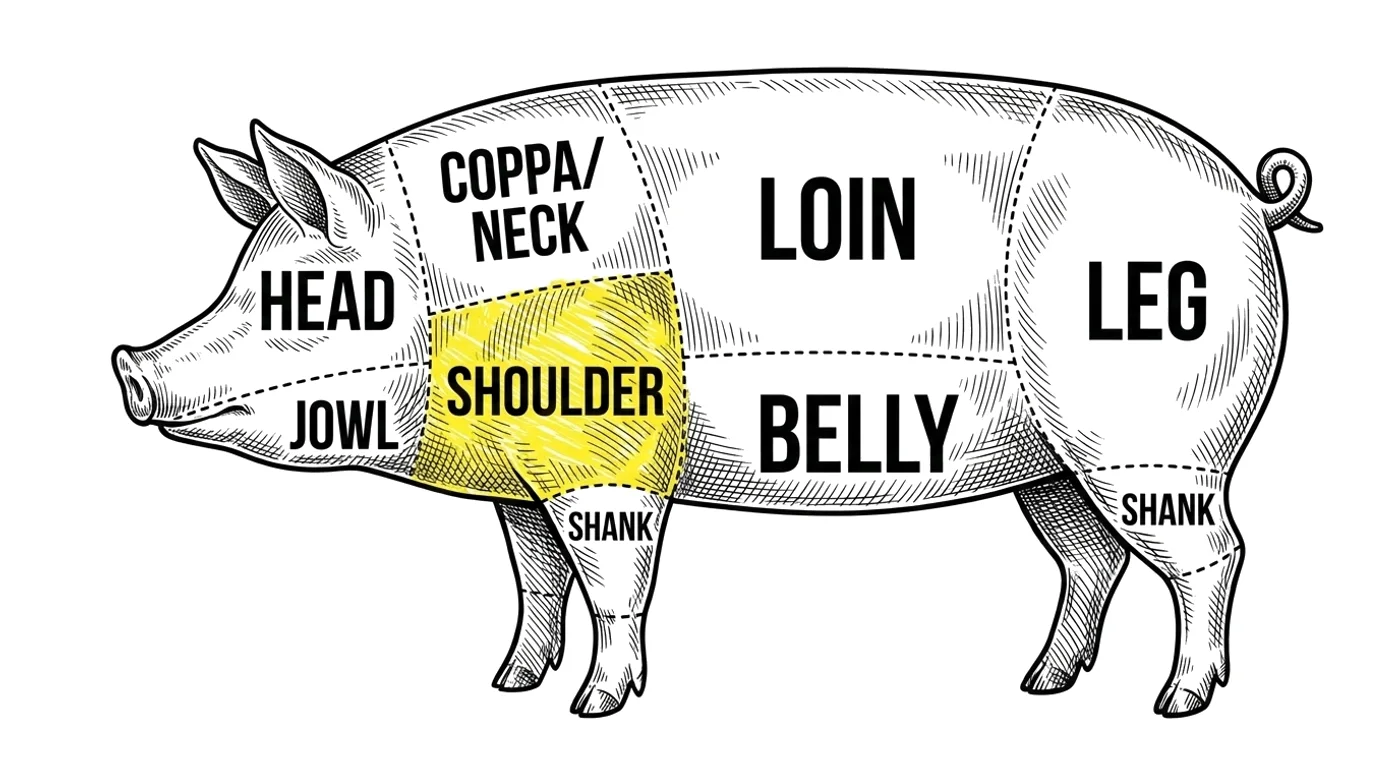
A fine meat batter provides the continuous matrix, while lean meat and back fat remain visible at three to five millimetres. The source branch also uses hock, cheek or head meat and collagen-rich pork trim, materials that increase gelatin, savour and binding when cleanly trimmed. Pepper, paprika and diced garlic give a direct Central European profile. The finished link is intensely smoke-brown, juicy and cohesive, with discernible inclusions but no large coarse cubes or frankfurter-smooth uniformity.
Production and process
Cold binding meat is ground fine and reduced with ice, salt and nitrite cure to a sticky batter. Remaining lean and partly frozen fat are ground to the officially described inclusion size and folded in without smearing. The mass is stuffed into the documented hog-casing calibre, dried under controlled cool air, smoked strongly and cooked to a measured centre. A complete cooling programme is essential because head and connective tissues do not make the product stable at room temperature.
History and regional forms
The official Austrian account records Waldviertler as known since about 1940 and places it within the regional smoked-sausage tradition of north-western Lower Austria. That date supports a twentieth-century documented identity rather than an invented medieval lineage. Variants can appear as straight portions or rings and may alter the balance between beef and pork within the Codex class. The common features are fine batter, visible inclusions, intensive smoke, cooking and the Waldviertler name.
Use, storage and related products
Serve the link hot with bread, mustard or Kren, or beside potatoes, cabbage and other vegetables. Chilled Waldviertler can be sliced for a cold platter. It differs from Saumaise, another Waldviertel speciality, because Saumaise is a caul-wrapped coarse portion rather than a hog-cased Fleischwurst. It also differs from Burenwurst and Waldviertler Hauswürstel through its own Codex class, inclusion size and presentation. Refrigerate after cooking and freeze unused portions.
The recipe for this product is in preparation and will be published once it has been verified.
Safety. Recalculate Cure #1 on the 900 g animal block, retain the official 3–5 mm and 30–32 mm architecture, verify 72°C and chill rapidly.