
Weißkrautwürstchen
Also known as White Cabbage Sausage, German Cabbage-Leaf Sausage Rolls
Germany
Overview
Weißkrautwürstchen in this entry is a historical German preparation of seasoned minced pork wrapped in blanched white-cabbage leaves, browned and braised in gravy. The leaf functions as an edible wrapper, but the dish is closer to a cabbage roll than to a butcher's intestine-cased sausage. Bacon, onion and a butter-flour-stock sauce give the finished parcel a rich savoury character. It is cooked for immediate hot service or chilled as a perishable prepared dish.
Where it's from
The cut
Identity and terminology
The name combines Weißkraut, white cabbage, with Würstchen, little sausages. That wording creates a serious identity trap. North German Kohlwurst or Lungenwurst is a smoked sausage served with cabbage and may contain no cabbage at all. The 1922 recipe cited for this branch instead encloses meat inside cabbage leaves. It must also remain separate from Polish Gołąbki, which commonly includes rice, and French Saucisse de Choux, where chopped cabbage is mixed into a casing-stuffed sausage.
Composition and characteristics
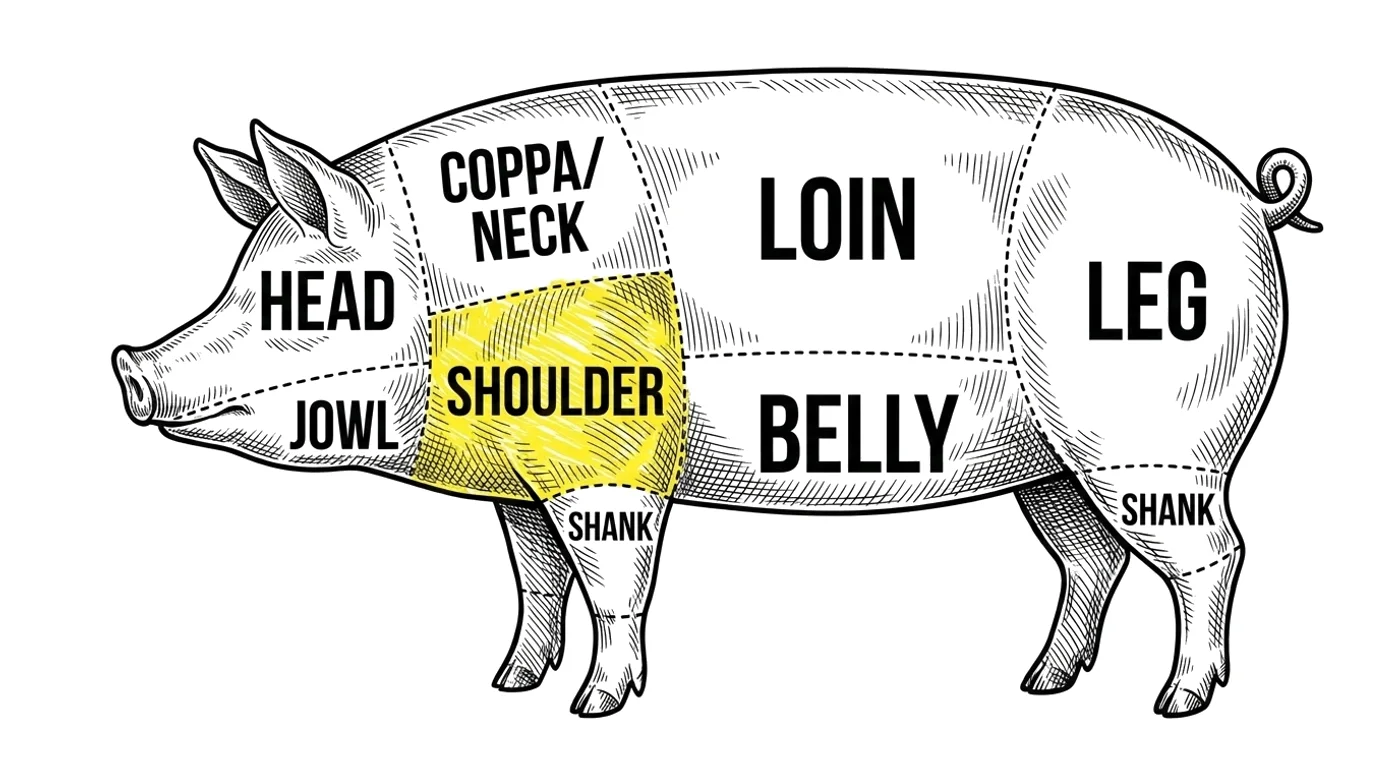
The filling is deliberately simple: pork shoulder provides lean structure, streaky bacon contributes fat and cured-pork depth, and salt and black pepper season it. Flexible blanched cabbage leaves should be drained and trimmed so they fold without tearing. Onion softens in butter, flour thickens the stock and cream rounds the gravy. A finished parcel is compact, browned at the edges and tender enough to cut with a fork, while the cabbage stays intact around a juicy fully cooked centre.
Production and process
Whole leaves are blanched only until pliable, chilled, trimmed and weighed. Cold pork and bacon are prepared as a coarse filling, divided between leaves and tied with food-safe string. The parcels are browned carefully, then braised in a measured gravy until the largest centre reaches the cooked endpoint and the leaves are tender. String is removed before service. When held, parcels and sauce are transferred to shallow containers and cooled rapidly rather than left in the covered braising pot.
History and regional forms
The source attributes the formula to Lina Meier's 1922 English-language Art of German Cooking and Baking, a period cookbook preserved by Cornell University and digitised by the Internet Archive. That establishes an early twentieth-century printed branch, not a universal definition for every German cabbage sausage. Leaf-wrapped meat has many European relatives, so similarities do not prove a single origin. The Atlas keeps the precise historical form and reports the naming ambiguity rather than silently converting it into Kohlwurst.
Use, storage and related products
Serve the parcels hot with their onion gravy, boiled potatoes or bread. Wheat and milk in the controlled gravy must be declared. Weißkrautwürstchen differs from Gołąbki through the absence of grain and tomato sauce, from Saucisse de Choux because cabbage is the wrapper rather than part of the forcemeat, and from smoked Kohlwurst because it is not an intestine-cased sausage. Refrigerate leftovers promptly and reheat only the portion required until steaming hot.
The recipe for this product is in preparation and will be published once it has been verified.
Safety. Replace counted ingredients and leftover gravy with weighed quantities, cook the centre to 71°C, declare wheat and milk, cool rapidly and preserve the Kohlwurst boundary.