
Wiener Wurst (Austrian Slicing Sausage)
Also known as Wiener, Austrian Wiener, Wiener Wurst
Vienna, Austria
Overview
Wiener Wurst is an Austrian Fleischwurst made as a broad slicing sausage, not the slender link called Wiener Würstel. A fine binding batter carries visible pieces of first-quality meat and bacon, normally with a three-to-four-millimetre grain. The sausage is filled into a large smoke-permeable casing, smoked and cooked, then chilled and sliced thinly. Pepper, garlic, mustard, nutmeg, ginger and paprika are characteristic seasoning directions rather than a single immutable spice formula.
Where it's from
The cut
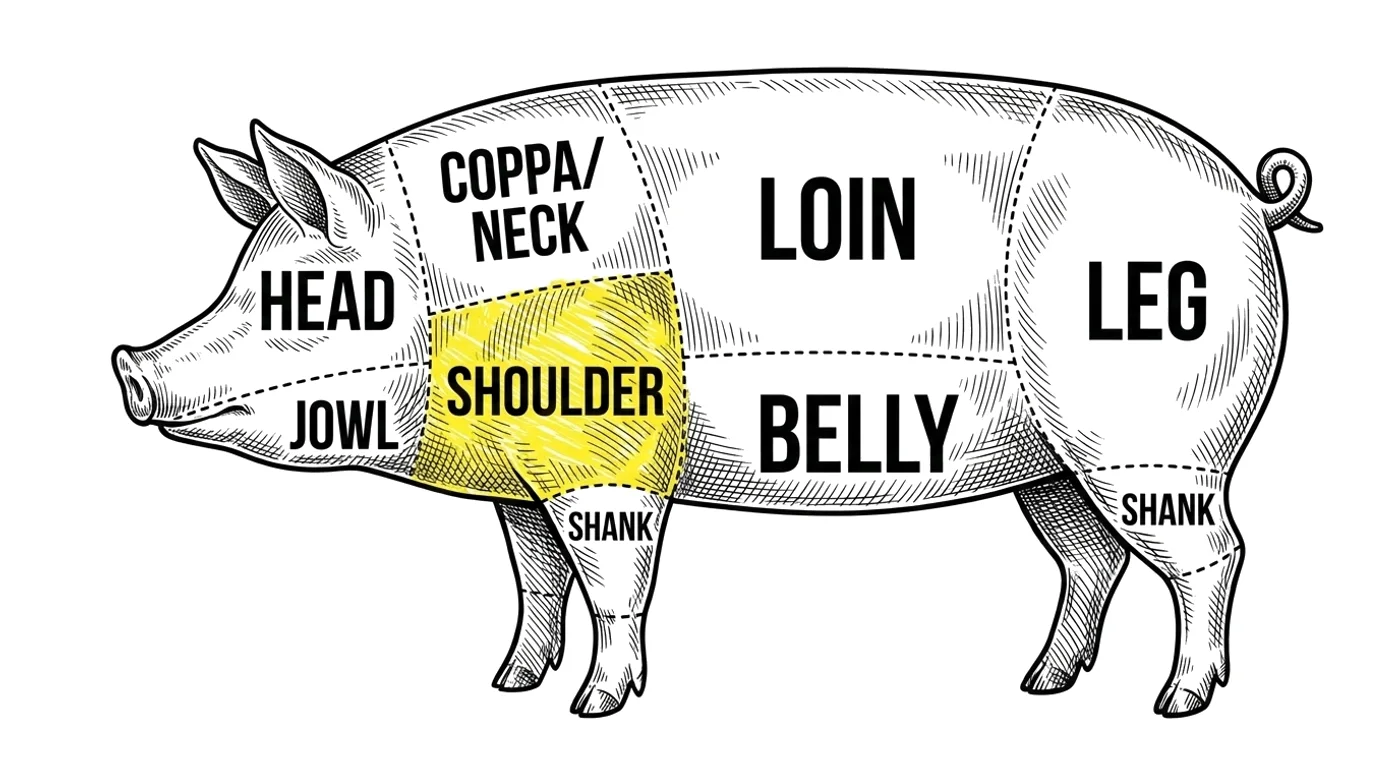
Identity and terminology
The official Austrian Traditional Foods register titles the product Wiener and explicitly warns against confusing it with Wiener Würstchen. In Austrian usage, Wiener Würstel is another name for the small Frankfurter link. Wiener Wurst, by contrast, is a Fleischwurst in a baton with value-defining coarse inclusion and is compared in Germany with Kochsalami. The Atlas uses the expanded title Wiener Wurst (Austrian Slicing Sausage) so both products can coexist without relying on national naming conventions.
Composition and characteristics
The registered model combines first-quality pork or beef, bacon and a fine brät made from additional meat and ice. The visible inclusion supplies the mottled cut face, while the batter binds water and fat into a stable background. A finished slice should be cohesive, lightly smoky and resilient, with clear small pieces rather than the completely homogeneous interior expected of a Wiener Würstel. The broad casing and cold sliced service are primary identification features.
Production and process
Binding meat is finely comminuted with salt, nitrite cure and ice while the show meat and bacon are prepared separately at the defining coarse grain. The two structures are mixed without smearing, stuffed into smoke-permeable casing and dried at the surface. Traditional beech smoke colours and flavours the baton before scalding or hot-air cooking. For the home branch, a probe-confirmed cook, controlled chilling and continuous refrigeration replace historical assumptions about semi-durability.
History and regional development
Austria's register notes that Wiener Wurst was absent from the 1912 Codex and places its recognised emergence between the world wars. The product has been interpreted as a rapidly produced heated counterpart to salami, developed when smoking and drying answered the need for more durable provisions. Longer drying once produced a travel sausage, and later names often invoked hiking or tourism. That historical practice does not establish shelf stability for a modern unvalidated home formula.
Use, storage and related products
Wiener Wurst is usually served cold in thin slices as part of an Austrian Jause or a mixed sausage platter. Its large format and coarse inclusion separate it from Wiener Würstel, Frankfurter and hot dogs. Kochsalami is a close German comparison, while Austrian Dürre and Speckwurst have their own compositional and visual conventions. Keep the cooked baton refrigerated, use clean slicing equipment and protect the exposed surface from post-cook contamination.
The recipe for this product is in preparation and will be published once it has been verified.
Safety. Calculate Cure #1 on the animal block, keep the batter cold, cook to a measured 72°C cold point, cool rapidly and treat the product as refrigerated rather than historically semi-durable.