
Wiener Würstel
Also known as Austrian Frankfurter, Frankfurter, Wiener sausage
Vienna, Austria
Overview
Wiener Würstel is Vienna's slender, finely emulsified sausage of beef and/or pork with bacon, traditionally filled into sheep casing, lightly smoked and scalded. In Austria it is normally ordered as a Frankfurter. In Germany, where Frankfurter Würstchen refers to the pork sausage of Frankfurt am Main, the Viennese mixed-meat link is called Wiener Würstchen. The finished link is pale reddish-pink inside, lightly brown outside and valued for a clean casing snap and mild pepper-and-mace seasoning.
Where it's from
The cut
Identity and terminology
Wiener means Viennese, while Würstel is the Austrian diminutive for sausage. The paired names Frankfurter and Wiener do not map consistently across borders. Austria's Traditional Foods register titles the product Frankfurter (Wiener Würstel) and links it directly to Vienna. German terminology reverses the emphasis to protect the Frankfurt origin name. American labels often use frankfurter, wiener and hot dog interchangeably under federal standards, which describes a product class rather than either European regional history.
Composition and characteristics
The Austrian Codex model permits high-quality beef and/or pork with bacon, drinking water and a small quantity of potato starch. A natural sheep casing gives the expected snap and narrow calibre. White pepper, mace and sometimes garlic produce a discreet aroma. The large proportion of water is technically important: it must be bound into a cold, stable emulsion rather than released as jelly. The cut face is homogeneous and fine, with no coarse pieces or white fat cubes.
Production and process
Lean meat is comminuted first with salt, nitrite cure and ice water to extract protein. Bacon and seasoning are added while the batter remains below 10°C. The emulsion is stuffed into narrow sheep casings, linked in pairs, dried, lightly smoked and scalded. The source's high-temperature smoke is moderated in the Curesmith branch to protect the emulsion and avoid cooking by smoke before the controlled poach. A probe-confirmed 71°C cold point and rapid cooling make the home process executable.
History and regional forms
The Austrian register attributes the Vienna sausage to Johann Georg Lahner, a Frankfurt-trained butcher who began making it in Vienna in 1805. The important technical change was mixing pork and beef, a combination available to him in Vienna but outside the old Frankfurt sausage convention. Street stands, cafés and industrial meat production carried the link across the Habsburg lands and then abroad. Its export success explains why much of the world uses frankfurter for the Viennese form.
Use, storage and related products
Wiener Würstel is warmed in water and served with a bread roll, sweet or sharp mustard, horseradish, ketchup or goulash gravy. It is eaten as a quick snack at Austrian Würstelstände and also appears in home meals. The link differs from German Frankfurter Würstchen through its Vienna identity and mixed-meat allowance, from Fleischwurst through its narrow casing, and from Burenwurst through its fine grain. Refrigeration remains necessary even though it is cured, smoked and fully cooked.
Recipe and cure
This is not a finished recipe. It is a window into how this meat is traditionally cured. Before you follow any process, run it through one of our curing calculators so the salt, cure and timings are right and safe for your own batch.
Make this — the measured Curesmith version →“Make this” opens the same cure as a measured recipe, scaled to your batch.
- Meat
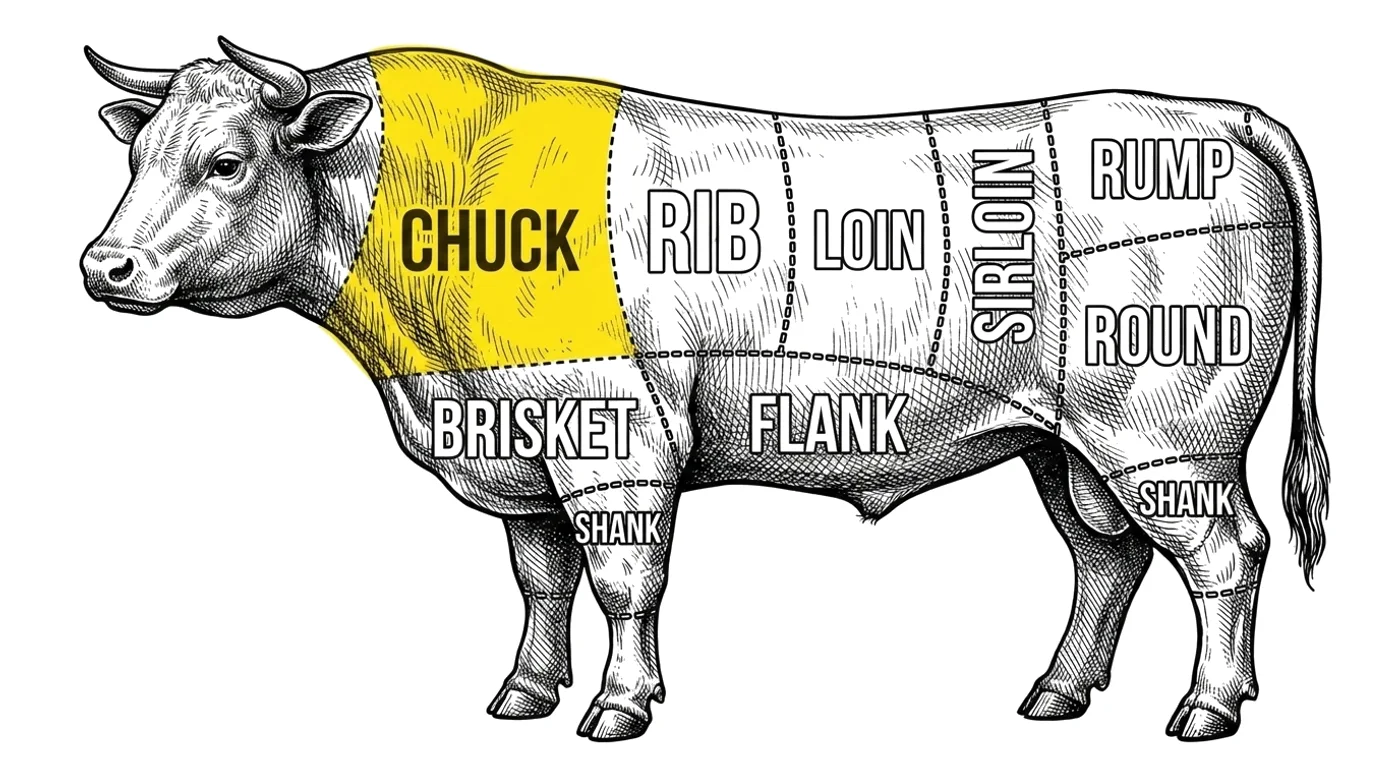
- Lean beef chuck
- Cut
- Lean beef chuck
- Salt (%)
- 2.2
- Curing salt
- Cure #1 as specified in the recipe
- Fermented
- No
- Starter or mould
- None; this product is not fermented
- Smoked
- Yes
- Maturation
- Refrigerate at 0–4°C; use within 4 days after opening or freeze promptly
- Basis
- per 1,000 g lean beef chuck
- Style
- fine cured, lightly smoked and scalded Viennese sausage
Ingredients
- Lean beef chuck100% · 1000 g
- Lean pork shoulder70% · 700 g
- Skinless pork belly100% · 1000 g
- Ice water48.9% · 1320 g
- Fine salt2.2% · 60 g
- Cure #1, 6.25% sodium nitrite0.25% · 6.5 g
- White pepper0.15% · 4 g
- Ground mace0.07% · 2 g
- Fresh garlic, crushed0.37% · 10 g
Method
- Trim, weigh and chill meat, fat, water and equipment to 0–2°C.
- Grind lean meat and belly separately through 5 mm and chill again.
- Fine-process the lean meat with salt, cure and ice water, then add belly and spices without exceeding 10°C.
- Stuff firmly into 24 mm sheep casings formed as 18–20 cm links, remove air pockets and close securely.
- Dry at controlled warm-smoke conditions, then apply light beech smoke at 55–60°C.
- Poach or steam gently until the cold point reaches 71°C.
Safety. Keep the batter cold, use measured cure, cook to 71°C, cool rapidly and store at 0–4°C.