
Wild Boar Sausage
Also known as Boar sausage, Wild hog sausage
Generic
Overview
Wild Boar Sausage is an ingredient-defined family rather than one geographically fixed recipe. Its central feature is meat from wild Sus scrofa, usually balanced with domestic pork or pork fat because hunted boar can be much leaner and more variable than commercial pork. This Curesmith branch is a juniper-seasoned, smoked and fully cooked sausage with a dark red-brown slice and a firm, coarse bite.
Where it's from
The cut
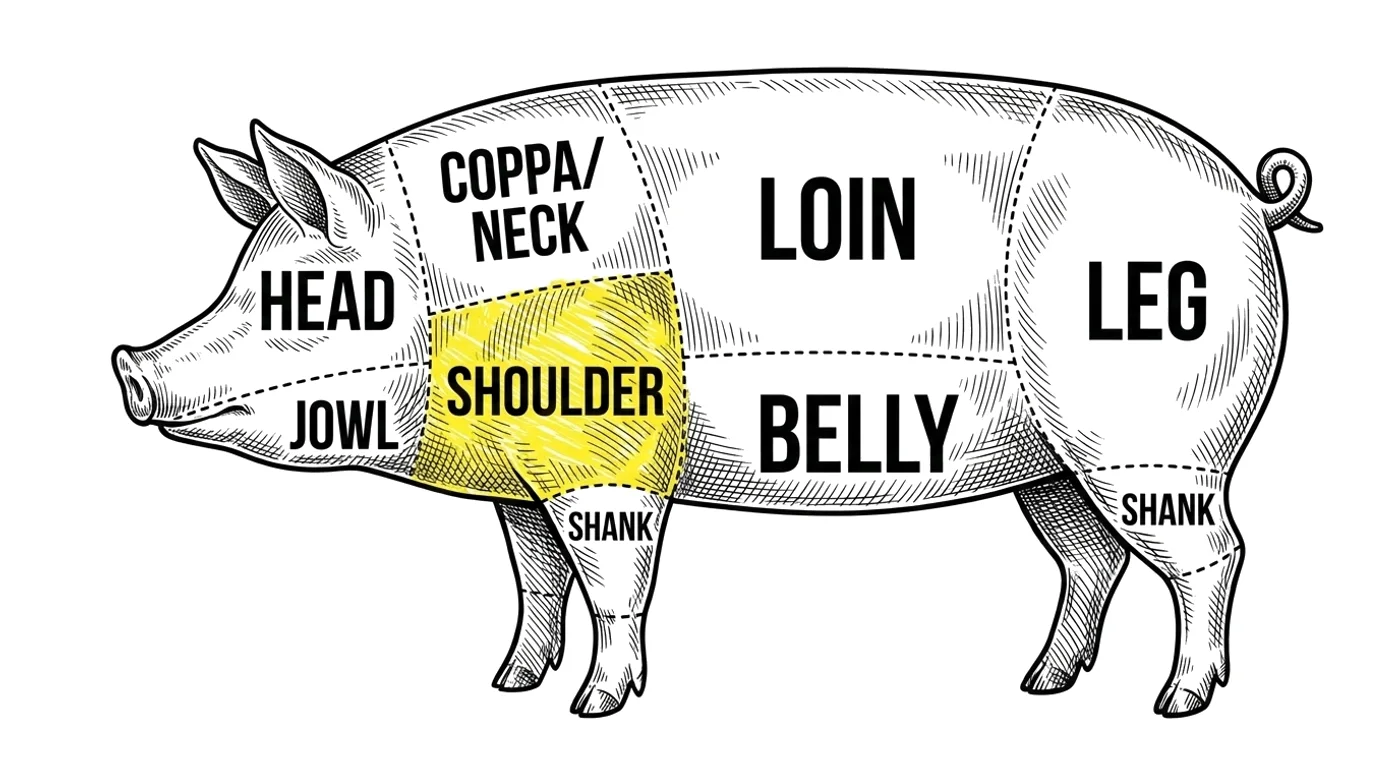
Identity and terminology
The name describes the animal source, not a protected place or a single national tradition. In Europe, wild boar normally means hunted or managed Sus scrofa. North American labels such as wild hog or feral pig may cover animals with differing domestic ancestry, so species, provenance and inspection status matter more than a romantic game label. Fresh, cooked-smoked and dry-fermented products can all be called wild boar sausage; the process class must therefore accompany the name.
Composition and characteristics
Wild boar meat is generally darker and less uniformly fatty than pork, but age, sex, season and diet create substantial variation. Controlled sausage trials have found that combining boar meat with domestic pig fat can improve texture and overall acceptability. In the cooked version, clean back fat softens the dense game meat while juniper, garlic and smoke reinforce its resinous, savoury character without masking spoilage or strong boar taint.
Production and process
Sound production begins with legally sourced, inspected game and the applicable Trichinella-control route. Lean boar and domestic pork are ground cold with firm fat, mixed to a proper protein bind, cured for the short cooked process, stuffed and surface-dried before smoking. The sausage is then heated throughout and chilled quickly. Neither smoke nor a cured colour proves that game meat has received an adequate parasite and bacterial lethality step.
History and regional forms
Turning hunted boar into sausage is a practical response to a carcass that yields abundant lean trim, but the practice has no defensible single inventor or birthplace. European hunting regions produce fresh links, cooked smoked sausages and mature salami, with local choices of juniper, wine, garlic, paprika or pepper. Comparable sausages are made from feral hogs in North America. Modern outbreak investigations also show why raw or lightly processed homemade game sausage cannot be treated as safe merely because it is traditional.
Use, storage and related products
A fully cooked wild boar sausage can be sliced cold for a game-meat board, warmed gently with lentils or cabbage, or browned on a grill without prolonged cooking. It remains a refrigerated ready-to-eat product. Fresh wild boar sausage must instead be cooked by the consumer, while fermented wild boar salami requires a separate validated acidification and drying system. Those forms are related by meat source but are not interchangeable.
Recipe and cure
This is not a finished recipe. It is a window into how this meat is traditionally cured. Before you follow any process, run it through one of our curing calculators so the salt, cure and timings are right and safe for your own batch.
Make this — the measured Curesmith version →“Make this” opens the same cure as a measured recipe, scaled to your batch.
- Meat
- Wild boar hind-leg and shoulder meat, fully trimmed
- Cut
- Wild boar hind-leg and shoulder meat, fully trimmed
- Salt (%)
- 1.8
- Curing salt
- Cure #1 as specified in the recipe
- Fermented
- No
- Smoked
- Yes
- Maturation
- 0–4°C; consume within 5 days or freeze
- Basis
- per 1,000 g wild boar hind-leg and shoulder meat, fully trimmed
- Style
- cured smoked cooked wild-game sausage
Ingredients
- Wild boar hind-leg and shoulder meat, fully trimmed100% · 1000 g
- Pork shoulder, approximately 20% fat50% · 500 g
- Pork back fat15% · 150 g
- Fine salt1.8% · 30 g
- Cure #1, 6.25% nitrite0.24% · 4 g
- Ground black pepper0.2% · 3.5 g
- Dried juniper berries, finely crushed0.2% · 3.5 g
- Fresh garlic, finely minced0.35% · 6 g
- Ice-cold water10.1% · 166.5 g
Method
- Use only meat that has passed the legally applicable game-inspection and Trichinella-control route. Remove shot-damaged, bruised or contaminated tissue.
- Chill the meat and fat until firm. Grind wild boar and shoulder through 10 mm and back fat through 8 mm.
- Mix meat, fat, salt, Cure #1, pepper, juniper and garlic while adding the ice water. Continue until the mass is tacky and cohesive.
- Stuff firmly into hog casings, expel air and form 25–30 cm links.
- Hang under refrigeration until the casing surface is dry and tack-free.
- Apply warm smoke at 54–60°C, then raise the chamber gradually to finish cooking.
Safety. Wild boar carries a material Trichinella risk. Use inspected meat and the applicable testing route, prevent cross-contamination and apply a measured full cook. Curing, smoking, drying and freezing alone are not reliable substitutes.