
Overview
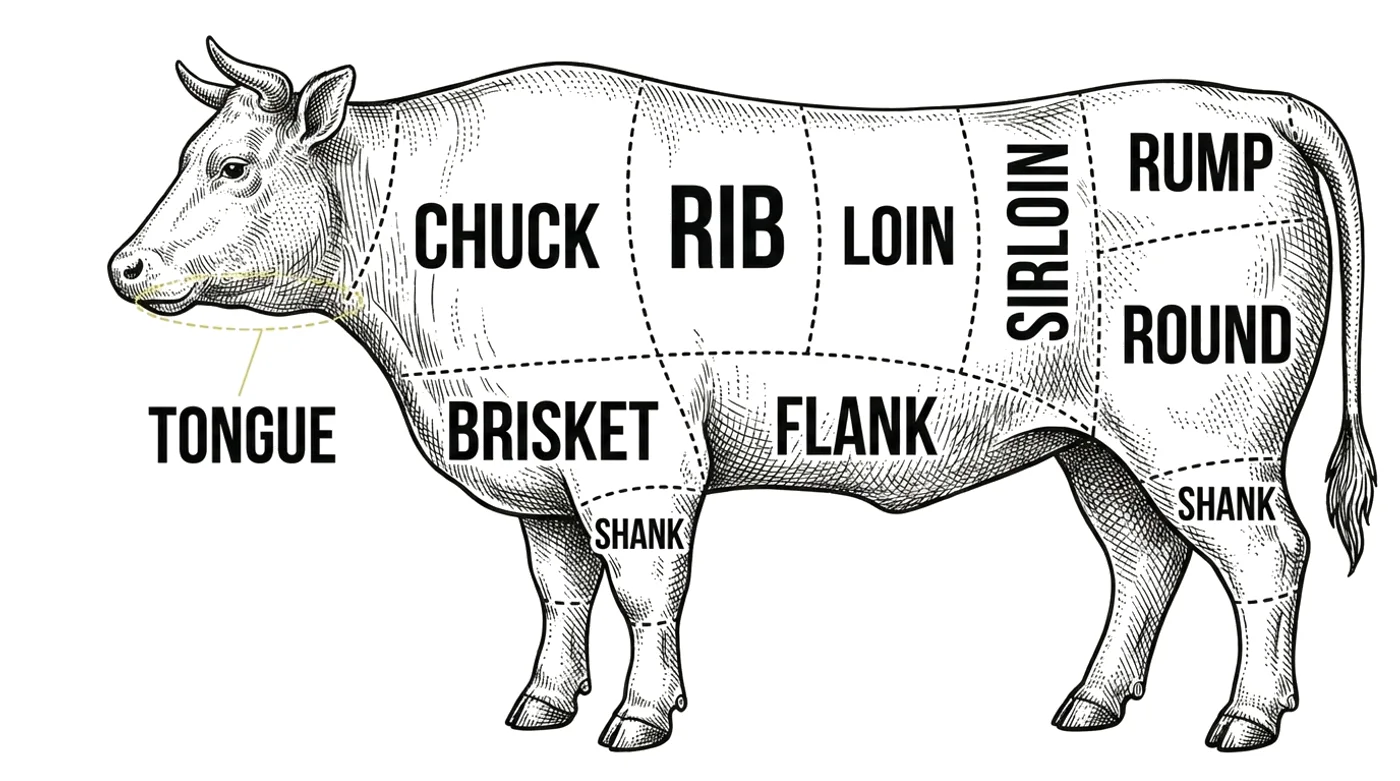
Zungenwurst is a German and Austrian cooked-sausage family defined by conspicuous pieces of cured tongue set within a cooked matrix. Many familiar forms are blood sausages, especially Blutzungenwurst, but the broader name can also cover non-blood tongue sausages. It is a family, with distinct national and compositional branches.
Where it's from
The cut
Identity and terminology
Zunge means tongue and Wurst means sausage. The term should not automatically be translated as blood-and-tongue sausage because blood is not universal to every branch. German and Austrian food codes distinguish sliceable cooked sausages by their matrix, inclusion level and analytical character. Blutzungenwurst is a qualified branch, not a blanket synonym.
Composition and characteristics
The identifying feature is large, pale-red or pink pieces of peeled, cured tongue visible against a darker surrounding matrix. In blood forms, the matrix is deep red-brown and may contain fat or rind material; non-blood versions are lighter. The sausage is firm, sliceable and normally made in a broad casing or mould.
Production branches
Tongues are separately cleaned, cured, cooked and peeled before incorporation. The surrounding cooked-sausage mass may be blood-based or built from meat, fat, rind and broth. Austrian traditional guidance sets a substantial tongue proportion for named blood-tongue forms. Assembly must distribute the inclusions evenly before the final cook, cooling and refrigerated holding.
History and cultural context
Zungenwurst belongs to the Central European cooked-sausage tradition in which valuable slaughter components were preserved in structured, sliceable products. Tongue became a premium visible inclusion rather than a hidden offal ingredient. Regional butchery codes later formalised the distinctions between tongue, blood, liver and spreadable cooked sausages, preserving recognisable product classes.
Culinary use and relationships
It is served cold in thin or moderate slices with bread, mustard, pickles and other cold-cut accompaniments. Related entries include Blutwurst, blood sausage, head cheese and cooked liver sausages. A slice showing distinct tongue pieces is essential to the identity; a homogeneous blood sausage with no visible tongue belongs elsewhere.
Recipe and cure
This is not a finished recipe. It is a window into how this meat is traditionally cured. Before you follow any process, run it through one of our curing calculators so the salt, cure and timings are right and safe for your own batch.
Make this — the measured Curesmith version →“Make this” opens the same cure as a measured recipe, scaled to your batch.
- Meat
- Cooked, peeled beef tongue, diced
- Cut
- Cooked, peeled beef tongue, diced
- Salt (%)
- 1.8
- Curing salt
- Cure #1/#2 as specified
- Fermented
- No
- Smoked
- No
- Basis
- 1,000 g prepared filling
- Style
- Cooked blood-sausage branch with visible cured tongue.
Ingredients
- Cooked, peeled beef tongue, diced100% · 1000 g
- Food-grade defibrinated pig blood100% · 1000 g
- Cooked pork rind85% · 850 g
- Pork back fat, blanched50% · 500 g
- Fine salt1.8% · 60 g
- Cure #1 containing 6.25% sodium nitrite0.25% · 8.5 g
- Black pepper0.2% · 6.5 g
- Ground allspice0.1% · 3.5 g
- Marjoram0.15% · 5 g
- Onion powder0.1% · 3.5 g
Safety. Tongue and blood must come from inspected edible material and remain under strict cold control. Each component requires an appropriate cook before or during assembly, followed by validated final lethality, rapid cooling and refrigeration. Large inclusions can create cold spots, so the final process must be assessed at the slowest-heating point.