
Cure note · 9 June 2026
Microclimate in Dry Curing: Temperature, Humidity, Control
Microclimate is the environment that makes dry curing safe. Learn the right temperature, humidity, and air exchange for your chamber, and the mistakes that ruin months of work.
Watch the Episode
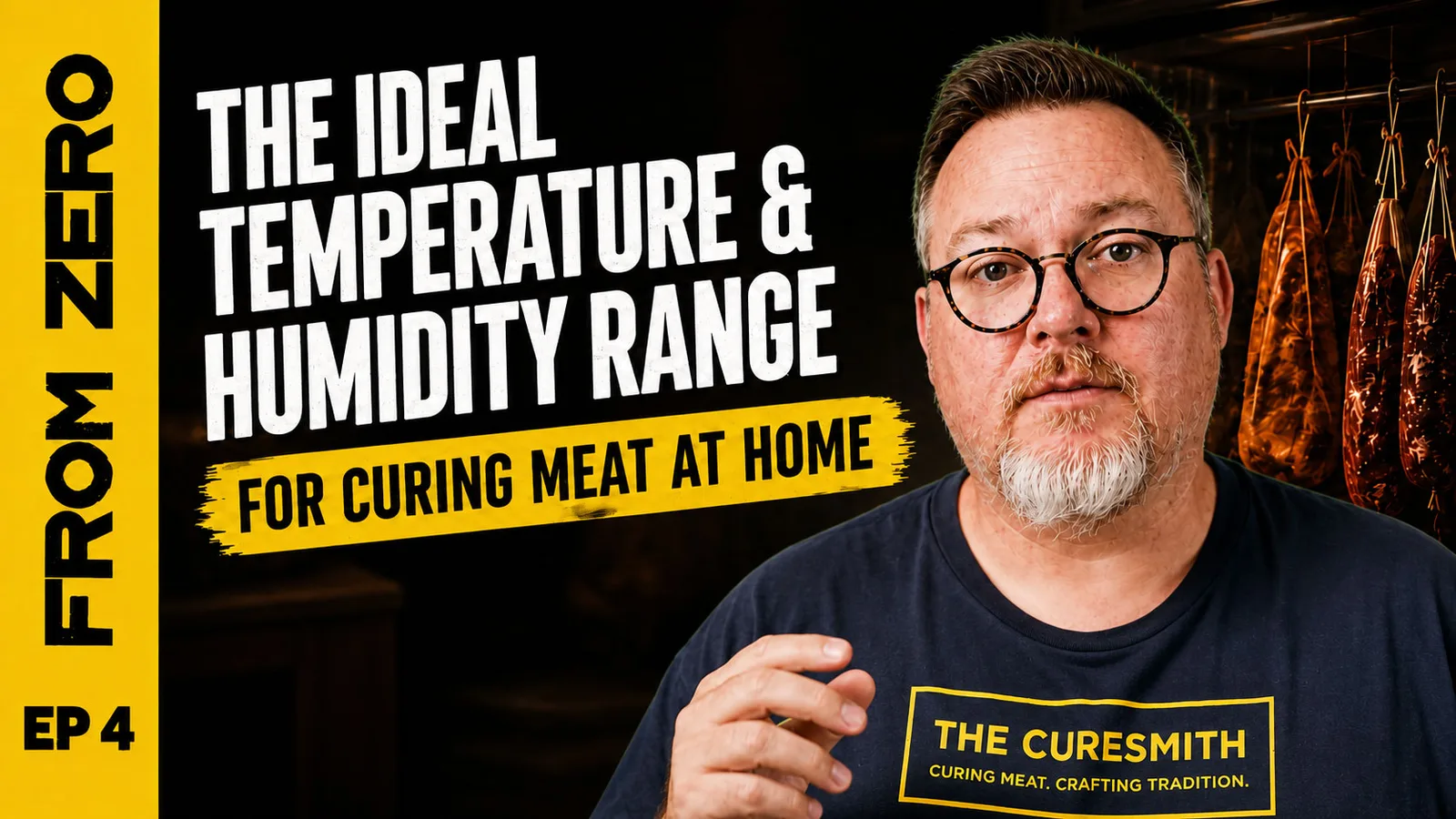
Episode 4 of From Zero covers all of this in depth: the cave lesson, the microbial temperature table, the curing-vs-maturing distinction, case hardening on camera, the humidity window, the fan debate with the full volume calculations, and the exceptions.
What Is Microclimate in Dry Curing?
Microclimate is the small, specific, controlled environment immediately around the meat as it cures.
Not the climate outside. Not the season. Not whether it is hot or cold in the kitchen. The precise combination of temperature, relative humidity, and air exchange in the space where the meat actually hangs.
In the Curesmith’s Temple, the framework that structures this series, Microclimate is the second corner of the Safety Triangle, the Roof that sits at the top of the Temple. The first corner is Water Activity, covered in Episode 3. The third corner is pH, coming in Episode 5.
These three corners work together. Water Activity is the primary preservation variable in dry curing: reducing the free water available to microbial life is what makes a cured product safe to eat over time. But Water Activity cannot fall properly without the right Microclimate around the product. The environment controls whether moisture moves out of the meat slowly and evenly, or quickly and unevenly in ways that cause serious problems.
Microclimate is not a stand-alone safety guarantee. It is one corner of the Roof, working alongside the others.
Curing and Maturing Are Not the Same Phase
Before anything else, it is worth drawing a distinction that many beginners miss, and that causes real problems when it is missed.
Curing and maturing are not the same thing. They happen in sequence. They require different conditions.
Curing is the salting phase. Salt is applied according to a formula, penetrates the muscle, draws out free water, and begins the reduction of Water Activity. This phase belongs in the refrigerator, in the range of 4 to 7 degrees Celsius. As close to 4 degrees as the refrigerator allows.
One point about the curing phase that is worth stating plainly: relative humidity plays no role here. The meat is sealed, either vacuum-packed or in a covered container. The ambient humidity of the refrigerator has no meaningful contact with the product surface. Do not be concerned about the humidity reading inside your fridge during the cure. It is irrelevant at this stage.
Maturing is what happens after the salting is complete. The meat needs to continue losing moisture slowly and evenly over an extended period. This phase requires a different environment entirely, and a domestic refrigerator cannot provide it.
Why a Normal Fridge Cannot Mature Meat Properly
A domestic refrigerator is designed to keep food cold. It is not designed to allow controlled, even drying over weeks or months.
The refrigeration cycle removes moisture from the air inside the cabinet as a byproduct of cooling. The result is air that is cold and very dry. In that environment, the outer surface of the meat dries rapidly, far faster than the interior can release moisture. The outside hardens. And when the outside hardens, it closes off the surface in a way that traps moisture inside the product rather than allowing it to migrate outward and evaporate.
This is case hardening, and it is one of the most damaging failures in home dry-curing.
Case hardening is particularly insidious because the exterior of the product can appear perfectly fine while the interior is in serious difficulty. The outer layer forms a hard, tight crust. Beneath it, the remaining free water cannot escape. In mild cases the result is a dense, uneven texture and poor flavour development. In severe cases, the trapped moisture creates the conditions for spoilage to begin inside the product while the outside looks acceptable.
Here is the part that catches many people out. A product can show the correct weight loss on the scale and still be case-hardened. The scale measures total weight. It cannot tell you whether that weight was lost evenly, or whether the outside dried while the inside was left behind.
The goal of dry curing is not to create a dry shell around a wet core. It is to reduce moisture evenly throughout the entire piece. That requires a controlled maturing environment, not a standard fridge.
The Right Temperature for Maturing
The accepted range for maturing dry-cured meats is broadly 8 to 18 degrees Celsius.
The popular, widely accepted working range within that is 10 to 14 degrees, and that is where most home-curing guidance will direct you. For a standard home chamber setup, 12 to 14 degrees is the commonly accepted working target. It sits in the conservative centre of the accepted range: not so cold that drying stalls for most products, not warm enough to place unnecessary pressure on the other safety hurdles.
Above 14 to 16 degrees, the pressure on the multi-hurdle system starts to increase. Microbial activity becomes more active, and the other hurdles, salt, reduced Water Activity, hygiene, have to compensate. For large whole-muscle cuts, particularly anything with a bone through the centre, temperatures above this range are not a risk worth taking. Above 18 degrees, the risk profile changes significantly for most products. That is not a safe working temperature for home maturing.
Temperature also affects the microbial organisms we are most concerned about. Most of the key pathogens in dry-cured meat, including Salmonella, Clostridium botulinum, Staphylococcus aureus, and Campylobacter, grow best at or near body temperature. Moving the meat well below that range slows their activity significantly. But it does not stop it entirely. Listeria monocytogenes can grow at minus 0.4 degrees Celsius. Non-proteolytic Clostridium botulinum can grow from around 3 degrees. Refrigeration is a slowing mechanism, not a kill step.
This is why temperature must always be understood as one part of a multi-hurdle system. It slows microbial activity. It buys time for the other hurdles to do their work. It does not make a product safe on its own.
Cold Maturation: A Direction Worth Knowing
There is a practice that most home-curing guides do not cover, and that deserves attention.
Some experienced curers mature at temperatures between 3 and 8 degrees Celsius, what can be called cold maturation. Curers with decades of experience report that the quality of the finished product is superior at these lower temperatures: finer texture, more complex and restrained flavour, a cleaner result overall.
The science behind this is real. Flavour development in dry-cured meat is driven primarily by two groups of enzymatic processes. Proteolysis is the gradual breakdown of muscle proteins by naturally occurring enzymes, producing the small peptides and free amino acids that are the direct precursors of flavour. Lipolysis is the breakdown of fats by lipases, producing free fatty acids and volatile compounds that contribute to aroma. Both processes are temperature-sensitive. Lower temperatures slow them, but what they appear to produce over a longer maturation time is more controlled and even enzymatic activity, with less risk of the accelerated breakdown that can produce off-flavours at higher temperatures.
The tradeoff is time. A product maturing at 13 degrees in four months may need eight months or more at 5 degrees to reach an equivalent state of development.
There is also a practical equipment benefit. A domestic refrigerator is built to operate between roughly 3 and 7 degrees. When a temperature controller is added to hold the chamber at 12 to 14 degrees, the fridge is working against its own design. Over time, this places additional strain on the compressor motor. At cold maturation temperatures, no controller is needed. The fridge operates within its designed range without modification, which also reduces the likelihood of needing a dehumidifier, since colder operating temperatures reduce the humidity load inside the chamber.
Cold maturation is not where you start. The standard range of 12 to 14 degrees is the sensible beginning. But once you understand how your chamber and your products behave, it is a direction worth exploring.
Humidity: The Most Underestimated Variable
If temperature is the variable most beginners think about, humidity is the one most beginners underestimate.
The instinct is understandable. Dry curing is about removing moisture, so surely a drier environment is better. That instinct is wrong.
The outer surface of the meat must stay open long enough for moisture from the interior to migrate outward. If the surface dries too quickly, that migration is blocked. If the air is too humid, moisture cannot leave the surface at all and drying stalls. The maturing environment needs to allow drying without forcing it.
The accepted range for relative humidity in a dry-curing maturing environment is 65 to 80 percent. A preferred working average is 73 percent.
Below 70 percent, the surface of the meat begins to dry more aggressively. Below 65 percent, the risk of case hardening increases meaningfully.
Above 80 percent, drying slows substantially, the surface of the meat may remain wet for extended periods, and uncontrolled mould pressure increases. Not all mould in a curing environment is undesirable; in some long-aged products, a controlled white mould on the surface is part of the normal maturation process. The concern above 80 percent is specifically the rapid, uncontrolled growth of moulds that indicate the chamber is simply too wet to allow safe drying.
If ever forced to choose between slightly too wet and slightly too dry, err toward slightly too wet. Excess surface mould can be wiped with a cloth dampened in a light brine solution. A case-hardened product is far more difficult to rescue.
To measure relative humidity accurately, two electronic hygrometers are better than one. The conventional advice to use one electronic sensor and one analogue as a cross-check is no longer reliable. Analogue hygrometers can carry an inaccuracy of up to 10 percent, which is too large a margin when the acceptable humidity window is only 15 percentage points wide. A dedicated data logger, a standalone electronic sensor that records temperature and humidity continuously and sends data to your phone, is the most useful second instrument.
All hygrometers lose accuracy over time and should be calibrated at least every six months. The standard home method is the saturated salt solution test: wet table salt to a damp sandy consistency in a small container, place it sealed in an airtight container with the hygrometer for 48 hours, and the reading should settle at 75 percent relative humidity. Adjust the sensor calibration offset accordingly.
Air Exchange Is Not the Same as Airflow
Of the three variables that make up the home-curing microclimate, air exchange is the most commonly misunderstood, and the misunderstanding carries real consequences.
Air exchange and airflow are not the same thing.
Air exchange is the replacement of the stale air inside your chamber with fresh air from outside it. Over time, a closed maturing chamber accumulates carbon dioxide from natural microbial activity on the surface of the meat. Fresh air restores the balance. This is the renewal a chamber genuinely needs, and it is almost certainly already happening when you open the door daily or every other day to inspect the meat.
Airflow is the directed movement of air across the product surface. This is what causes case hardening.
In still air, a thin layer of humid air naturally forms at the meat surface. That layer moderates evaporation, limiting it to roughly the rate at which the meat can release moisture from the interior. Directed airflow strips that protective layer continuously, driving surface evaporation beyond what the interior can sustain.
No fan belongs in a home curing chamber. The advice to add a fan appears widely online and it is not wrong in its original context: commercial curing rooms can be 150 cubic metres or larger, and in a space of that scale, mechanical air management is necessary to prevent dead zones. A home chamber holds between 1 and 2.4 cubic metres. In that space, temperature variation between the top and bottom is typically 0.3 to 0.5 degrees, and humidity variation might be 1 to 2 percent. Neither of those differences will change the outcome of a cure. A standard 80mm computer fan moves approximately 55 cubic metres of air per hour, turning over the entire volume of a 1 cubic metre fridge 55 times every hour. The problem a fan exists to solve does not exist in a home chamber. The problem it creates is very real.
To check whether any unwanted airflow is reaching your product, use the paper strip test. Hang a light strip of paper or thread at meat level inside the chamber, close the door, and let the chamber run normally. If that paper moves, there is meaningful airflow at product level. Find the source and eliminate it.
The Microbial Growth Temperature Table
| Organism | Minimum (°C) | Optimum (°C) | Maximum (°C) |
| Salmonella | 7 | 35–37 | 45 |
| Clostridium botulinum, proteolytic | 10 | 37 | 48 |
| Clostridium botulinum, non-proteolytic | 3 | 26–30 | 45 |
| Clostridium perfringens | 12 | 44–49 | 50 |
| Staphylococcus aureus | 6 | 37 | 48 |
| Campylobacter jejuni | 30 | 42 | 45 |
| Listeria monocytogenes | -0.4* | 37 | 45 |
| Escherichia coli O157:H7 | 7 | 37 | 46 |
| Shigella | 7 | 35–37 | 47 |
| Bacillus cereus | 4 | 30–37 | 50 |
** Cited minimum per ICMSF (1996). Some experimental strains have shown growth at lower temperatures under research conditions.*
Sources: FDA Bad Bug Book, 2nd Edition (2012); FDA Fish and Fishery Products Hazards and Controls Guidance, Appendix 4; ICMSF (1996).
The Home Curer’s Working Targets
| Phase | Parameter | Target |
| Curing | Temperature | 4°C to 7°C |
| Maturing (standard) | Temperature | 10°C to 14°C |
| Maturing (cold) | Temperature | 3°C to 8°C |
| Maturing | Relative humidity | 65% to 80%, preferred average 73% |
| Maturing | Air exchange | Open door daily or every other day. No fan. |
Frequently Asked Questions
What is the ideal temperature for a meat curing chamber? For the maturing phase, the commonly accepted working range is 10 to 14 degrees Celsius, with 12 to 14 degrees as the practical home chamber target. The curing phase belongs in a standard refrigerator at 4 to 7 degrees. Above 18 degrees is not a safe working temperature for home maturing. Cold maturation between 3 and 8 degrees is also practiced by experienced curers and is associated with superior flavour development over longer timelines.
What humidity should a curing chamber be? The accepted range for relative humidity in a dry-curing maturing chamber is 65 to 80 percent. A reliable working average is 73 percent. Below 65 percent, the risk of case hardening increases. Above 80 percent, drying slows and uncontrolled mould pressure increases. Relative humidity plays no role during the curing phase, when the meat is sealed, and need not be monitored at that stage.
What is case hardening in dry curing? Case hardening is when the outer surface of a dry-cured product dries too quickly and forms a hard, tight crust before the interior has had time to release moisture evenly. Moisture becomes trapped inside, creating the conditions for spoilage even though the outside looks fine. It is caused by humidity that is too low, by direct airflow across the product, or by curing in a standard refrigerator without humidity control. A product can show correct weight loss on the scale and still be case-hardened.
Can I use a normal fridge to cure meat? A standard domestic refrigerator is appropriate for the curing phase, where sealed meat sits at 4 to 7 degrees Celsius. It is not appropriate for maturing. The refrigeration cycle removes moisture from the air as a byproduct of cooling, creating conditions that are too dry and cause case hardening. Maturing requires a dedicated chamber where temperature and relative humidity are controlled together.
What is the difference between curing and maturing meat? Curing is the salting phase, where salt penetrates the meat, draws out free water, and begins the reduction of Water Activity. This phase is done in the refrigerator at 4 to 7 degrees. Maturing is the extended drying and flavour development phase that follows. It requires a dedicated environment with controlled temperature, typically 10 to 14 degrees, and controlled relative humidity, typically 65 to 80 percent.
Why does humidity matter in dry curing? Humidity controls the rate at which the outer surface of the meat dries. If humidity is too low, the surface dries too quickly, trapping moisture inside and causing case hardening. If humidity is too high, moisture cannot leave the surface and drying stalls. The maturing environment needs humidity high enough to keep the surface open for even, gradual drying, but not so high that the process stalls. The working range of 65 to 80 percent balances both risks.
Do I need a fan in my curing chamber? No. A fan is not needed and can actively cause harm in a home chamber. Commercial curing rooms use fans to manage dead zones in large spaces, but in a home chamber of 1 to 2.4 cubic metres, temperature and humidity variation are within the natural tolerance of the process. Directing airflow at the product surface accelerates surface drying and causes case hardening. Air exchange, which is what the chamber genuinely needs, happens naturally when the door is opened daily to inspect the meat.
Do I need a dehumidifier in my curing chamber? Not necessarily. A dehumidifier is justified in two specific situations: a chamber in a very high ambient humidity environment, or an older refrigerator with an evaporator plate causing condensation at maturing temperatures. In a frost-free refrigerator in a moderate climate, a dehumidifier is usually not needed. Before adding any equipment to a curing chamber, ask what specific problem it solves and whether it creates a larger problem than the one it addresses.
Go Further
Every week, the Curesmith newsletter covers one substantive idea from more than twenty years of curing practice. Sometimes it is a deeper exploration of a corner of the Safety Triangle. Sometimes it is a diagnostic question, a case study from the chamber, or a closer look at one of the Temple Pillars.
If that sounds useful, sign up at thecuresmith.com.
EPISODE RESEARCH NOTES AND SOURCES
Primary Source Documents
Curesmith book chapter: Microclimate, Temperature and RH (Gilbert Ferreira, unpublished)
The Curesmith, Curing Questions Answered, Episode 1: Do You Need a Fan in Your Curing Chamber? (Production Document, 2026)
ChatGPT working draft: The Invisible Climate That Cures Meat (used as narrative reference, May 2026)
Cited References
FDA. Bad Bug Book: Foodborne Pathogenic Microorganisms and Natural Toxins Handbook, 2nd Edition. 2012. https://www.fda.gov/food/foodborne-pathogens/bad-bug-book-second-edition
FDA. Fish and Fishery Products Hazards and Controls Guidance, Appendix 4. https://www.fda.gov/food/seafood-guidance-documents-regulatory-information
ICMSF. Microorganisms in Foods 5: Microbiological Specifications of Food Pathogens. Blackie Academic & Professional, 1996.
Toldrá, F. and Flores, M. Proteolysis and Lipolysis in Flavour Development of Dry-cured Meat Products. Meat Science, 49(S1), 1998.
Toldrá, F. The role of muscle enzymes in dry-cured meat products with different drying conditions. Trends in Food Science and Technology, 17(3), 2006.
Marianski, S. and Marianski, A. Home Production of Quality Meats and Sausages. Bookmagic LLC, 2010.
University of Wisconsin–Madison, Center for Meat Process Validation. Principles of Preservation of Shelf-Stable Dried Meat Products, 2005. https://meathaccp.wisc.edu
Food Safety Authority of Ireland. Guidance Note 33: Good Manufacturing Practices for the Production of Ready-to-eat Raw Fermented Meat Products. FSAI, Dublin, 2018.
Clemente, G. et al. Drying modelling of defrosted pork meat under forced convection conditions. Meat Science, 88(3), 374–378, 2011.
Petrova, I. et al. Manufacture of dry-cured ham: A review. Part 2. Drying kinetics, modelling and equipment. European Food Research and Technology, 241(4), 447–458, 2015.
Simal, S. et al. Simulation of the drying curves of a meat-based product: effect of the external resistance to mass transfer. Journal of Food Engineering, 58(2), 193–199, 2003.
Production Reminders
- The Curesmiths Temple animated asset must open Episode 4 with the Microclimate corner highlighted. It must close the episode with all three Safety Triangle corners on screen simultaneously, signalling that Episode 5 completes the Roof.
- The microbial growth temperature table must be animated with the same visual language and brand palette as the aW threshold table from Episode 3.
- The case hardening cross-section demonstration is the single most important visual in this episode. If a real product cross-section is available, use it.
- The paper strip test should be demonstrated on camera. Simple, practical, and immediately replicable.
- Cross-reference the Curing Questions Answered Episode 1 (fan in the chamber) explicitly, with a visible on-screen link or card.
- San Daniele is spelled with one L throughout all materials.
- Episode 4 is the last episode before the Safety Triangle is complete. The close should feel like the penultimate chapter, not the final one.