
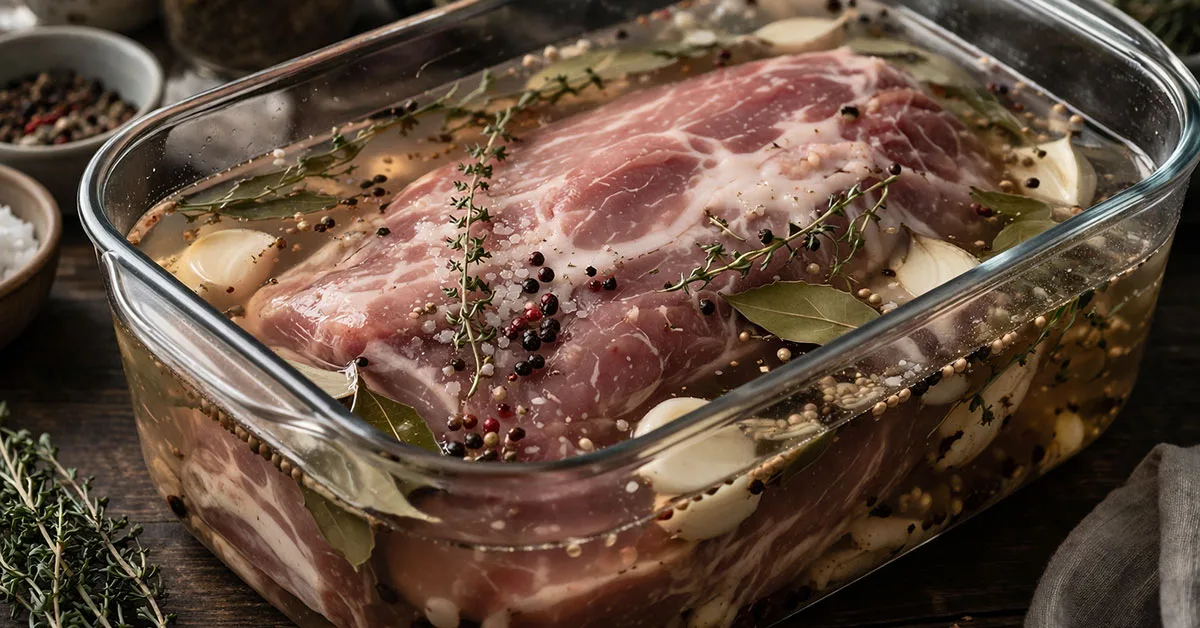
Brine & wet cure calculator
EQ Wet Brine Calculator
Work out a precise wet brine for anything from a Christmas ham to a whole chicken. Equilibrium method, dosed against the whole meat-and-water system, so it cannot over-salt, with bone-in weights handled for you.
Calculate your brine
Salt, sugar, cure and water for an equilibrium wet brine
Purpose and scope
The recipes published on The Curesmith are intended for educational and informational purposes only. Meat curing, fermentation and smoking involve processes that, if carried out incorrectly, can result in products that are unsafe to eat. By using any recipe on this website you acknowledge that you do so entirely at your own risk, and you agree that The Curesmith and its authors cannot be held liable for any outcome arising from its use.
Limitation of liability
The Curesmith and its authors accept no responsibility or liability for any illness, injury, loss or damage arising from the use of these recipes, including but not limited to illness caused by improperly cured, handled or cooked meat products, errors in measurement or technique, equipment failure, or deviation from the stated method or quantities.
Nitrite and cure safety
Meat curing involves the use of nitrite salts, which must be measured accurately and used strictly according to the quantities specified. Nitrite in excessive quantities is toxic. Please ensure you understand the following before proceeding:
- Always use a calibrated digital scale accurate to at least one gram. For smaller batches, a scale accurate to 0.1g is strongly recommended.
- Never exceed the stated cure amounts. Never substitute cure types without recalculating.
- Store all curing salts clearly labelled, separately from regular salt, and out of reach of children.
- Different cure products have different nitrite concentrations. Always check your manufacturer's label and adjust quantities accordingly.
Food hygiene and cross-contamination
Raw and cured meat products must be stored, handled and prepared in a clean environment using food-safe equipment. Hands, surfaces, tools and containers must be thoroughly cleaned and where appropriate sanitised before use. Cross-contamination between raw meat and ready-to-eat products must be avoided at all times.
Temperature control
Temperature control is critical throughout all curing and smoking processes. Inadequate temperature management can allow the growth of dangerous pathogens including Clostridium botulinum, Listeria monocytogenes, Salmonella and E. coli. A reliable refrigerator thermometer and a calibrated probe thermometer are essential pieces of equipment for anyone producing cured or smoked meat at home.
Uncooked cured products
Whole muscle products that are eaten without cooking, such as air-dried bresaola, coppa or prosciutto, must reach their target weight loss before consumption. Products that have not been cured and dried to the correct specification may not be safe to eat uncooked. Pancetta and guanciale cured to less than 38% weight loss must not be consumed uncooked.
Bacon and other uncooked cured products
Bacon and other uncooked cured products must be cooked thoroughly before eating. Cold smoking adds flavour and colour but does not cook the product. A cold-smoked bacon or sausage remains a raw product and must reach a safe internal temperature before it is safe to consume. For pork and beef this is 72°C / 162°F. For poultry this is 74°C / 165°F.
When in doubt, seek professional guidance
If you are unsure about any aspect of the curing, smoking or fermentation process, we strongly encourage you to seek formal training or guidance from a qualified food safety professional before proceeding. The information on this website is not a substitute for proper food safety education and training.
Commercial production
These recipes are produced for home and small-scale producers. They are not intended for commercial food production. Commercial meat processing is subject to regulatory requirements that vary by country and jurisdiction. If you intend to produce cured or smoked products for sale, you must ensure full compliance with all applicable food safety regulations in your region.
Bone-in cut, weight adjustment
The prepared, trimmed weight (or bone-adjusted, above).
Enough to fully submerge the meat.
Salt & sugar
Typical 1.75 to 2.5% of the system.
Optional. Balances the salt.
Curing time estimator
Measure at the thickest cross-section, to the bone for bone-in cuts.
Cure (nitrite)
Cure composition
Check manufacturer's label.
Standard max: 156 ppm (over the whole system).
Brine formulation
Nitrite safety check
Brining
Calculator by The Curesmith — thecuresmith.com
EQ wet brining tips
About EQ wet brining
Equilibrium curing, or EQ curing as it is more commonly known, is a more precise and scientific approach to curing meat than traditional methods.
Rather than applying a rough handful of salt and hoping for the best, EQ curing works on a simple but powerful principle: an exact quantity of every curing ingredient is calculated based on the weight of the meat and the weight of the water used in the brine. The system is designed to reach a state of dynamic equilibrium, meaning the concentration of salt, sugar and nitrite (if used) becomes equal throughout both the meat and the surrounding brine. Once equilibrium is reached, the meat stops absorbing. It cannot take on more salt than was calculated, which means it is virtually impossible to over-salt your cure, regardless of how long the meat remains in the brine.
This approach solves one of the most common frustrations in home curing: meat that comes out too salty, too mild, or inconsistent from batch to batch. With EQ curing, you are in precise control of every variable.
How the calculation works
How to cure
Once the brine is mixed (water boiled and salt fully dissolved, and cooled to room temp), the meat is placed in the container and fully submerged. It must remain completely covered by the brine throughout the entire curing period. The container is then refrigerated at 2 to 4°C for the full calculated curing time. The meat should be turned regularly to ensure even distribution of the brine and consistent absorption throughout the cut.
Using the calculator
There is some mathematics involved in working all of this out, but the EQ Wet Cure Calculator below does all the heavy lifting for you. Simply enter your meat weight, water weight, and your desired salt and sugar percentages, and the calculator will work out exactly how much of each ingredient to use, as well as the minimum curing time based on the thickness of your cut.
Additional important information
Basic Curing Ratios
Curing without Cure #1 or Cure #2
When curing with salt alone, no added nitrite or nitrate, the following ratios apply as a percentage of meat weight:
Minimum2% (20g per kg). Below this level the cure will not provide adequate preservation or meaningful flavour penetration.
Recommended2.35% (23.5g per kg). This is my preferred starting point for most EQ cures, enough to season well and preserve safely without risk of the meat being too salty.
Maximum3% (30g per kg). I would never recommend going this high when using the EQ method. The equilibrium principle means the meat will absorb every gram you apply, and at this level the result will almost certainly be unpleasantly salty.
Curing with Cure #1 or Cure #2
When a curing salt is included in your mix, you need to account for the fact that both Cure #1 and Cure #2 are pre-mixed with salt by the manufacturer, they are never sold as pure nitrite or pure nitrate. This salt content contributes to your total salt level, which means the amount of additional salt you apply needs to be slightly lower than in a salt-only cure.
Recommended2.25% (22.5g per kg). This is my preferred ratio when a curing salt is included.
Maximum2.75% (27.5g per kg). Again, I would not recommend reaching this level when working with the EQ method.
The calculator handles all of this automatically, it deducts the salt contribution of the cure from your target salt level and shows you the additional salt required alongside the cure weight.
Nitrite and Nitrate, What You Need to Know
Nitrite and nitrate are never added to meat in their pure form. They are always sold as a pre-mixed product combined with salt, and the precise composition varies depending on where you are in the world. Always read the manufacturer’s label carefully and confirm the exact nitrite or nitrate percentage of your specific product before calculating any cure. The calculator allows you to enter the exact percentage from your label rather than relying on a default figure.
The maximum allowable nitrite concentration when curing meat is 156 parts per million. In practice this typically equates to around 0.25% of the weight of the meat (2.5g per kg) for standard Cure #1 at 6.25% nitrite, though this will vary depending on the nitrite percentage of your specific product. The calculator determines the exact quantity required to reach your target ppm.
When do you actually need to add a curing salt?
This is a question many home curers wrestle with, and the honest answer is: it depends on how and where you are curing.
Whole muscle cuts, a pork loin, a beef bresaola, a duck breast, are sterile below the surface. The problematic anaerobic bacteria that nitrite protects against (including Clostridium botulinum) cannot survive in the oxygenated environment of the meat’s surface, and they cannot penetrate intact muscle tissue. In these situations, salt alone may be sufficient for a safely managed, short-term cure.
However, when we use the EQ method, particularly when meat is sealed in vacuum bags, we are creating a completely anaerobic environment throughout the curing process. Removing oxygen changes the equation significantly. To ensure that pathogenic bacteria cannot proliferate in a vacuum-sealed environment, the meat must be kept at 4°C or lower at all times. If your refrigerator runs at 6°C or above, or if temperature control cannot be guaranteed, you should include 0.25% Cure #1 or Cure #2 to protect the cure regardless of the cut.
The bottom line: if there is any doubt about your temperature control, or if the meat will be vacuum sealed for an extended period, add a curing salt. The small additional step is not worth skipping when food safety is at stake.
Sugar, A Note on Types and Quantities
Sugar is not essential in every cure, but it serves a useful purpose: it balances the sharpness of the salt, adds complexity of flavour, and contributes to surface browning and colour development during smoking or cooking. The amount used is very much a matter of personal preference. The ratios below are guidelines based on what I use, individual recipes on The Curesmith will always specify the sugar type and quantity clearly.
Dextrose is my preferred choice. Dextrose is a simple sugar derived from corn and is chemically identical to glucose. It is less sweet than refined sugar and ferments more readily, which makes it particularly useful in dry-cured sausages and products that undergo any fermentation. Because it is less sweet than regular sugar, you need to use slightly more of it to achieve the same effect:
Brown sugar can be used in place of white sugar at the same ratio (0.9%), adding a mild molasses note that works well with smoked products like bacon or pastrami.
Extended Health and Safety Disclaimer
This calculator is provided as a general educational tool to assist with equilibrium curing calculations. It is not a substitute for food safety training, technical expertise or professional advice. Meat curing carries inherent risks, including spoilage, pathogen growth, incorrect curing salt use, and serious foodborne illness, if the process is not carried out correctly.
By using this calculator, you acknowledge that you are solely responsible for how you apply the information and results it produces. You must independently confirm that your ingredients, curing salts, nitrite percentages, measurements, temperatures, handling methods, packaging, equipment and storage conditions are all accurate and appropriate for your specific intended use.
Always use a precision scale. Follow strict hygiene and sanitation practices throughout. Keep meat under safe refrigeration at all times during the curing process. Never use pure nitrite or pure nitrate directly, only use approved curing premixes, and always confirm their exact composition from the manufacturer’s label before calculating or applying any cure.
Any curing time shown by this calculator is an estimate only. Actual curing time may vary depending on the thickness, shape, density, fat content, temperature control, bag sealing and other variables specific to your cut and your environment. Cure penetration, product condition and safety must always be assessed before the meat is removed from cure, dried, smoked, cooked or consumed.
Food safety laws, permitted practices and allowable nitrite limits vary by country and region. It is your responsibility to ensure that your curing process complies with the applicable laws, standards and food safety guidance where you live and work.
The Curesmith makes no warranties or guarantees regarding the safety, completeness, accuracy, legal compliance or final outcome of any product made using this calculator, and accepts no liability for any illness, injury, loss, damage or adverse result arising from its use or reliance on its output.
If you are unsure at any stage, do not proceed. Reach out to us directly at connect@thecuresmith.com and we will do our best to help.
Where to go next
Related calculators
- Gradient BrineA stronger, timed brine measured in grams per litre, pulled on time before it over-salts.
- Wet Cure BaconBrined bacon, the wet-cure route to streaky or back bacon.
- EQ Dry CureSalt, cure and sugar for any whole-muscle dry cure, from bacon to bresaola. Equilibrium method, so it cannot over-salt.