
Sausage calculator
Fermented Sausage Calculator
Everything for a salami: build the meat blend, set the fat, and get the salt, cure, dextrose and seasonings as a precise percentage of the mix, with the starter culture, casing and weight-loss target to match. The safest way to approach the hardest craft in curing.
Build your fermented sausage
Meat, fat, cure, dextrose, culture and seasonings for a dry-cured salami
Purpose and scope
The recipes published on The Curesmith are intended for educational and informational purposes only. Meat curing, fermentation and smoking involve processes that, if carried out incorrectly, can result in products that are unsafe to eat. By using any recipe on this website you acknowledge that you do so entirely at your own risk, and you agree that The Curesmith and its authors cannot be held liable for any outcome arising from its use.
Limitation of liability
The Curesmith and its authors accept no responsibility or liability for any illness, injury, loss or damage arising from the use of these recipes, including but not limited to illness caused by improperly cured, handled or cooked meat products, errors in measurement or technique, equipment failure, or deviation from the stated method or quantities.
Nitrite and cure safety
Meat curing involves the use of nitrite salts, which must be measured accurately and used strictly according to the quantities specified. Nitrite in excessive quantities is toxic. Please ensure you understand the following before proceeding:
- Always use a calibrated digital scale accurate to at least one gram. For smaller batches, a scale accurate to 0.1g is strongly recommended.
- Never exceed the stated cure amounts. Never substitute cure types without recalculating.
- Store all curing salts clearly labelled, separately from regular salt, and out of reach of children.
- Different cure products have different nitrite concentrations. Always check your manufacturer's label and adjust quantities accordingly.
Food hygiene and cross-contamination
Raw and cured meat products must be stored, handled and prepared in a clean environment using food-safe equipment. Hands, surfaces, tools and containers must be thoroughly cleaned and where appropriate sanitised before use. Cross-contamination between raw meat and ready-to-eat products must be avoided at all times.
Temperature control
Temperature control is critical throughout all curing and smoking processes. Inadequate temperature management can allow the growth of dangerous pathogens including Clostridium botulinum, Listeria monocytogenes, Salmonella and E. coli. A reliable refrigerator thermometer and a calibrated probe thermometer are essential pieces of equipment for anyone producing cured or smoked meat at home.
Uncooked cured products
Whole muscle products that are eaten without cooking, such as air-dried bresaola, coppa or prosciutto, must reach their target weight loss before consumption. Products that have not been cured and dried to the correct specification may not be safe to eat uncooked. Pancetta and guanciale cured to less than 38% weight loss must not be consumed uncooked.
Bacon and other uncooked cured products
Bacon and other uncooked cured products must be cooked thoroughly before eating. Cold smoking adds flavour and colour but does not cook the product. A cold-smoked bacon or sausage remains a raw product and must reach a safe internal temperature before it is safe to consume. For pork and beef this is 72°C / 162°F. For poultry this is 74°C / 165°F.
When in doubt, seek professional guidance
If you are unsure about any aspect of the curing, smoking or fermentation process, we strongly encourage you to seek formal training or guidance from a qualified food safety professional before proceeding. The information on this website is not a substitute for proper food safety education and training.
Commercial production
These recipes are produced for home and small-scale producers. They are not intended for commercial food production. Commercial meat processing is subject to regulatory requirements that vary by country and jurisdiction. If you intend to produce cured or smoked products for sale, you must ensure full compliance with all applicable food safety regulations in your region.
Meat breakdown
Fat
% of the meat weight. Typical 20 to 30%.
Salt & sugar
Typical 2.4 to 2.8% for fermented sausage.
Feeds the starter culture. 0.3 to 0.7% is typical.
Cure (nitrite)
Cure composition
Check manufacturer's label.
Standard max: 156 ppm (of the mix).
Starter culture
Casing & drying
Wider casings dry more slowly. This is guidance for your drying schedule.
Fermented sausage is safe and ready at 38 to 40%+ weight loss. Gate on this, not on days.
Additional ingredients optional, % of mix
Formulation
Nitrite safety check
Ferment, dry & finish
Calculator by The Curesmith — thecuresmith.com
Fermented sausage tips
About fermented sausage
Dry-cured and fermented sausage is one of the most technically demanding and rewarding areas of meat curing. Unlike fresh or cooked sausages, fermented sausages undergo a controlled biological transformation: beneficial bacteria acidify the meat, lowering the pH to a level that inhibits harmful pathogens, while extended drying removes moisture until the water activity (aW) is too low to support microbial growth.
This calculator takes the complexity out of the formulation stage. It calculates every ingredient precisely against your total mix weight, recommends the correct cure type for your casing and drying time, guides your starter culture selection, and produces both a print-ready formulation sheet and a fully dynamic Excel recipe with a built-in drying log.
Please read the health and safety notice carefully before using this calculator. Fermented sausage production carries genuine food safety risks. Always follow safe curing practices throughout.
Additional important information
Understanding the Fermentation Process
Fermentation is the stage that makes dry-cured sausage fundamentally different from any other form of curing. When you stuff your sausage and place it in the fermentation chamber, the starter culture you have added begins converting the dextrose in the mix into lactic acid. This lactic acid drops the pH of the meat from its natural level of around 5.8 to 6.2 down to your target, typically somewhere between 4.8 and 5.5 depending on the culture and the style of product.
This pH drop is critical for two reasons. First, it creates an environment that is hostile to pathogenic bacteria, including Salmonella, Listeria and Clostridium botulinum, that cannot survive or proliferate at low pH. Second, it changes the texture of the meat proteins, causing them to gel and bind. This is what gives good salami its characteristic firm, even slice and its tight, non-crumbly texture.
The fermentation stage must be controlled precisely. Temperature, humidity and time all interact. If fermentation is too fast or the temperature too high, the culture can over-acidify, producing a product that is excessively tangy and has a grainy, mushy texture. If fermentation is too slow or incomplete, the pH may not drop far enough to provide adequate safety before the sausage moves to the drying environment.
Always verify the target pH with a calibrated pH meter before moving from fermentation to drying. This is a food safety requirement, not a suggestion.
Water Activity (aW), The Critical Safety Parameter
Weight loss percentage is the practical measurement used in the drying room, but the underlying safety parameter is water activity, expressed as aW. Water activity is a measure of the free water available in a food for microbial activity, it is not the same as moisture content.
Most pathogens cannot grow at aW below 0.91. Clostridium botulinum requires aW above 0.97 to produce toxin. The target for a shelf-stable fermented sausage is typically aW below 0.87 to 0.90.
In practice, a 35% weight loss from the total stuffed weight corresponds roughly to an aW of 0.91 to 0.92 in a well-formulated product. A 40% weight loss typically achieves aW of 0.87 to 0.88. These are guidelines, not guarantees, actual aW depends on the fat content, salt level, initial moisture of the meat and other variables.
If you have access to a water activity meter, measure it directly. If not, treat the 38% minimum weight loss as the absolute floor and 40% as the reliable target.
Do not taste or consume fermented sausage before the minimum 38% weight loss has been reached.
The Role of Nitrite and Nitrate in Fermented Sausage
Nitrite and nitrate serve a specific and essential function in fermented sausage that goes beyond their role in standard cured meats. In a whole muscle cure, a bresaola or a prosciutto, the muscle is sterile below the surface and the risk of anaerobic pathogen growth is relatively low. In a fermented sausage, the meat has been ground, mixed and stuffed into a casing. This creates an anaerobic environment throughout the entire product, not just at the surface.
Nitrite (from Cure #1 or Coloroso) provides immediate protection during the early stages of fermentation and the first phase of drying. It works by directly inhibiting the growth of Clostridium botulinum and other anaerobic pathogens.
Nitrate (present in Cure #2 and Savianda alongside nitrite) provides slow-release protection over the full drying and ageing period. As the product dries, naturally occurring bacteria in the meat gradually convert nitrate to nitrite, maintaining a low-level protective concentration throughout a process that may last months. This is why Cure #2 or Savianda is required for any sausage that will be dried for more than 30 days.
The maximum allowable nitrite concentration is 156 ppm for most cured meat products in most jurisdictions. This calculator targets 156 ppm by default. Always check the composition of your specific curing salt from the manufacturer’s label, the nitrite percentage varies between products and regions.
Fat Ratio and Quality
The fat in a fermented sausage is not simply flavour, it is structural. During the drying process, water migrates out of the lean meat fraction. The fat remains and, as the lean shrinks around it, the characteristic marbled grain structure of good salami develops. If the fat is of poor quality, too warm when mixed, or present in the wrong quantity, this structure fails.
Back fat (pork fatback, from above the loin) is the standard recommendation. It is firm at refrigeration temperatures, cuts cleanly, and does not smear easily. Belly fat, jowl fat and shoulder fat can all be used and each contributes a slightly different flavour and texture character. Very soft fats, such as kidney fat or fat from older animals, are not suitable.
Fat temperature is critical. Fat must be at or below 2°C when mixed into the meat. If the fat warms above approximately 8 to 10°C during mixing, it begins to smear, coating the meat particles in a greasy film that prevents the proteins from binding correctly and results in a sausage that slices poorly and has an unpleasant greasy mouthfeel.
For this reason, many experienced producers grind the fat separately (at a coarser grind than the lean), mix it into the seasoned meat for the minimum time required to achieve an even distribution, and stuff immediately.
Dextrose vs Sugar, Why It Matters
The sugar in a fermented sausage formulation is not there primarily to add sweetness. It is the fuel for the starter culture. The culture consumes fermentable sugars and converts them to lactic acid, remove the sugar and the culture has nothing to ferment.
Dextrose (glucose) is the preferred substrate because starter culture bacteria can use it immediately and predictably. It ferments at a consistent rate, giving you reliable pH control throughout the fermentation period.
Sucrose (regular sugar) must first be broken down by enzymes into glucose and fructose before the bacteria can use it. This adds a step that can introduce variability, particularly at lower fermentation temperatures where enzymatic activity is slower.
The practical implication is that if you are substituting regular sugar for dextrose, you should use 1.5 times the dextrose quantity to account for the lower fermentability of sucrose and the fact that only the glucose component is immediately usable.
In terms of sweetness: dextrose is approximately 70 to 75% as sweet as regular sugar. At the low percentages used in fermented sausage (0.3 to 0.5% of mix weight), neither will produce a noticeably sweet product.
Starter Culture and Fermentation Conditions, A Closer Look
The starter culture dropdown includes seven commercial cultures covering the full range from very slow and mild to fast and tangy. Choosing the right one depends on three things: the style of product you are making, the temperature you can maintain in your fermentation chamber, and how much time you want to spend in the fermentation stage.
Traditional European salami (mild, complex, long-dried) → T-SPX or Primal SK Soft. Slow cultures, low fermentation temperatures (18 to 24°C), extended fermentation (3 to 7 days). These cultures produce the cleanest flavour at the cost of time and precise temperature control.
Italian-style products (moderate tang, clean flavour) → Flora Italia LC or Primal SK Natur. Good balance of speed and flavour quality. Suitable for a wide range of formats.
Faster production or higher tang → F-LC or Bitec LS 25. Higher fermentation temperatures (24 to 30°C), shorter time (1 to 3 days). Suitable for producers who need faster throughput without the extreme tang of the fastest cultures.
American-style products (pepperoni, summer sausage) → F-RM-52. Fast, aggressive acidification at high temperatures. Produces a pronounced tang. Not suitable for traditional long-aged products.
Temperature control in the fermentation chamber is as important as the culture selection. Most failures in fermented sausage production at the fermentation stage come from inconsistent temperature, either too low (sluggish fermentation, incomplete acidification) or too high (over-acidification, textural problems, off-flavours).
Surface Mold, What It Does and How to Manage It
A healthy white surface mold (Penicillium nalgiovense, sold commercially as Mold 600 and similar products) is not cosmetic. It serves three active functions during drying:
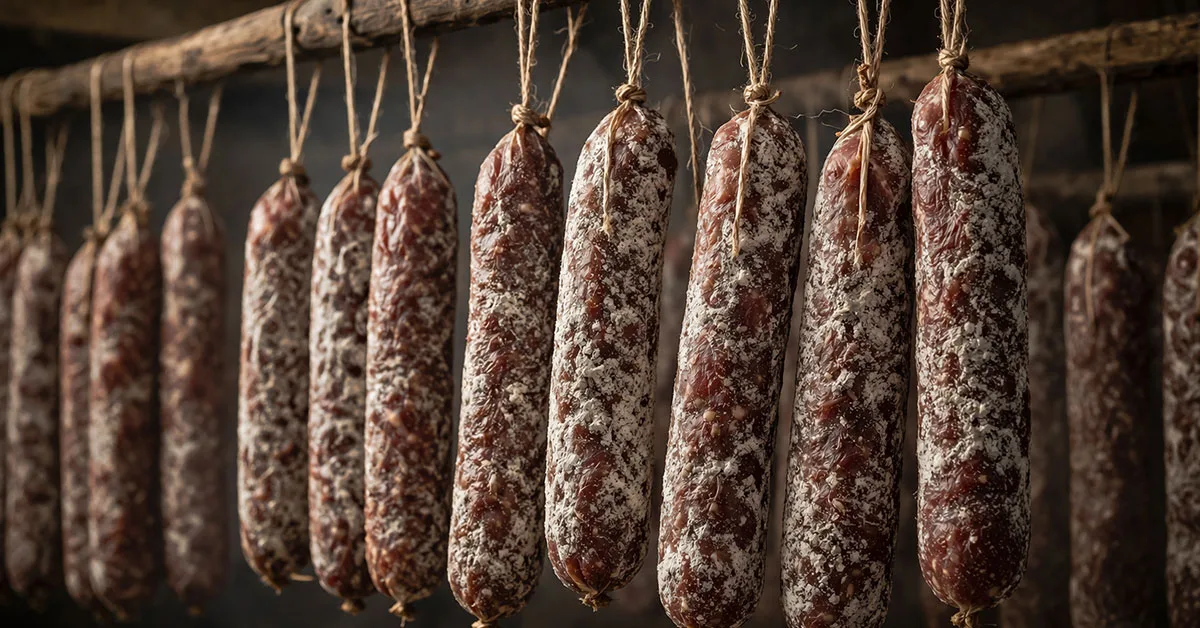
Moisture regulation. The mold forms a permeable layer over the casing that slows the rate of surface drying. This prevents case hardening, where the surface dries too fast and forms a barrier that traps moisture inside, creating a product that appears dry on the outside but remains wet and unsafe at the core.
pH buffering. As the sausage dries, the lactic acid concentration at the surface can rise to a level that produces harsh, sour flavours. The mold metabolises these surface acids, softening the flavour and contributing to the characteristic earthy, complex taste associated with traditional salami.
Protection. A healthy mold coat protects the surface from contamination by unwanted wild moulds, particularly the green and black moulds (Penicillium verrucosum, Aspergillus species) that can produce mycotoxins. A well-established white mold effectively outcompetes these organisms for surface territory.
To establish mold successfully, maintain 90 to 95% relative humidity for the first 48 to 72 hours after stuffing at your fermentation temperature. Once the mold is visible and evenly distributed, you can move to your standard drying conditions. If you see green, black or unusual coloured mould developing, remove it immediately with a cloth dampened in a light brine or wine solution and investigate your chamber conditions.
Extended Health and Safety Disclaimer
This calculator is provided as a general educational tool to assist with equilibrium curing calculations. It is not a substitute for food safety training, technical expertise or professional advice. Meat curing carries inherent risks, including spoilage, pathogen growth, incorrect curing salt use, and serious foodborne illness, if the process is not carried out correctly.
By using this calculator, you acknowledge that you are solely responsible for how you apply the information and results it produces. You must independently confirm that your ingredients, curing salts, nitrite percentages, measurements, temperatures, handling methods, packaging, equipment and storage conditions are all accurate and appropriate for your specific intended use.
Always use a precision scale. Follow strict hygiene and sanitation practices throughout. Keep meat under safe refrigeration at all times during the curing process. Never use pure nitrite or pure nitrate directly, only use approved curing premixes, and always confirm their exact composition from the manufacturer’s label before calculating or applying any cure.
Any curing time shown by this calculator is an estimate only. Actual curing time may vary depending on the thickness, shape, density, fat content, temperature control, bag sealing and other variables specific to your cut and your environment. Cure penetration, product condition and safety must always be assessed before the meat is removed from cure, dried, smoked, cooked or consumed.
Food safety laws, permitted practices and allowable nitrite limits vary by country and region. It is your responsibility to ensure that your curing process complies with the applicable laws, standards and food safety guidance where you live and work.
The Curesmith makes no warranties or guarantees regarding the safety, completeness, accuracy, legal compliance or final outcome of any product made using this calculator, and accepts no liability for any illness, injury, loss, damage or adverse result arising from its use or reliance on its output.
If you are unsure at any stage, do not proceed. Reach out to us directly at connect@thecuresmith.com and we will do our best to help.
Where to go next