
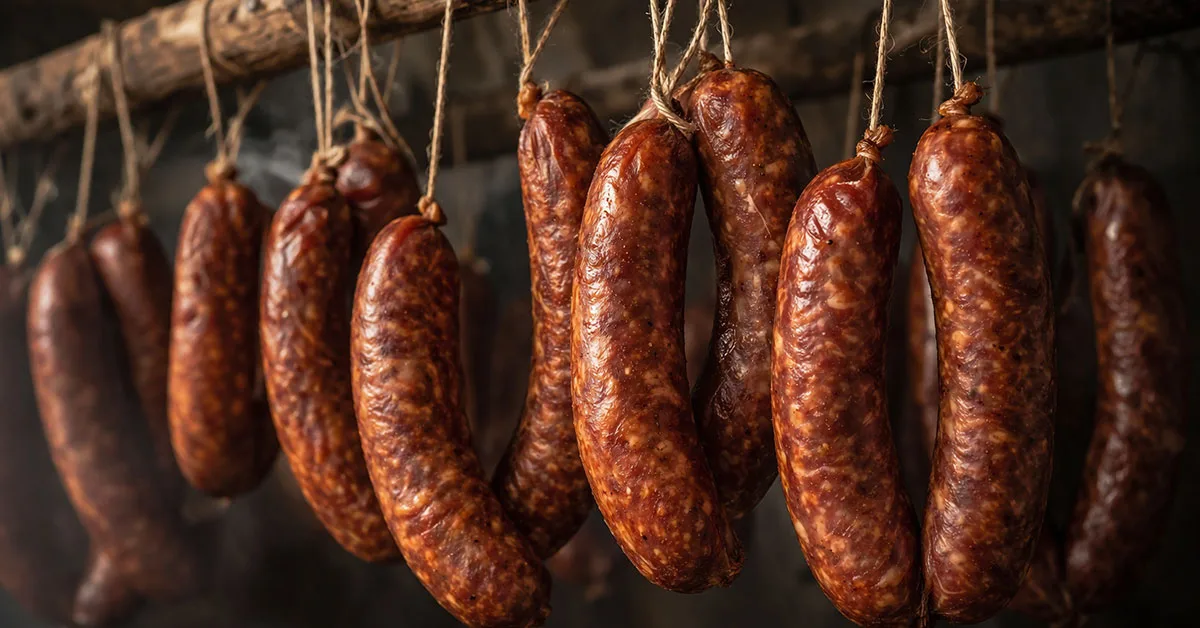
Sausage calculator
Hot Smoked Sausage Calculator
Everything for a smoked kielbasa or smoked bratwurst: build the meat blend, set the fat, and get the salt, Cure #1, sugar and seasonings as a precise percentage of the mix, with pellicle, wood, chamber and internal-temperature guidance for the smoke. Cure #1 dosed to a safe, exact nitrite level.
Build your hot-smoked sausage
Cure #1, salt, sugar and smoke guidance for a cured, smoked, cooked sausage
Purpose and scope
The recipes published on The Curesmith are intended for educational and informational purposes only. Meat curing, fermentation and smoking involve processes that, if carried out incorrectly, can result in products that are unsafe to eat. By using any recipe on this website you acknowledge that you do so entirely at your own risk, and you agree that The Curesmith and its authors cannot be held liable for any outcome arising from its use.
Limitation of liability
The Curesmith and its authors accept no responsibility or liability for any illness, injury, loss or damage arising from the use of these recipes, including but not limited to illness caused by improperly cured, handled or cooked meat products, errors in measurement or technique, equipment failure, or deviation from the stated method or quantities.
Nitrite and cure safety
Meat curing involves the use of nitrite salts, which must be measured accurately and used strictly according to the quantities specified. Nitrite in excessive quantities is toxic. Please ensure you understand the following before proceeding:
- Always use a calibrated digital scale accurate to at least one gram. For smaller batches, a scale accurate to 0.1g is strongly recommended.
- Never exceed the stated cure amounts. Never substitute cure types without recalculating.
- Store all curing salts clearly labelled, separately from regular salt, and out of reach of children.
- Different cure products have different nitrite concentrations. Always check your manufacturer's label and adjust quantities accordingly.
Food hygiene and cross-contamination
Raw and cured meat products must be stored, handled and prepared in a clean environment using food-safe equipment. Hands, surfaces, tools and containers must be thoroughly cleaned and where appropriate sanitised before use. Cross-contamination between raw meat and ready-to-eat products must be avoided at all times.
Temperature control
Temperature control is critical throughout all curing and smoking processes. Inadequate temperature management can allow the growth of dangerous pathogens including Clostridium botulinum, Listeria monocytogenes, Salmonella and E. coli. A reliable refrigerator thermometer and a calibrated probe thermometer are essential pieces of equipment for anyone producing cured or smoked meat at home.
Uncooked cured products
Whole muscle products that are eaten without cooking, such as air-dried bresaola, coppa or prosciutto, must reach their target weight loss before consumption. Products that have not been cured and dried to the correct specification may not be safe to eat uncooked. Pancetta and guanciale cured to less than 38% weight loss must not be consumed uncooked.
Bacon and other uncooked cured products
Bacon and other uncooked cured products must be cooked thoroughly before eating. Cold smoking adds flavour and colour but does not cook the product. A cold-smoked bacon or sausage remains a raw product and must reach a safe internal temperature before it is safe to consume. For pork and beef this is 72°C / 162°F. For poultry this is 74°C / 165°F.
When in doubt, seek professional guidance
If you are unsure about any aspect of the curing, smoking or fermentation process, we strongly encourage you to seek formal training or guidance from a qualified food safety professional before proceeding. The information on this website is not a substitute for proper food safety education and training.
Commercial production
These recipes are produced for home and small-scale producers. They are not intended for commercial food production. Commercial meat processing is subject to regulatory requirements that vary by country and jurisdiction. If you intend to produce cured or smoked products for sale, you must ensure full compliance with all applicable food safety regulations in your region.
Meat breakdown
Fat
% of total meat weight.
Water / ice
% of total mix weight (meat + fat).
Salt & sugar
1.6 to 2.0% is typical.
Balances the smoke and salt, and aids colour. 0.3 to 0.5% is typical.
Cure (nitrite)
Check manufacturer's label.
Standard max: 156 ppm.
Casing & smoke
Typical 65 to 80 C. Start low, finish hot.
Pork & beef: 71 C (160 F). Poultry: 74 C (165 F). Always verify with a probe.
Additional ingredients optional, % of mix
Formulation
Nitrite safety check
Pellicle, smoke & cook
Calculator by The Curesmith — thecuresmith.com
Hot smoked sausage tips
Additional important information
How Hot Smoking Differs from Cold Smoking
The fundamental difference between hot and cold smoking is temperature, and temperature determines everything about how each process works, what safety requirements apply, and what the finished product looks and tastes like.
Cold smoking takes place at 15 to 30°C. The smoke flavours and partially preserves the product but does not cook it. The product remains raw and must be cooked before eating. Cure is mandatory because the temperature is within the bacterial danger zone throughout the entire process.
Hot smoking takes place at 60 to 80°C or above. At these temperatures the sausage is being cooked as it smokes. By the time it reaches the target internal temperature, 71°C for pork and beef, 74°C for poultry, it is fully cooked, safe to eat without further preparation, and has taken on smoke flavour and colour throughout the session. Cure is strongly recommended but not mandatory in the same way it is for cold smoking, because the cooking process itself is the primary food safety control.
This distinction makes hot smoking considerably more accessible than cold smoking for home producers. The process is shorter, the equipment requirements are simpler, and the safety margin is significantly wider. A properly set up hot smoker running at 70°C is doing two jobs simultaneously, smoking and cooking, which is why a hot-smoked kielbasa can come off the smoker and go straight to the table.
Temperature Management, The Foundation of Hot Smoking
Getting the temperature right is the single most important technical skill in hot smoking. There are two temperatures to manage simultaneously, the chamber temperature and the internal temperature of the product, and both must be understood and controlled throughout the session.
Chamber temperature is the temperature of the air inside the smoking chamber, measured at the level of the sausages. The typical target range for hot-smoked sausage is 60 to 80°C. Below 60°C the cooking process is too slow and the product may spend too long in the lower temperature range where bacterial growth is possible. Above 80°C the fat begins to render aggressively, the casing can split, and the surface of the sausage dries out and hardens before the interior is cooked through.
Most experienced hot smokers work with a graduated approach, starting at 50 to 60°C for the first 30 to 60 minutes (which also serves to dry the pellicle and begin smoke penetration), then raising to 65 to 70°C for the main cooking phase, and finally finishing at 75 to 80°C to push the internal temperature to target and set the colour. This produces a better result than running at a single fixed temperature throughout.
Internal temperature is the temperature at the geometric centre of the thickest part of the sausage. This is the food safety measurement, the product is safe to eat when the internal temperature reaches and is sustained at the target. For pork and beef sausage the target is 71°C / 160°F. For poultry sausage it is 74°C / 165°F.
Use a calibrated digital probe thermometer. Insert it into the end of the sausage lengthwise so the tip reaches the centre of the thickest point. Check multiple sausages in the batch, internal temperatures can vary between links depending on their position in the smoker and their individual diameter.
Never use colour, cooking time or the feel of the casing as a substitute for temperature measurement. A sausage can look perfectly smoked, feel firm and yield clear juices and still be undercooked at the centre. A probe thermometer is not optional, it is the only reliable safety tool available.
The Smoke Ring, What It Is and What It Is Not
One of the most visually striking features of well-made hot-smoked sausage is the smoke ring, the pink or reddish band that appears just inside the casing when you cut the sausage. It is often cited as a sign of quality and good smoking practice. Understanding what it is prevents confusion about whether it indicates undercooking.
The smoke ring is caused by a chemical reaction between gases in the smoke, specifically nitric oxide and carbon monoxide, and the myoglobin in the meat. These gases penetrate the surface of the sausage during smoking and react with myoglobin to form carboxymyoglobin and nitrosomyoglobin, both of which are pink in colour and stable even when cooked. The reaction occurs in the outer layer of the meat where the smoke compounds have penetrated, which is why the ring has a defined depth and does not extend all the way to the centre.
A well-defined smoke ring is evidence that the smoke penetrated the sausage effectively before the surface set, it is a sign of good pellicle formation, appropriate starting temperature and good smoke density. A sausage with no smoke ring was either not smoked long enough, started at too high a temperature, or had a wet surface that prevented smoke penetration.
The smoke ring does not indicate undercooking. A sausage with a beautiful pink smoke ring can be perfectly cooked. A sausage with no smoke ring can be undercooked. Always verify internal temperature regardless of colour.
If you are using cure in your formulation, the nitrite in the cure also reacts with myoglobin to produce a pink colour throughout the meat, which is separate from and in addition to the smoke ring effect. This is why cured and smoked sausage has a consistently pink interior even when fully cooked, it is the cured colour, not an indication of rawness.
Cure in Hot Smoked Sausage, Why It Still Matters
Cure is strongly recommended for hot-smoked sausage even though it is not mandatory in the same way it is for cold smoking. Understanding why helps you make an informed decision about whether to include it.
Protection during the ramp-up phase. When a sausage first goes into the smoker, the internal temperature is close to refrigerator temperature, 4 to 5°C. It then takes time to heat through to the safe minimum of 71°C. During this ramp-up phase, the internal temperature passes through the bacterial danger zone (5 to 60°C). The time spent in this zone is typically not long enough to cause problems in a properly handled sausage, but nitrite provides an additional margin of protection during this window, particularly against Clostridium botulinum, which can produce toxin rapidly under anaerobic conditions even at relatively low temperatures.
Extended shelf life. Nitrite inhibits the growth of spoilage bacteria as well as pathogens. A cured hot-smoked sausage stored in the refrigerator will keep for 7 to 10 days. An uncured hot-smoked sausage should be treated like any cooked pork product, consumed within 2 to 3 days or frozen.
Colour and flavour. The characteristic deep pink colour and the slightly sweet, complex cured flavour that most people associate with smoked sausage comes from the nitrite reaction with myoglobin. Without cure, hot-smoked sausage has a greyish-brown interior and a noticeably different flavour profile, still good, but different. If you are making a style where the pink interior and cured flavour are part of the expected result, kielbasa, smoked bratwurst, frankfurter-style sausage, cure is not optional from a product quality perspective even if it is optional from a food safety perspective.
Fat stability. Nitrite also acts as an antioxidant, slowing the oxidative rancidity of fat. This is particularly relevant for hot-smoked sausage that will be stored for more than a day or two before eating. Without nitrite, the smoked fat can develop an off, rancid flavour more quickly.
Pellicle Formation for Hot Smoking
The pellicle is the dry, slightly tacky surface skin that forms when the stuffed sausage is exposed to moving air after stuffing. It is just as important for hot smoking as it is for cold smoking, though the consequences of skipping it are slightly less severe, the product will still be cooked and safe to eat, but the smoke flavour and colour will be uneven and inferior.
When smoke contacts a dry pellicle surface, the smoke compounds adhere and penetrate efficiently, producing an even, rich colour and a well-integrated smoke flavour. When smoke contacts a wet surface, it beads off and concentrates in droplets, producing an uneven, blotchy colour and a surface that can taste bitter and acrid.
For hot smoking there is a practical alternative to refrigerator pellicle formation, you can place the sausages in the smoker at 50 to 55°C with no smoke applied for the first 30 to 60 minutes. At this temperature the surface dries rapidly and a good pellicle forms in less time than it would at refrigerator temperature. Once the surface is dry and tacky, you begin applying smoke and raise the temperature to your target chamber temperature. This method is particularly useful in warm weather when ambient temperatures make refrigerator pellicle formation slower, or when you are processing a large batch and refrigerator space is limited.
Wood Selection and Application for Hot Smoking
The principles of wood selection for hot smoking are similar to cold smoking, but the dynamics are different. In hot smoking, the wood is burning or smouldering in a chamber that is also at cooking temperature, which means smoke compounds are being generated and deposited at a faster rate than in cold smoking. The total session time is also much shorter, a hot-smoked sausage may spend 2 to 6 hours in the smoker, compared to multiple sessions over several days for a cold-smoked product.
This means two things. First, the total smoke exposure in hot smoking is lower, so the risk of over-smoking is somewhat reduced compared to cold smoking. Second, the density and timing of smoke application still matters significantly, a dense, continuous smoke for the first half of the cook followed by a period without smoke often produces a better result than continuous smoke throughout.
Chips are well-suited to hot smoking. They catch quickly, produce good smoke and burn out relatively fast, which gives natural breaks in smoke application. Soaking chips in water before use slows their burn rate and produces a moister, cooler smoke, though opinions vary on whether this meaningfully improves the result.
Chunks work well in offset smokers and kamado-style cookers, where they smoulder slowly at cooking temperature over a long session.
Pellets designed for smoking produce consistent, clean smoke and are well-suited to pellet smokers and dedicated hot-smoking equipment.
Dust is less common in hot smoking but works in maze-style generators placed inside the chamber.
Timing of smoke application: For most hot-smoked sausage, apply smoke during the first half to two-thirds of the cooking session. The surface is most receptive to smoke before it begins to set and dry. Applying heavy smoke in the final stages of the cook rarely improves the flavour and can introduce bitter notes. Many producers stop adding wood entirely once the internal temperature reaches 60°C and allow the sausage to finish cooking in the residual heat.
Casings for Hot Smoking
Not all casings behave equally at hot-smoking temperatures, and choosing the right casing for the process is important.
Natural casings, sheep, hog and beef, are the most forgiving and produce the best result in hot smoking. They are smoke-permeable, which allows flavour to develop throughout the sausage rather than just at the surface. They contract with the meat as it cooks and produce a characteristic snap when bitten through in the finished product. Natural casings can withstand the temperatures of hot smoking without splitting if the temperature is raised gradually.
Fibrous casings, made from cellulose and paper, are smoke-permeable and very sturdy. They are the standard choice for large-format hot-smoked sausage, deli logs and ring bologna. They do not shrink with the meat, so finished products in fibrous casings often have a slightly wrinkled appearance at the surface. Fibrous casings should be soaked in warm water before use.
Collagen casings, edible collagen in standard sizes, non-edible in large sizes, are convenient and consistent. Edible collagen casings work well for hot smoking at moderate temperatures, but can split or blister if the temperature rises too quickly or too high. Raise the chamber temperature gradually when using collagen casings and avoid exceeding 80°C.
Plastic and synthetic casings are not suitable for hot smoking and must not be used. They do not transmit smoke, cannot withstand cooking temperatures and may release harmful compounds when heated.
Shelf Life and Storage of Hot Smoked Sausage
Cured hot-smoked sausage (made with Cure #1 or Coloroso) keeps well under refrigeration. Whole, uncut sausage stored below 4°C will maintain good quality for 7 to 10 days. Once cut, consume within 3 to 5 days.
Uncured hot-smoked sausage should be treated as a standard cooked meat product. Consume within 2 to 3 days of smoking, or freeze immediately.
Frozen hot-smoked sausage retains excellent quality for 2 to 3 months. Vacuum packing before freezing significantly extends quality and prevents freezer burn. Allow to thaw in the refrigerator overnight, never at room temperature.
Reheating: Hot-smoked sausage can be eaten cold straight from the refrigerator, or reheated. The most common reheating method is a brief poach in hot water at 75 to 80°C for 5 to 10 minutes, which warms the sausage through without drying it out. Grilling or pan-frying also work well, use medium heat and turn frequently to warm through without burning the casing. There is no need to bring the product to 71°C again when reheating a fully cooked and properly stored sausage, this is a reheating step, not a food safety step. Aim for an internal temperature of 60 to 65°C for a pleasantly warm, juicy result.
Extended Health and Safety Disclaimer
This calculator is provided as a general educational tool to assist with equilibrium curing calculations. It is not a substitute for food safety training, technical expertise or professional advice. Meat curing carries inherent risks, including spoilage, pathogen growth, incorrect curing salt use, and serious foodborne illness, if the process is not carried out correctly.
By using this calculator, you acknowledge that you are solely responsible for how you apply the information and results it produces. You must independently confirm that your ingredients, curing salts, nitrite percentages, measurements, temperatures, handling methods, packaging, equipment and storage conditions are all accurate and appropriate for your specific intended use.
Always use a precision scale. Follow strict hygiene and sanitation practices throughout. Keep meat under safe refrigeration at all times during the curing process. Never use pure nitrite or pure nitrate directly, only use approved curing premixes, and always confirm their exact composition from the manufacturer’s label before calculating or applying any cure.
Any curing time shown by this calculator is an estimate only. Actual curing time may vary depending on the thickness, shape, density, fat content, temperature control, bag sealing and other variables specific to your cut and your environment. Cure penetration, product condition and safety must always be assessed before the meat is removed from cure, dried, smoked, cooked or consumed.
Food safety laws, permitted practices and allowable nitrite limits vary by country and region. It is your responsibility to ensure that your curing process complies with the applicable laws, standards and food safety guidance where you live and work.
The Curesmith makes no warranties or guarantees regarding the safety, completeness, accuracy, legal compliance or final outcome of any product made using this calculator, and accepts no liability for any illness, injury, loss, damage or adverse result arising from its use or reliance on its output.
If you are unsure at any stage, do not proceed. Reach out to us directly at connect@thecuresmith.com and we will do our best to help.
Where to go next