
Chistorra
-, Navarra/Basque, Spain
Thin, bright-red and garlicky, eaten young and fried, a Basque-Navarrese favourite.
Overview
Chistorra is thin, bright-red and garlicky, eaten young and fried, a basque-navarrese favourite. A long, narrow, flexible red sausage in fine casing, strongly scented with pimentón and garlic. It should remain juicy when fried.
Where it's from
Climate. Navarra and the Basque country.
Altitude. Foothills and valleys
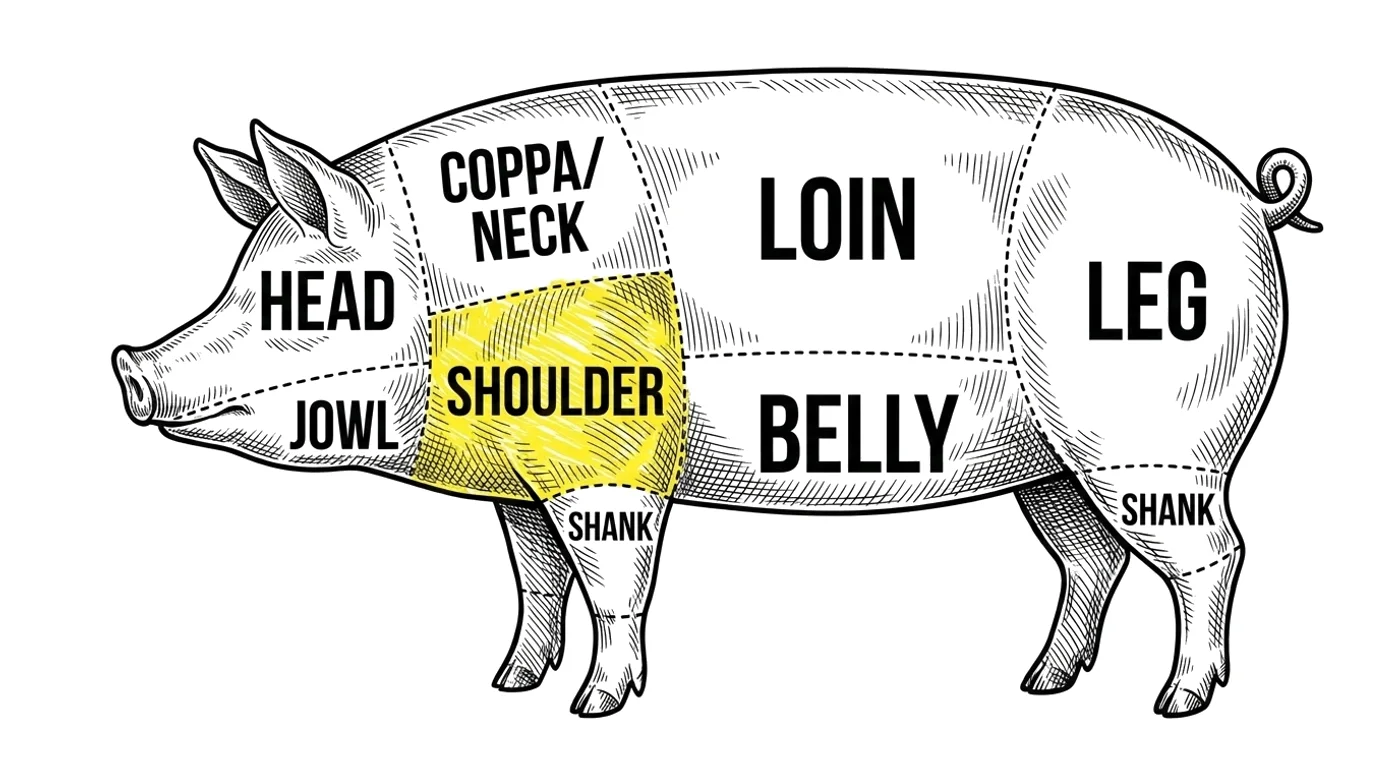
The cut
How to recognise it
A long, narrow, flexible red sausage in fine casing, strongly scented with pimentón and garlic. It should remain juicy when fried. Shape and size: Very thin, long, bright red. Lean colour: Red. Fat and marbling: Flecked. Casing or exterior: Sheep casing, 17 to 25 mm. Surface: Possible. The form is very thin, long, bright red. the lean is red. the fat or marbling is flecked. and the exterior uses sheep casing, 17 to 25 mm. A raw or grey centre, split filling, sourness, greasy purge or poor refrigerated handling is unacceptable.
- Shape and size
- Very thin, long, bright red
- Lean colour
- Red
- Fat and marbling
- Flecked
- Casing
- Sheep casing, 17 to 25 mm
- Surface bloom
- Possible
Origins and history
Chistorra, txistorra in Basque, is the thin, quick sausage of Navarra and the Basque country, with cousins in Aragon and Leon. It belongs to the winter matanza, the family pig slaughter: made in the first days from fresh pork, garlic and pimenton, stuffed into narrow sheep casing, and eaten within days rather than hung for months. Its slimness is the point, giving a fast cure and a sausage ready to fry while still young. The name comes from the Basque txistor, a thin sausage. It remains a bar and festival staple, fried and tucked into a crusty roll, and 'Chistorra de Navarra' gained EU IGP/PGI protection around 2024, which limits the protected name to pork, salt, pimenton and garlic in a thin natural casing. The generic name stays unprotected, so quality and style vary widely.
Txistorra grew from the Navarrese winter slaughter and the need to use fresh trimmings quickly. The narrow casing created a sausage that seasoned and dried rapidly and could be fried for breakfast, pintxos and festival meals. The European Union registered the three official language forms as a PGI through Implementing Regulation 2024/2793. The protected sausage's unusually narrow 17 to 25 mm diameter helps explain both its rapid production and its traditional need for frying or grilling.
Name. Chistorra, from the Basque txistor, 'thin sausage'.
- Production today
- Producers in Navarra and the Basque country.
- Protection
- Not EU-protected as a general name.
- Tradition vs modern
- Eaten young, often fried, rather than long-cured.
- Seasonality
- Year-round; a festival favourite.
Compare with. Salsiccia di Calabria
Serving and cultural significance
Always cooked before eating, never sliced raw like a dry chorizo. Fried or griddled until the fat runs and the skin blisters, then eaten in a crusty roll, with fried eggs and potatoes (huevos rotos), as a pintxo on bread, or dropped whole into bean and potato stews. Its bright fat and paprika colour a dish quickly, so a little goes a long way.
Recipe and cure
This is not a finished recipe. It is a window into how this meat is traditionally cured. Before you follow any process, please run it through one of our curing calculators, so the salt, cure and timings are right and safe for your own batch.
Curesmith home adaptation — not designation-compliant
Make this — the measured Curesmith version →The cure below is the traditional reference. “Make this” opens the measured Curesmith home recipe, scaled to your batch.
Traditional or protected production
The Navarra PGI, registered in the EU on 31 October 2024, is made only from pork meat and fat. Its defining feature is the narrow 17–25 mm calibre. It is a paprika-and-garlic sausage sold for cooking rather than a large ready-to-eat dry chorizo.
The reference process can be summarised as follows: Grind the protected pork meat and fat, mix with salt, pimentón and garlic, stuff into 17–25 mm casing and carry out the short protected conditioning or drying process in Navarra.
- Meat
- pork
- Cut
- minced pork and fat
- Salt (%)
- 2
- Curing salt
- Cure #2
- Fermented
- No
- Starter or mould
- Natural surface mould
- Smoked
- No
- Target aW or weight loss
- ~30% weight loss
- Temperature (°C)
- ferment 22 to 24, then dry 13 to 15
- Humidity (%)
- ferment ~90, then 75 to 80
- Maturation
- a few days to a couple of weeks, eaten young
- Basis
- per 1000 g of lean pork (main meat); back fat and spices are added as a percentage of the lean
- Style
- Traditional fermented and dried sausage
Ingredients
- lean pork (base)100% · 1000 g/kg
- back fat40% · 400 g/kg
- smoked paprika (pimenton dulce)2.8% · 28 g/kg
- garlic1% · 10 g/kg
Method
- Mince pork and fat and mix with all ingredients to green meat weight.
- Stuff into casing.
- Ferment to the target pH.
- Dry to the target weight loss.
Notes
- The official protected specification controls the named product. Any Curesmith EQ, starter-culture, curing-salt or home-scale adaptation is a separate method and must not be presented as designation-compliant.
- This traditional recipe uses no nitrite. For safety we recommend adding Cure #2: in a low-oxygen, slow-dried product nitrite is the specific guard against Clostridium botulinum, while salt, acidity and drying control Salmonella, E. coli, Listeria and Staphylococcus.
- Recipe reconciled to the fuller traditional cure, with the starter culture, curing salt and the complete spicing recorded as ingredients.
- A fresh or semi-dry chorizo-style sausage, eaten young and fried; built on the standard chorizo family.
In the Codex
What this product teaches, and where to read more.
Temple. Roof, Water Activity