
Chorizo de Pamplona
Pamplona, Navarra, Spain
Fine-grained, firm and smooth, a paprika chorizo sliced very thin.
Overview
Chorizo de Pamplona is fine-grained, firm and smooth, a paprika chorizo sliced very thin. A large straight sausage with a very fine uniform red-and-white mosaic, smooth slicing texture and paprika-garlic aroma.
Where it's from
Climate. Navarra, dry and ventilated.
Altitude. Ebro basin and foothills
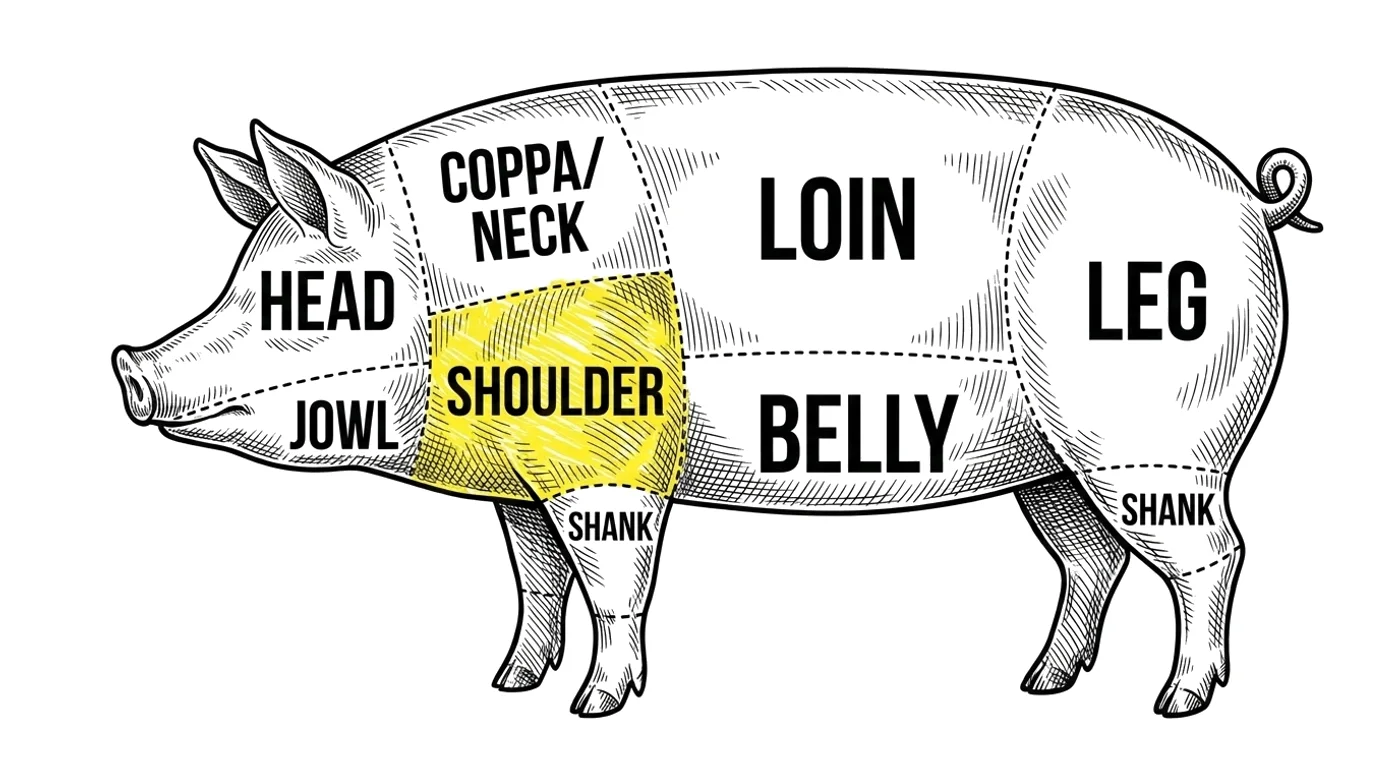
The cut
How to recognise it
A large straight sausage with a very fine uniform red-and-white mosaic, smooth slicing texture and paprika-garlic aroma. Shape and size: Large-diameter, smooth, fine paste. Lean colour: Uniform red. Fat and marbling: Fine, blended. Casing or exterior: Wide hog cular casing, 40 mm minimum, finely ground. Surface: Possible. The form is large-diameter, smooth, fine paste. the lean is uniform red. the fat or marbling is fine, blended. and the exterior uses wide hog cular casing, 40 mm minimum, finely ground. Grease smear, hollow pockets, case hardening, a wet centre, rancidity or uncontrolled dark mould is a production fault.
- Shape and size
- Large-diameter, smooth, fine paste
- Lean colour
- Uniform red
- Fat and marbling
- Fine, blended
- Casing
- Wide hog cular casing, 40 mm minimum, finely ground
- Surface bloom
- Possible
Origins and history
Chorizo only became the red sausage we know after peppers crossed from the Americas and dried pimentón entered Spanish kitchens through the sixteenth and seventeenth centuries; earlier chorizo was pale. Pamplona developed its own line: not the coarse, rustic chorizo of the villages but a finely ground paste stuffed into a wide, straight casing, often lightly cold-smoked and matured slowly much like a salami. The style was formalised in 1980 with its own Norma de Calidad, a national quality standard rather than a European protected name, which set the fine grind and the minimum width that still define it.
Pamplona's commercial charcuterie developed a smoother, more regular chorizo than the coarse rural forms. Its national quality definition formalised the fine particle size and broad straight casing that still identify the style.
Name. Chorizo; Pamplona the Navarrese capital.
- Production today
- Producers in Navarra.
- Protection
- Not EU-protected as a general name.
- Tradition vs modern
- Fine grind is the signature.
- Seasonality
- Year-round.
Compare with. Chorizo de Soria, Chorizo
Serving and cultural significance
Always eaten raw, never cooked. The fine, tight paste is the point of it: it slices clean and very thin without crumbling. Serve it in bocadillos, on a board with good bread, or as a bar tapa, where the sweet, smoky pimentón sits well against a glass of red.
Recipe and cure
This is not a finished recipe. It is a window into how this meat is traditionally cured. Before you follow any process, please run it through one of our curing calculators, so the salt, cure and timings are right and safe for your own batch.
Make this — the measured Curesmith version →The cure below is the traditional reference. “Make this” opens the measured Curesmith home recipe, scaled to your batch.
Traditional or protected production
Chorizo de Pamplona is a large straight dry sausage, generally at least 40 mm in diameter, distinguished by an unusually fine grind. It may be all pork or a pork-and-beef mixture and is seasoned with pimentón and garlic.
The reference process can be summarised as follows: Finely grind the lean meat, dice or finely prepare the fat, season, rest, stuff into a large permeable casing and carry out controlled fermentation and slow drying.
- Meat
- pork and beef
- Cut
- finely minced pork and beef
- Salt (%)
- 2.5
- Curing salt
- Cure #2
- Fermented
- Yes
- Target pH
- 4.9
- Starter or mould
- Natural surface mould
- Smoked
- Yes
- Target aW or weight loss
- ~30% weight loss
- Temperature (°C)
- ferment 22 to 24, then dry 13 to 15
- Humidity (%)
- ferment ~90, then 75 to 80
- Maturation
- 4 to 6 weeks
- Basis
- per 1000 g of lean pork (main meat); beef, back fat and spices are added as a percentage of the lean
- Style
- Traditional fermented and dried sausage
Ingredients
- lean pork (base)100% · 1000 g/kg
- beef30% · 300 g/kg
- back fat25% · 250 g/kg
- smoked paprika (pimenton dulce)2.8% · 28 g/kg
- hot paprika (pimenton picante)0.5% · 5 g/kg
- oregano, ground0.2% · 2 g/kg
- garlic0.35% · 3.5 g/kg
Method
- Mince pork and fat and mix with all ingredients to green meat weight.
- Stuff into casing.
- Ferment to the target pH.
- Dry to the target weight loss.
Notes
- This traditional recipe uses no nitrite. For safety we recommend adding Cure #2: in a low-oxygen, slow-dried product nitrite is the specific guard against Clostridium botulinum, while salt, acidity and drying control Salmonella, E. coli, Listeria and Staphylococcus.
- Recipe reconciled to the fuller traditional cure, with the starter culture, curing salt and the complete spicing recorded as ingredients.
- A pork and beef blend. No source gives a ratio, so the house default is used: pork as the main meat, beef at 30% and back fat at 25% of the pork.
In the Codex
What this product teaches, and where to read more.
Temple. Roof, Water Activity