
Chosco de Tineo
Tineo, Asturias, Spain
Robust, smoky and paprika-red, a hearty cooked Asturian speciality.
Overview
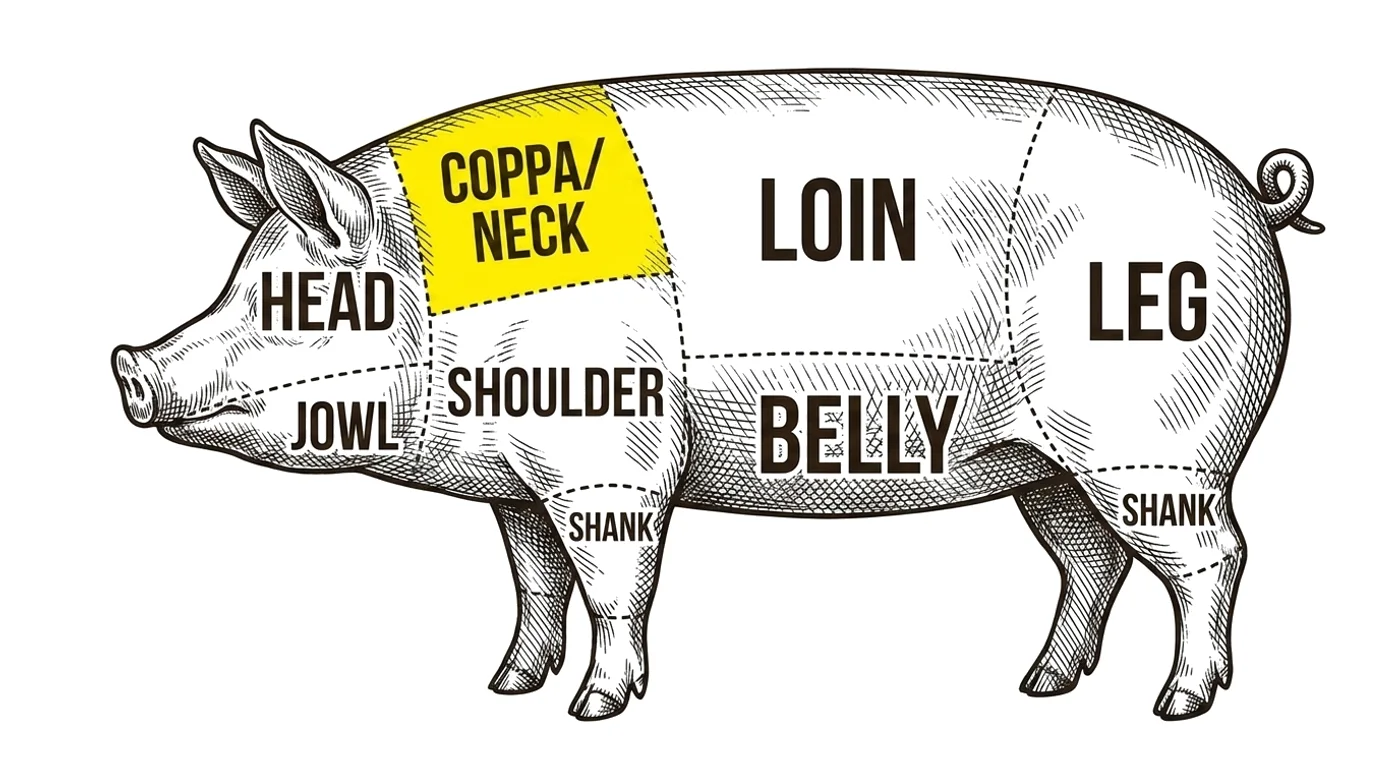
Chosco de Tineo is an Asturian casing filled principally with pork loin and tongue, seasoned, lightly smoked and cured. It may resemble a large sausage, but its structure is built from substantial meat pieces rather than a conventional mince. The home product must be cooked before eating.
Where it's from
Climate. The mountains of Tineo in western Asturias.
Altitude. Asturian mountains
The cut
How to recognise it
A whole Chosco is broad, irregular and darkened by smoke beneath a natural casing. When cooked and sliced, large red-pink pieces of loin and darker tongue should remain visible in a compact mosaic. Smoke is clean and moderate. A raw centre, sour odour, separated filling, tar bitterness or ruptured casing is defective.
- Shape and size
- Rounded, stuffed in the blind gut, deep red
- Lean colour
- Dark red, paprika-stained
- Fat and marbling
- Marbled
- Casing
- Pork caecum
- Surface bloom
- None
Origins and history
Western Asturian farms used the winter matanza to preserve nearly every part of the pig. Loin was valuable, while tongue added flavour and gelatin, and both could be packed into a caecal casing to form a large compact piece. Smoke from the farmhouse hearth suited the damp Atlantic climate and gave the Chosco enough resilience to wait for cooking in festive meals. Tineo became the recognised centre of the craft, and the product survived as a marker of western Asturian identity while many household slaughter practices declined. PGI protection formalised the meat composition, casing, smoking and production area. The current consolidated specification in force from 7 February 2025 must be used for final legal review.
Name. Chosco, a local name; Tineo the council.
- Production today
- Small producers around Tineo.
- Protection
- IGP.
- Tradition vs modern
- Smoked then boiled, a traditional cooked product.
- Seasonality
- Traditionally the winter slaughter.
Compare with. Botillo del Bierzo
Serving and cultural significance
Cook Chosco whole, allow it to settle, and cut it into generous slices. Serve with potatoes, cabbage, beans or bread. The loin provides clean meat while the tongue supplies richness, so acidic pickles or greens make useful accompaniments.
Recipe and cure
This is not a finished recipe. It is a window into how this meat is traditionally cured. Before you follow any process, please run it through one of our curing calculators, so the salt, cure and timings are right and safe for your own batch.
Curesmith home adaptation — not designation-compliant
Make this — the measured Curesmith version →The cure below is the traditional reference. “Make this” opens the measured Curesmith home recipe, scaled to your batch.
Traditional or protected production
The current PGI specification controls the loin-and-tongue composition, seasoning, casing, smoking and production within western Asturias. The protected product may be marketed in forms covered by the specification, but its raw cured state must not be confused with safe ready-to-eat status in a home process.
- Meat
- pork
- Salt (%)
- 2.8
- Curing salt
- Traditionally salt and paprika; a little Cure #1 optional for the smoked stage
- Fermented
- No
- Smoked
- Yes
- Target aW or weight loss
- cooked, not dried
- Temperature (°C)
- cooked through to a safe core temperature
- Humidity (%)
- n/a
- Maturation
- smoked, then boiled before eating
- Basis
- per 1000 g green meat
- Style
- Traditional, smoked then boiled
Ingredients
- Lean pork or loin (base)100% · 1000 g/kg
- Pork tongue18.75% · 188 g/kg
- Back fat6.25% · 62 g/kg
- Pimentón, sweet2.5% · 25 g/kg
- Pimentón, hot0.2% · 2 g/kg
- Garlic0.35% · 4 g/kg
Method
- Marinate or mix the meat with salt, paprika, garlic and seasoning.
- Stuff into the gut casing.
- Smoke gently, then boil for hours before eating.
- Serve hot.
Notes
- The official protected specification controls the named product. Any Curesmith EQ, starter-culture, curing-salt or home-scale adaptation is a separate method and must not be presented as designation-compliant.
- This is a cooked product. It must be cooked through before eating. Where a cure is used it is Cure #1 (nitrite), suited to the shorter, cooked process rather than long drying.
- Recipe reconciled to the fuller traditional cure, with the starter culture, curing salt and the complete spicing recorded as ingredients.
In the Codex
What this product teaches, and where to read more.
Temple. Pillar, Meat Quality