
Figatelli de l’Île de Beauté / Figatellu de l’Île de Beauté
Also known as Figatelli de l'Île de Beauté, Figatelli de l’Île de Beauté, Figatellu de l’Île de Beauté
Corsica (regional), Corsica, France
Rich and smoky with a distinct liver depth, grilled fresh or air-dried.
Overview
Figatellu is Corsica's strongly flavoured raw liver sausage, made with pork liver, meat and fat, seasoned and smoked. The protected Île de Beauté product was registered in 2023. It must be cooked thoroughly before eating.
Where it's from
Climate. Corsica, the maquis-scented island interior.
Altitude. Corsican hills
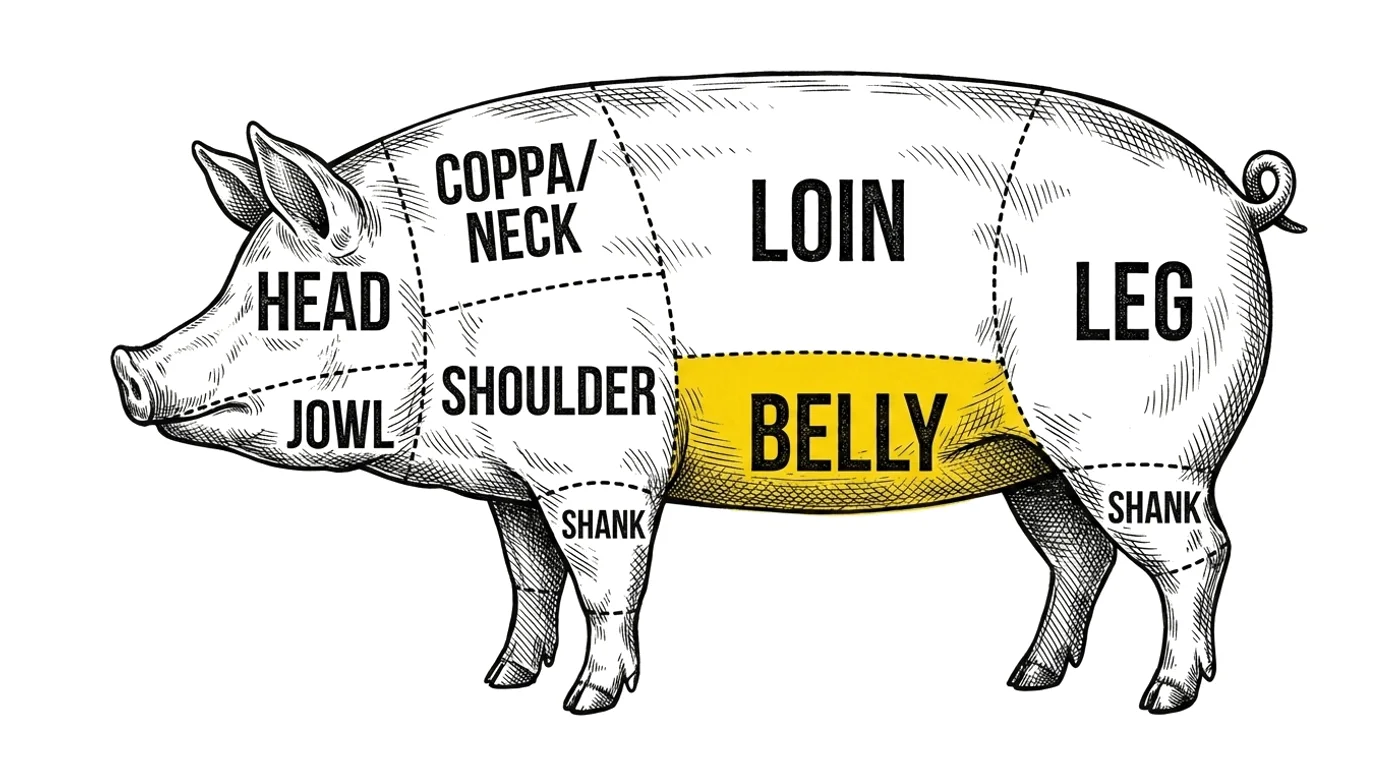
The cut
How to recognise it
The raw sausage is dark red-brown, often curved or linked, with a pronounced liver and smoke aroma. After cooking, the centre must be fully set and juicy without raw blood-coloured pockets. Sourness, rancidity, tar bitterness or an undercooked centre is unacceptable.
- Shape and size
- Slim, dark, U-shaped links
- Lean colour
- Dark, liver-rich
- Fat and marbling
- Flecked
- Casing
- Hog casing, 28 to 42 mm, in U-shaped loops
- Surface bloom
- Possible if dried
Origins and history
Fresh liver could not wait long after the winter slaughter, so Corsican households mixed it promptly with fatty pork, stuffed the mixture into casing and hung the links in hearth smoke. The sausage supplied a powerful early product while hams and whole muscles were still months from maturity. Figatellu became one of the island's most recognisable winter foods, grilled over wood, cooked with polenta or added to stews. Its strong flavour also made provenance important as tourism expanded and generic products borrowed the name. The broader Corsican producer consortium developed a controlled Île de Beauté chain, and the EU registered Figatelli together with Pancetta, Bulagna and Saucisson sec on 26 July 2023.
Name. Figatellu, from fegato, 'liver'.
- Production today
- Corsican producers.
- Protection
- IGP (Ile de Beaute).
- Tradition vs modern
- Grilled fresh or air-dried; chestnut smoke throughout.
- Seasonality
- A winter sausage.
Serving and cultural significance
Grill slowly, roast or cook in a pan, then serve with pulenta, eggs, potatoes or winter greens. The casing may split under fierce heat, so cook gently enough to bring the centre through without burning the exterior.
Recipe and cure
This is not a finished recipe. It is a window into how this meat is traditionally cured. Before you follow any process, please run it through one of our curing calculators, so the salt, cure and timings are right and safe for your own batch.
Curesmith home adaptation — not designation-compliant
Make this — the measured Curesmith version →The cure below is the traditional reference. “Make this” opens the measured Curesmith home recipe, scaled to your batch.
Traditional or protected production
The PGI specifies qualifying pork liver, meat and fat, seasoning, casing, smoke and production in Corsica. It remains a raw sausage intended for cooking.
- Meat
- pork
- Cut
- shoulder and belly, with pork liver
- Salt (%)
- 1.8
- Curing salt
- Not included in the base recipe below
- Fermented
- No
- Starter or mould
- Natural surface mould
- Smoked
- Yes
- Target aW or weight loss
- ~30% weight loss
- Temperature (°C)
- ferment 22 to 24, then dry 13 to 15
- Humidity (%)
- ferment ~90, then 75 to 80
- Maturation
- grilled fresh, or air-dried a few weeks
- Basis
- per 1000 g green meat
- Style
- Traditional fermented and dried sausage, smoked
Ingredients
- pork shoulder (base)100% · 1000 g/kg
- pork back fat15% · 150 g/kg
- pork liver30% · 300 g/kg
- sea salt1.8% · 18 g/kg
- garlic1% · 10 g/kg
- black pepper0.6% · 6 g/kg
- dry red wine6% · 60 g/kg
Method
- Mince pork and fat and mix with all ingredients to green meat weight.
- Stuff into casing.
- Ferment to the target pH.
- Dry to the target weight loss.
Notes
- The official protected specification controls the named product. Any Curesmith EQ, starter-culture, curing-salt or home-scale adaptation is a separate method and must not be presented as designation-compliant.
- This traditional recipe uses no nitrite. For safety we recommend adding Cure #2: in a low-oxygen, slow-dried product nitrite is the specific guard against Clostridium botulinum, while salt, acidity and drying control Salmonella, E. coli, Listeria and Staphylococcus.
- A fresh liver sausage. Cook it through, by grilling or baking, before eating. It is not a raw, sliceable salame.
- Meat split: pork shoulder as the base, back fat at 15% and pork liver at 30% of the shoulder, with ratios on the total protein weight. Some versions also add about 5% pig blood.
In the Codex
What this product teaches, and where to read more.
Temple. Roof, Microclimate