
Fuet
foo-ET
Also known as Secallona
Catalonia (regional), Catalonia, Spain
Firm, garlicky and pepper-forward, wrapped in its signature white bloom.
Overview
Fuet is a narrow Catalan dry sausage made from pork and firm fat, seasoned simply and matured beneath a pale natural mould. Its small diameter gives a short, even cure and a familiar flexible stick shape. The name is generic rather than protected.
Where it's from
Climate. Catalonia, where a thin section dries quickly in the local air.
Altitude. Catalonia
The cut
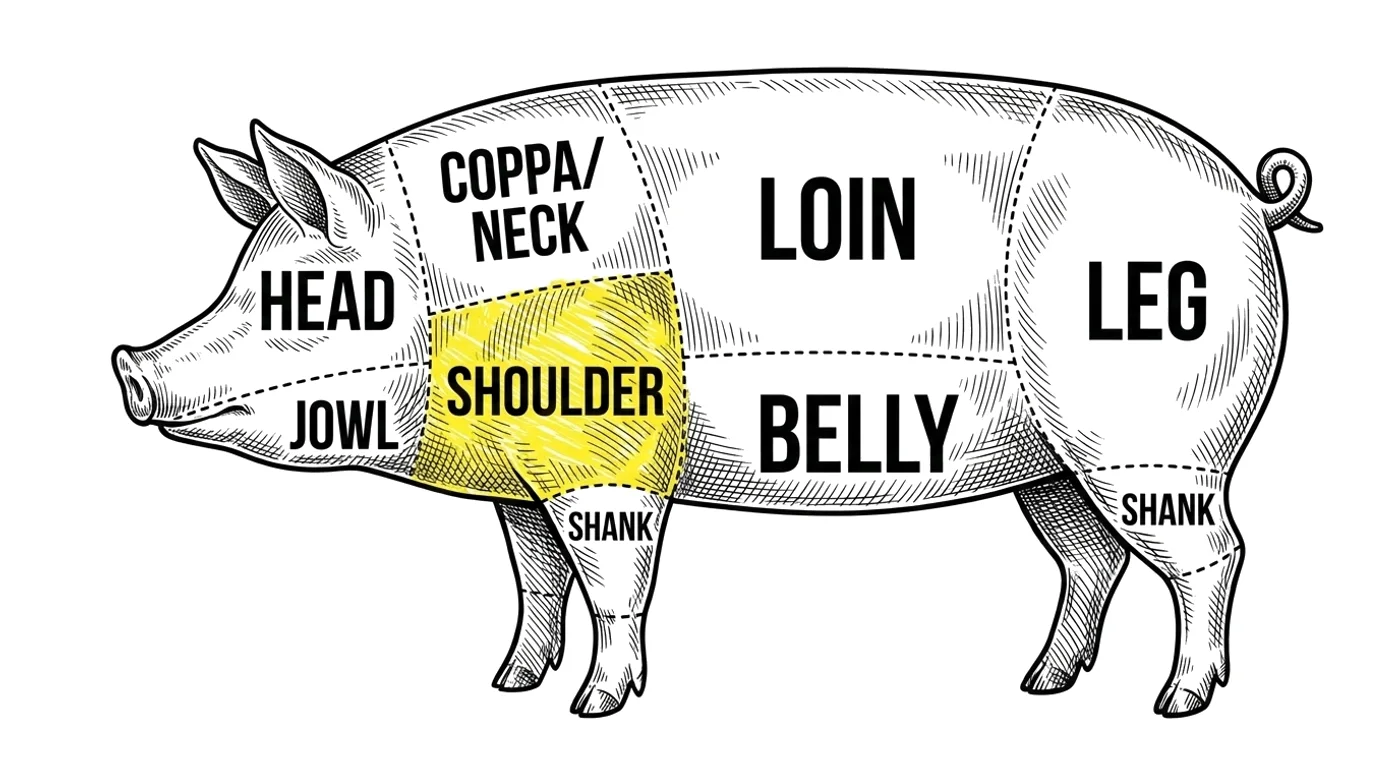
How to recognise it
Fuet is long and slender, normally in a narrow natural casing covered with a dry white-grey bloom. The slice is pink-red with small white fat particles and a mild pepper-garlic aroma. It should bend slightly rather than crumble. Sticky casing, green or black mould, a hollow centre, smeared fat or sharp sourness indicates poor processing.
- Shape and size
- Thin, long, whip-like, white-dusted
- Lean colour
- Pink flecked
- Fat and marbling
- Fine white specks
- Casing
- Hog casing (small intestine), 34 to 36 mm
- Surface bloom
- Characteristic white mould
Origins and history
Fuet belongs to the Catalan family of raw cured sausages that begins with fresh botifarra and continues through lightly dried secallona to firmer longanissa. The word fuet means whip, a reference to the long narrow form. Another Catalan name, espetec, is associated with the snapping sound made when the dried sausage is broken. Farm families hung the links after the winter slaughter, using the dry period to preserve pork for breakfasts, snacks and field work. The product became one of Catalonia's most widely recognised everyday sausages because it was small, portable and quick to mature. Generalitat records preserve this relationship between fuet, secallona and longanissa, but the generic name itself is not an EU geographical indication.
Name. Fuet is Catalan for 'whip', from its shape.
- Production today
- Catalan producers; Fuet d'Olot and similar local names.
- Protection
- Unprotected as a general name.
- Tradition vs modern
- The white surface mould is embraced as part of the product, not a flaw.
- Seasonality
- Made year-round.
Compare with. Salchichón
Serving and cultural significance
Cut Fuet into small diagonal slices and serve with pa amb tomàquet, cheese, olives or as part of an embotits board. It is also a common breakfast, school snack or hiking food. Many Catalans eat the white casing bloom, provided it is the intended clean mould.
Recipe and cure
This is not a finished recipe. It is a window into how this meat is traditionally cured. Before you follow any process, please run it through one of our curing calculators, so the salt, cure and timings are right and safe for your own batch.
Make this — the measured Curesmith version →The cure below is the traditional reference. “Make this” opens the measured Curesmith home recipe, scaled to your batch.
Traditional or protected production
Traditional Fuet uses pork and fat with salt, pepper and modest seasoning. It is stuffed into a narrow casing and dried longer than secallona but generally remains smaller and less aged than broad llonganissa. Regional producers may use protective mould and modern curing agents, but no single protected specification governs the generic product.
- Meat
- pork
- Cut
- minced pork
- Salt (%)
- 2.8
- Curing salt
- Cure #2
- Other agents
- garlic, pepper, sometimes aniseed
- Fermented
- Yes
- Target pH
- 5
- Starter or mould
- White Penicillium bloom
- Smoked
- No
- Target aW or weight loss
- ~30% weight loss
- Temperature (°C)
- light ferment, then dry 13 to 15
- Humidity (%)
- ferment ~90, then 80
- Maturation
- 2 to 4 weeks
- Basis
- per 1000 g of lean pork (main meat); back fat and other meats are added as a percentage of the lean
- Style
- Traditional dried thin sausage, white mould
Ingredients
- lean pork (base)100% · 1000 g/kg
- back fat42.86% · 429 g/kg
- paprika0.4% · 4 g/kg
- black pepper0.3% · 3 g/kg
- garlic0.3% · 3 g/kg
Method
- Mix minced pork with pepper, garlic and the rest to green weight.
- Stuff into a thin casing and inoculate the white mould.
- Light ferment, then dry.
- Dry to the target loss; the thin section dries fast.
Notes
- This traditional recipe uses no nitrite. For safety we recommend adding Cure #2: in a low-oxygen, slow-dried product nitrite is the specific guard against Clostridium botulinum, while salt, acidity and drying control Salmonella, E. coli, Listeria and Staphylococcus.
- Recipe reconciled to the fuller traditional cure, with the starter culture, curing salt and the complete spicing recorded as ingredients.
Safety. Thin, so it dries quickly and is relatively forgiving, but the process still applies. Verify before serving.
In the Codex
What this product teaches, and where to read more.
Temple. Roof, Water Activity