
Gołąbki
Also known as Polish cabbage rolls, Cabbage Roll Sausage
National, with regional variants, Poland
Where it's from
The cut
Identity
Gołąbki are Polish cabbage leaves wrapped around a savoury filling and braised or baked. The familiar everyday filling combines minced meat, rice and onion, often with tomato or mushroom sauce. Their closed cylindrical form resembles a casing around sausage meat, which explains the source-page label Cabbage Roll Sausage, but gołąbki are a prepared dish rather than a technical meat sausage.
Name
Gołąbki literally means little pigeons. The name refers to the compact shape of the wrapped parcels rather than their ingredients. English descriptions usually call them stuffed cabbage or cabbage rolls. Because the wrapper is a vegetable leaf and the filling commonly contains cooked grain, the product sits closer to dolma and other filled-leaf dishes than to an intestine-cased sausage.
Historical development
The precise route into Polish cooking is unsettled. Polish cultural sources point to possible Turkish, Armenian or Jewish influence and to early use in the eastern borderlands. Nineteenth-century cookery books already describe stuffed cabbage called gołąbki, with groats or rice, sauerkraut leaves and meats ranging from poultry to pork and bacon. That evidence supports a diverse dish family rather than one fixed recipe.
Composition and regional forms
The common meat version uses pork or mixed meat with rice, onion, salt and pepper in blanched white-cabbage leaves. Other Polish forms use buckwheat, barley, potatoes, mushrooms or soured cabbage. Poland's Traditional Products List includes named regional preparations, but those entries do not turn every gołąbki recipe into a protected geographical product.
Production and service
Leaves are softened, their thick ribs trimmed, and each portion of filling is enclosed with the seam underneath. The rolls are packed closely so they hold their shape while cooking. Tomato sauce is common in home and institutional cooking; mushroom sauce and sour cream also appear. Gołąbki are served hot and are well suited to reheating because the filling absorbs flavour from the sauce.
Boundaries
Gołąbki are not fermented cabbage, despite the use of cabbage leaves, and they are not shelf-stable. They are also distinct from German Weißkrautwürstchen, which is an intestine-cased sausage containing cabbage, and from meatless Christmas gołąbki filled with grain and mushrooms. Atlas placement should identify the entry as culinary context, not a canonical cured-meat identity.
Recipe and cure
This is not a finished recipe. It is a window into how this meat is traditionally cured. Before you follow any process, run it through one of our curing calculators so the salt, cure and timings are right and safe for your own batch.
- Meat
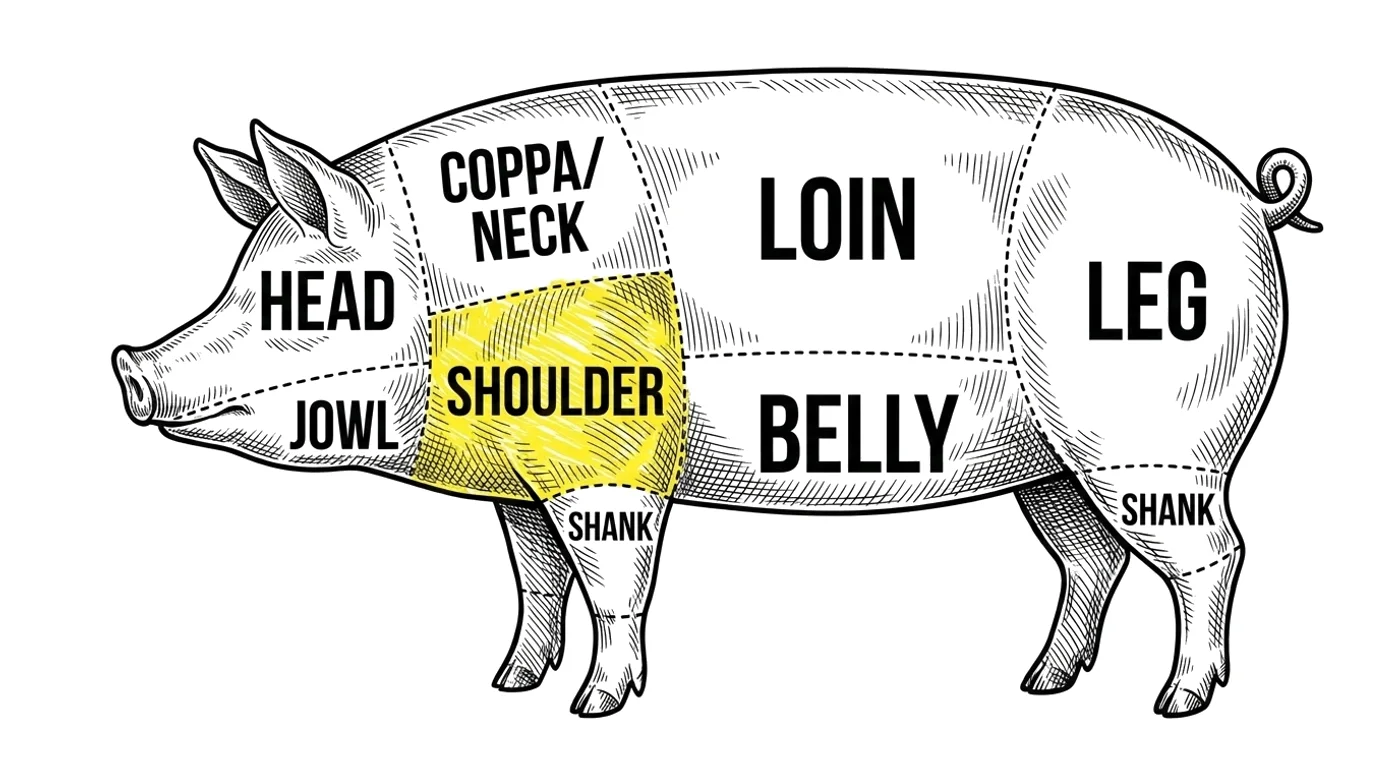
- Pork shoulder
- Cut
- Pork shoulder
- Salt (%)
- 1.5
- Curing salt
- None
- Fermented
- No
- Smoked
- No
- Maturation
- Refrigerate at 0–4°C for up to 4 days or freeze
- Basis
- per 1,000 g pork shoulder
- Style
- Polish stuffed cabbage dish in an edible leaf wrapper
Ingredients
- Pork shoulder100% · 1000 g
- Cooked long-grain rice, chilled7.7% · 231 g
- Onion, finely diced10.3% · 307.5 g
- Prepared blanched white-cabbage leaves107.7% · 1077 g
- Unsalted chicken stock25.6% · 769 g
- Plain tomato passata92.3% · 923 g
- Plain wheat flour1% · 31 g
- Fine salt0.5% · 15 g
- Black pepper0.05% · 1.5 g
- Dried oregano0.08% · 2.5 g
- Sweet paprika0.05% · 1.5 g
- Dried thyme0.05% · 1.5 g
Method
- Cook rice until just tender, spread shallow and chill to 5°C or below.
- Core and blanch the cabbage; separate leaves and trim thick ribs.
- Sweat onion until soft and lightly golden; cool to 5°C or below.
- Grind pork shoulder through 8–10 mm.
- Mix pork, rice, onion, salt and spices evenly without overworking.
- Portion filling into cabbage leaves, fold sides inward and roll tightly.
Safety. Chill cooked rice and onion before mixing with raw meat, cook every parcel fully, cool leftovers rapidly and refrigerate.