
Jambon d'Auvergne
Auvergne (regional), Auvergne, France
Firm, nutty and savoury, cured in the clean air of the volcanic Massif Central.
Overview
Jambon d'Auvergne is an unsmoked mountain ham seasoned with salt and garlic, matured for at least eight months in the volcanic uplands of central France. Garlic is not a garnish added at service; it belongs to the protected curing identity.
Where it's from
Climate. The clean air of the volcanic Massif Central in the Auvergne.
Altitude. Volcanic Massif Central
The cut
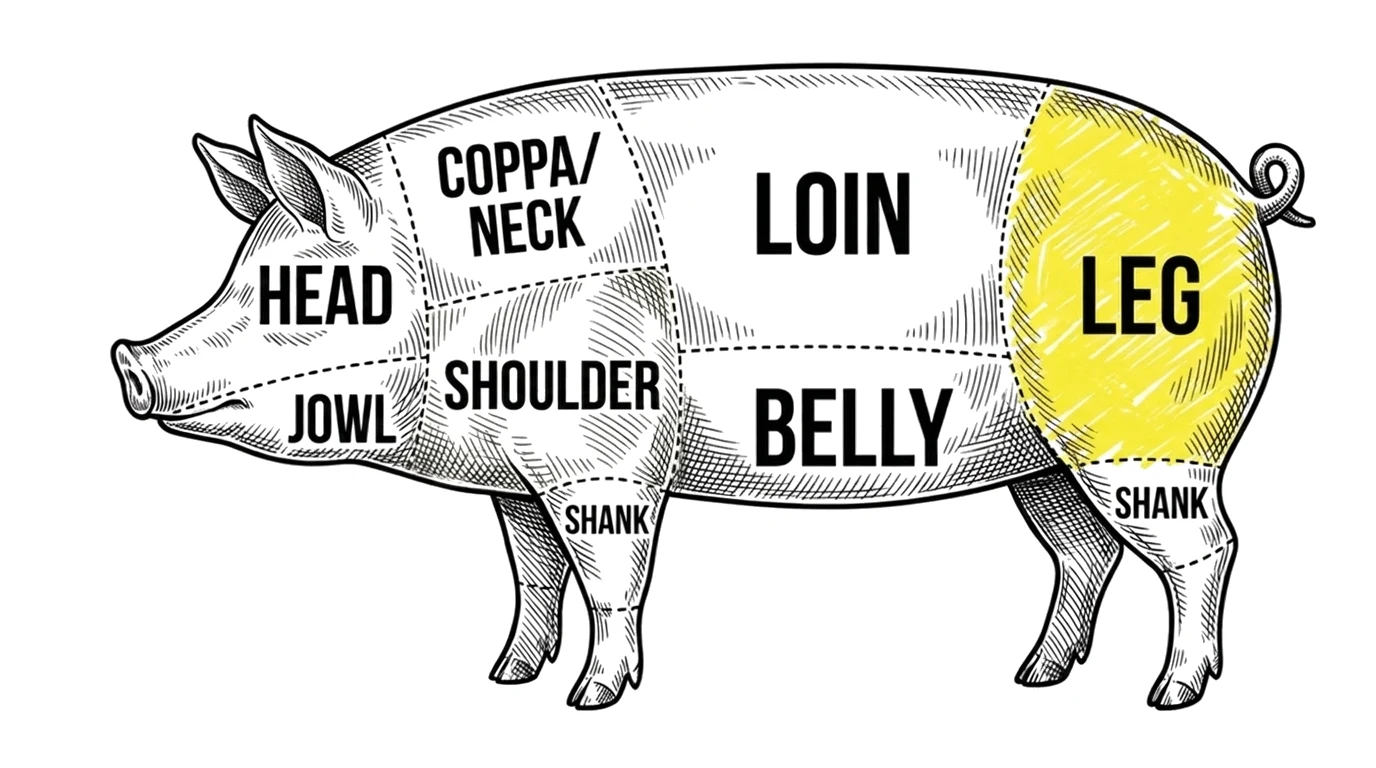
How to recognise it
The ham is rounded and dry, with a red to deep pink slice and white or cream fat. Garlic should be perceptible but integrated, and smoke should be absent. The texture is firm yet sliceable. Burnt garlic, rancidity, sourness or a sticky bone area are faults.
- Shape and size
- Whole leg, firm
- Lean colour
- Deep red
- Fat and marbling
- White
- Casing
- None
- Surface bloom
- Possible
Origins and history
Auvergne's farms combined pigs, dairy cattle, grain and cold-season household slaughter. High plateaux and volcanic valleys provided cool air and winter conditions for drying whole legs. Garlic grew easily, stored well and became a practical seasoning for salt cures, helping the local ham stand apart from the plainer products of neighbouring regions. Farmhouse production supplied family tables and travelling workers before specialist curing businesses carried the name into national markets. The ham remained connected with rustic bread, cheese and lentils rather than courtly luxury. PGI recognition protects the Auvergne production area, garlic-seasoned cure, unsmoked character and minimum maturation.
Name. Jambon, ham; Auvergne the region.
- Production today
- Producers across the Auvergne.
- Protection
- IGP.
- Tradition vs modern
- Upland-air ageing.
- Seasonality
- Year-round.
Compare with. Saucisson sec d’Auvergne / Saucisse sèche d’Auvergne, Jambon de l'Ardèche
Serving and cultural significance
Serve thinly with rye or country bread, lentils, Cantal cheese, pickles or a light Auvergne wine. Small pieces can season cabbage and potato dishes, but prolonged frying will harden the lean. Let the slices stand briefly after cutting so the garlic aroma opens, but protect the exposed ham from drying during longer service.
Recipe and cure
This is not a finished recipe. It is a window into how this meat is traditionally cured. Before you follow any process, please run it through one of our curing calculators, so the salt, cure and timings are right and safe for your own batch.
Curesmith home adaptation — not designation-compliant
Make this — the measured Curesmith version →The cure below is the traditional reference. “Make this” opens the measured Curesmith home recipe, scaled to your batch.
Traditional or protected production
The PGI requires processing in the protected area, dry curing with salt and garlic, no smoking, and at least eight months of maturation. The specification controls the pork leg, process and final characteristics.
Sea salt, salt-box method; no fixed percentage.
- Meat
- pork
- Salt (%)
- traditional, no fixed %
- Curing salt
- Sea salt only
- Fermented
- No
- Starter or mould
- Natural cellar mould possible
- Smoked
- No
- Target aW or weight loss
- ~ weight loss
- Temperature (°C)
- cold salting, then 10 to 15
- Humidity (%)
- 70 to 80
- Maturation
- 9 months and up
- Basis
- percentage of green meat weight
- Style
- Traditional dry salting (salt-box)
Method
- Salt and season the cut by the traditional method and rest cold so the salt draws through.
- Wash or brush off surface salt and begin the slow dry.
- Case or hang as the style requires.
- Age to the target loss, judging by weight.
Notes
- The official protected specification controls the named product. Any Curesmith EQ, starter-culture, curing-salt or home-scale adaptation is a separate method and must not be presented as designation-compliant.
- A more efficient way of curing this product is using the EQ Method. No more than 2.5% salt to meat weight is required. To follow the EQ method, please use our whole-muscle EQ curing calculator to work out proper ratios and curing times.
In the Codex
What this product teaches, and where to read more.
Temple. Roof, Microclimate