
Jambon de Lacaune
Lacaune (Tarn), Occitanie, France
Well-balanced and characterful, a mountain ham from a famous charcuterie town.
Overview
Jambon de Lacaune is the dry-cured ham of the Monts de Lacaune, a high, ventilated district of southern France. Sea salt and mountain maturation produce a mild, unsmoked ham linked to the same curing town that gives its name to protected Lacaune sausages.
Where it's from
Climate. The Monts de Lacaune in the Tarn, cool and well-ventilated.
Altitude. Monts de Lacaune
The cut
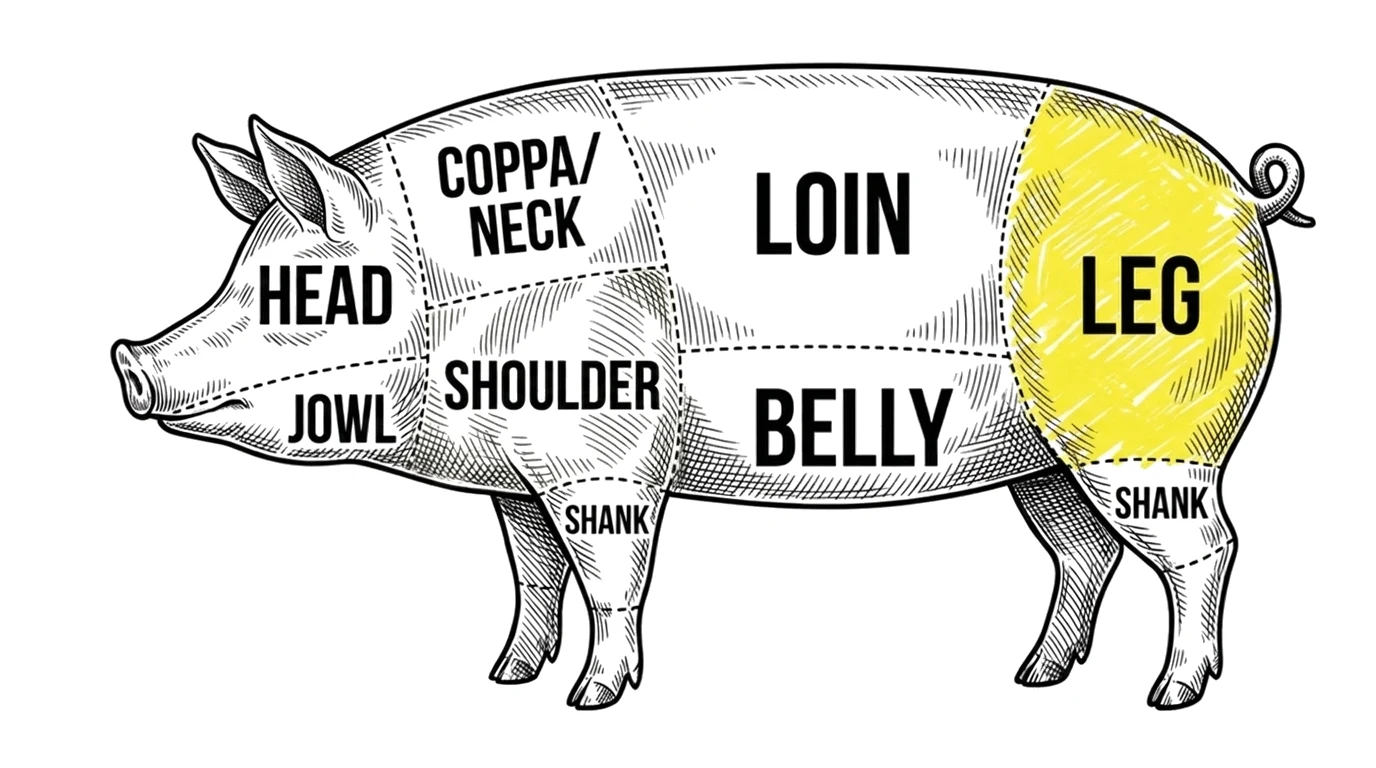
How to recognise it
The ham is elongated and neatly trimmed, with a red slice, clean pale fat and a gentle cured aroma. It is unsmoked and should taste balanced rather than sharply salty. A hard rim, grey centre, rancidity or bone taint is defective.
- Shape and size
- Whole leg
- Lean colour
- Red
- Fat and marbling
- White
- Casing
- None
- Surface bloom
- Possible
Origins and history
Lacaune developed as a curing centre at roughly 800 metres, where winds from Atlantic and Mediterranean systems met across the southern Massif Central. Local farms raised pigs and used the cold season to salt legs and make sausages. The town's butchers and curing houses expanded during the nineteenth and twentieth centuries, benefiting from roads, markets and the reputation of mountain air. Sea salt arrived through southern trade routes and remained part of the protected ham process. As production modernised, regional businesses organised around shared specifications rather than relying only on the evocative idea of natural air. Jambon de Lacaune received PGI recognition together with the area's dry sausages, securing the place name and a continuing local industry.
Name. Jambon, ham; Lacaune names the town and mountains.
- Production today
- Producers in the Lacaune area.
- Protection
- IGP.
- Tradition vs modern
- Mountain-air ageing.
- Seasonality
- Year-round.
Compare with. Saucisson de Lacaune / Saucisse de Lacaune
Serving and cultural significance
Cut thin slices and serve with bread, local cheese, pickles or wines from south-western France. The ham also suits simple salads and warm potatoes, provided it is not overcooked. It also works in a rustic sandwich with butter and cornichons, where its mild cure remains clearer than it would beneath a strong mustard.
Recipe and cure
This is not a finished recipe. It is a window into how this meat is traditionally cured. Before you follow any process, please run it through one of our curing calculators, so the salt, cure and timings are right and safe for your own batch.
Curesmith home adaptation — not designation-compliant
Make this — the measured Curesmith version →The cure below is the traditional reference. “Make this” opens the measured Curesmith home recipe, scaled to your batch.
Traditional or protected production
The PGI controls salting with sea salt, post-salting, drying and maturation in the Monts de Lacaune area. The protected geography and local curing knowledge apply to the complete process.
Sea salt, salt-box method; no fixed percentage.
- Meat
- pork
- Salt (%)
- traditional, no fixed %
- Curing salt
- Sea salt only
- Fermented
- No
- Starter or mould
- Natural cellar mould possible
- Smoked
- No
- Target aW or weight loss
- ~ weight loss
- Temperature (°C)
- cold salting, then 10 to 15
- Humidity (%)
- 70 to 80
- Maturation
- 7 to 12 months
- Basis
- percentage of green meat weight
- Style
- Traditional dry salting (salt-box)
Method
- Salt and season the cut by the traditional method and rest cold so the salt draws through.
- Wash or brush off surface salt and begin the slow dry.
- Case or hang as the style requires.
- Age to the target loss, judging by weight.
Notes
- The official protected specification controls the named product. Any Curesmith EQ, starter-culture, curing-salt or home-scale adaptation is a separate method and must not be presented as designation-compliant.
- A more efficient way of curing this product is using the EQ Method. No more than 2.5% salt to meat weight is required. To follow the EQ method, please use our whole-muscle EQ curing calculator to work out proper ratios and curing times.
In the Codex
What this product teaches, and where to read more.
Temple. Roof, Microclimate