
Jamón Serrano
ha-MOHN seh-RAH-noh
Made across Spain (white-pig breeds), Nationwide, Spain
Firm, savoury and lightly sweet, the accessible cousin of iberico.
Overview
Jamón Serrano is Spain's registered traditional dry-cured ham. Its TSG status protects a method and product character rather than a single place of origin. The name covers pork hind legs salted, rested, dried and matured through a defined process, producing a firm red ham with clean white fat.
Where it's from
Climate. Made across Spain, historically air-dried in cool mountain air (sierra).
Altitude. Varies; mountain tradition
The cut
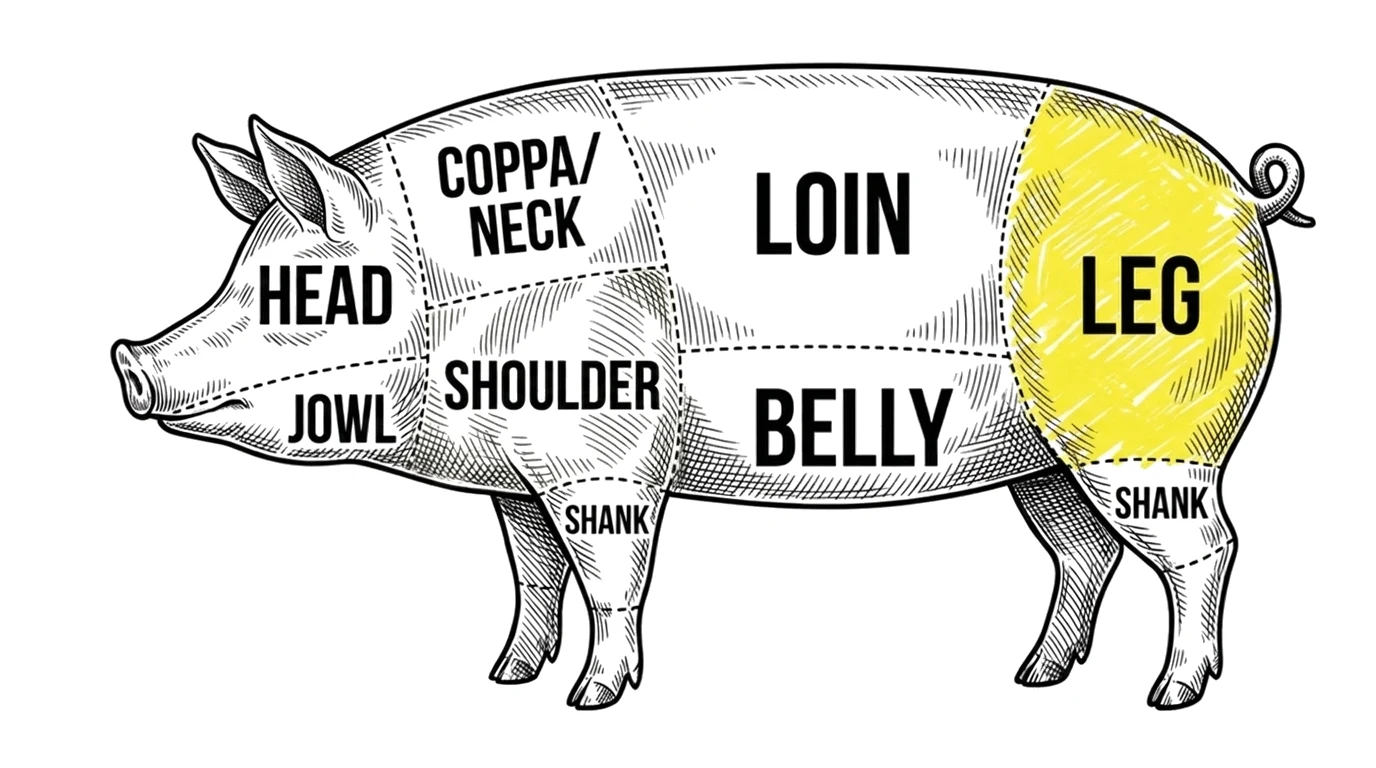
How to recognise it
The ham is elongated and firm, with pink-red to deep red lean and white or cream fat. Slices are less heavily marbled than Ibérico ham and have a clean savoury aroma. Certification and labelling distinguish TSG Jamón Serrano from generic cured ham. Sourness, rancid fat, a sticky bone area or an excessively salty dry rim are faults.
- Shape and size
- Whole leg, hoof often left on
- Lean colour
- Rosy to red
- Fat and marbling
- White cover
- Casing
- None
- Surface bloom
- Possible natural mould
Origins and history
Dry-curing pork legs is one of the oldest recurring practices in Iberian food history. Winter slaughter provided cool conditions for salting, while mountain and inland air allowed the legs to dry gradually. Serrano means from the sierra or mountain country, reflecting the association between upland curing air and good ham rather than one named mountain range. The product became the everyday white-pig counterpart to regional Ibérico hams, appearing in homes, taverns and urban shops throughout Spain. Industrial production broadened its availability, but also made a common standard necessary. Jamón Serrano was registered as a Traditional Speciality Guaranteed in 1999. The TSG confirms the traditional character and process while allowing production outside a narrowly defined geographical area.
Name. Serrano from sierra, 'mountain range'.
- Production today
- Made nationwide by many producers.
- Protection
- TSG (Traditional Speciality Guaranteed): protects the method, not a place. Origin-protected regional hams include Teruel DOP and Trevelez IGP.
- Tradition vs modern
- Grades by ageing; the mountain-air tradition survives alongside controlled-room production.
- Seasonality
- Made year-round.
Compare with. Jamón Ibérico de Bellota, Prosciutto di Parma
Serving and cultural significance
Slice thinly and serve with bread, tomato, olives, Manchego or fruit. Serrano ham also flavours croquetas, beans, vegetables and eggs. When cooked, use it late or briefly so that the lean does not become hard and salty.
Recipe and cure
This is not a finished recipe. It is a window into how this meat is traditionally cured. Before you follow any process, please run it through one of our curing calculators, so the salt, cure and timings are right and safe for your own batch.
Curesmith home adaptation — not designation-compliant
Make this — the measured Curesmith version →The cure below is the traditional reference. “Make this” opens the measured Curesmith home recipe, scaled to your batch.
Traditional or protected production
The TSG specification defines the pork leg, salting, resting, drying and maturation stages and establishes a minimum process. It protects the traditional method rather than a unique place. Certified producers must document compliance and may use the TSG name and symbol. Regional products such as Jamón de Teruel PDO and Jamón de Trevélez PGI remain legally separate.
Sea salt only, salt-box method. No fixed percentage.
- Meat
- white pig breeds
- Cut
- whole hind leg
- Salt (%)
- traditional, no fixed %
- Curing salt
- Sea salt only
- Other agents
- salt
- Fermented
- No
- Starter or mould
- Possible natural mould
- Smoked
- No
- Target aW or weight loss
- ~ weight loss by grade
- Temperature (°C)
- cold salting, then 15 to 30 ageing
- Humidity (%)
- 60 to 80
- Maturation
- 7 to 18 months
- Basis
- percentage of green meat weight
- Style
- Traditional dry salting (salt-box)
Ingredients
- sea salt3.75% · 37.5 g/kg
- sugar1.25% · 12.5 g/kg
- Cure #2 (optional)0.3% · 3 g/kg
Method
- Salt cold in sea salt, roughly a day per kilo.
- Rest so the salt equalises.
- Age to the target loss for the grade (bodega, reserva, gran reserva).
Notes
- The official protected specification controls the named product. Any Curesmith EQ, starter-culture, curing-salt or home-scale adaptation is a separate method and must not be presented as designation-compliant.
- A more efficient way of curing this product is using the EQ Method. No more than 2.5% salt to meat weight is required. To follow the EQ method, please use our whole-muscle EQ curing calculator to work out proper ratios and curing times.
- A salt-box rub of roughly 75:25 salt to sugar at 5% of meat, plus coarse covering salt and optional Cure #2. After curing, the exposed face is traditionally sealed with a pimenton-and-lard coat (about pimenton 2.5%, lard 10%), which is a surface seal rather than part of the ingoing cure.
Safety. The everyday Spanish ham. Salt-box method, judged by weight loss. Verify before serving.
In the Codex
What this product teaches, and where to read more.
Temple. Foundation, Time