
Katenrauchwurst
Also known as cottage smoked sausage
Holstein, northern Germany, Northern Germany, Germany
Overview
Katenrauchwurst is a dark brown smoked sausage with coarse pork and fat, strong clean smoke and juniper. it should remain firm without soot bitterness. A dark brown smoked sausage with coarse pork and fat, strong clean smoke and juniper. It should remain firm without soot bitterness. The Codex treats it as a complete production system, not merely a familiar name. Raw material, cut or particle size, casing, smoke, fermentation, cooking and maturation all contribute to the identity. The current status is Traditional northern German farmhouse-style sausage : no EU GI. The protected or traditional reference and the Curesmith home method remain separate.
Where it's from
The cut
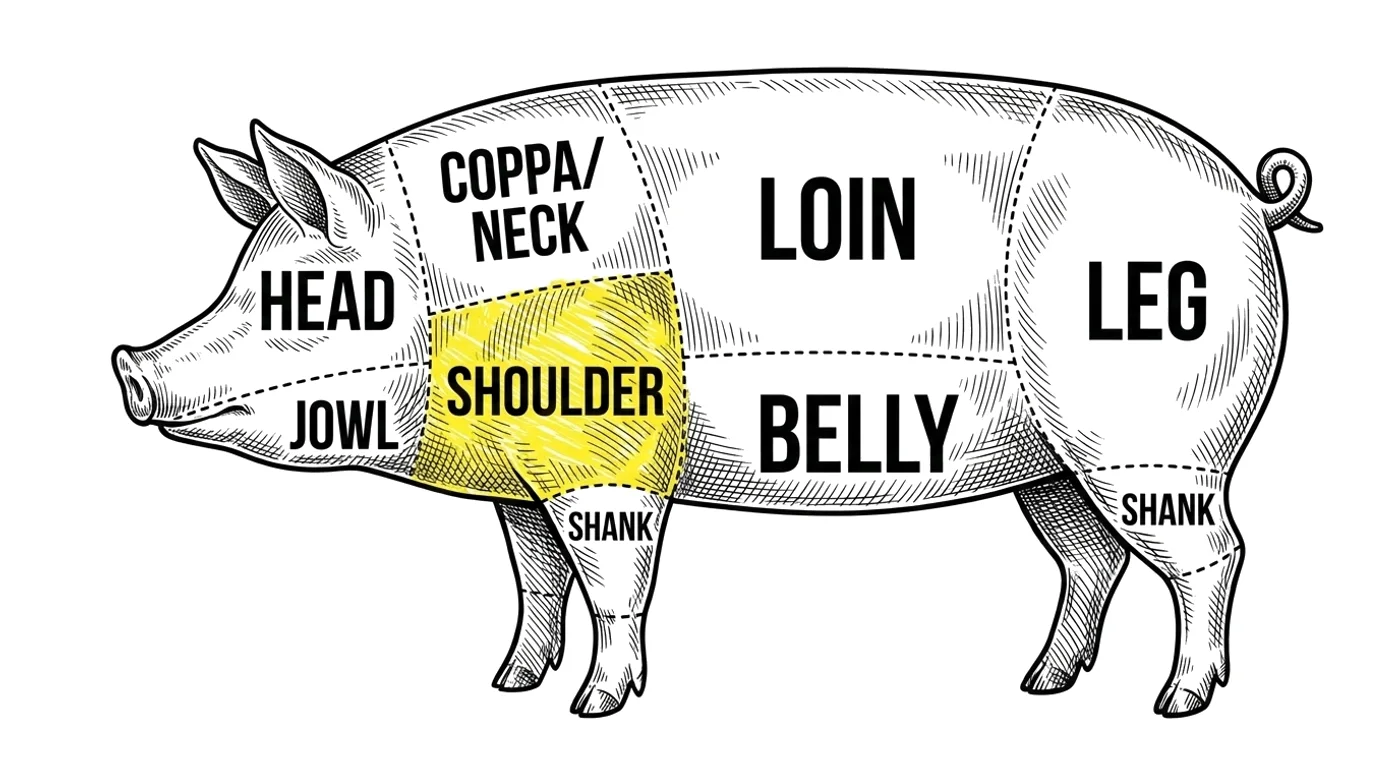
How to recognise it
A dark brown smoked sausage with coarse pork and fat, strong clean smoke and juniper. It should remain firm without soot bitterness. Grease smear, hollow pockets, case hardening, a wet centre, rancidity or uncontrolled dark mould is a production fault.
Origins and history
The word Kate refers to the small cottages and farmhouses of northern Germany, where meat once hung above or near an open hearth and absorbed smoke over many days. Katenrauchwurst preserves that farmhouse image in sausage form: a coarse pork mixture, firm smoke and a drying period suited to cool Schleswig-Holstein conditions. Modern products vary because the generic name is not one EU geographical indication. It must also be kept separate from Holsteiner Katenschinken, Holsteiner Schinken, Holsteiner Katenrauchschinken and Holsteiner Knochenschinken, which form a registered PGI family of whole hams rather than sausages.
Serving and cultural significance
Serve thinly with rye bread, potatoes, cabbage or beer, allowing the farmhouse smoke to remain central. It can also season soups, but heavy frying may make the smoke harsh and the lean dry. On a northern German cold plate it is commonly paired with coarse bread and sour vegetables, foods that cut through the dense smoke and pork fat.
Recipe and cure
This is not a finished recipe. It is a window into how this meat is traditionally cured. Before you follow any process, run it through one of our curing calculators so the salt, cure and timings are right and safe for your own batch.
Make this — the measured Curesmith version →The cure below is the traditional reference. “Make this” opens the measured Curesmith home recipe, scaled to your batch.
Traditional or protected production
Generic Katenrauchwurst is a northern German farmhouse-style smoked sausage. Pork and fatty pork are cured, seasoned, stuffed and fermented or conditioned before repeated cold smoke and drying. The degree of smoke and final firmness varies among producers. The sausage is legally and technically distinct from Holsteiner Katenrauchschinken, which is a protected whole ham within the Holsteiner Katenschinken PGI family.
- Meat
- pork
- Cut
- minced
- Salt (%)
- 2.2 to 2.5%
- Curing salt
- Cure #1
- Other agents
- dextrose; black pepper, allspice
- Fermented
- Yes
- Target pH
- ~4.9
- Starter or mould
- lactic acid bacteria starter
- Smoked
- heavily cold-smoked over weeks
- Target aW or weight loss
- ~30% weight loss
- Temperature (°C)
- ferment then dry 12 to 14
- Humidity (%)
- 72 to 75
- Maturation
- weeks
- Basis
- percentage of meat weight
- Style
- minced, cured, fermented and dried
Ingredients
- pork
- salt
- dextrose
- black pepper
- allspice
- Cure #1
Notes
- Nitrite at 156 ppm ingoing.
- Target roughly pH 4.9 through a prompt, clean ferment.
- Convert any volume spice measures to weight as a percentage of the meat.
- Defined by a long, slow cold-smoking over many weeks, traditionally in a farmhouse chimney.
Safety. A fermented sausage: the acid drop and drying carry the safety. Ferment promptly to close the early Staphylococcus aureus window.
In the Codex
What this product teaches, and where to read more.
Temple. Stairs