
Longaniza de Aragón
-, Aragon, Spain
Long, thin and firm, peppery with a note of anise, an Aragonese sausage.
Overview
Longaniza de Aragón is long, thin and firm, peppery with a note of anise, an aragonese sausage. A long horseshoe or loop with a pale pink-brown interior, clear fat and aromas of pepper, cinnamon, anise and garlic.
Where it's from
Climate. Aragon, dry and continental.
Altitude. Ebro basin and foothills
The cut
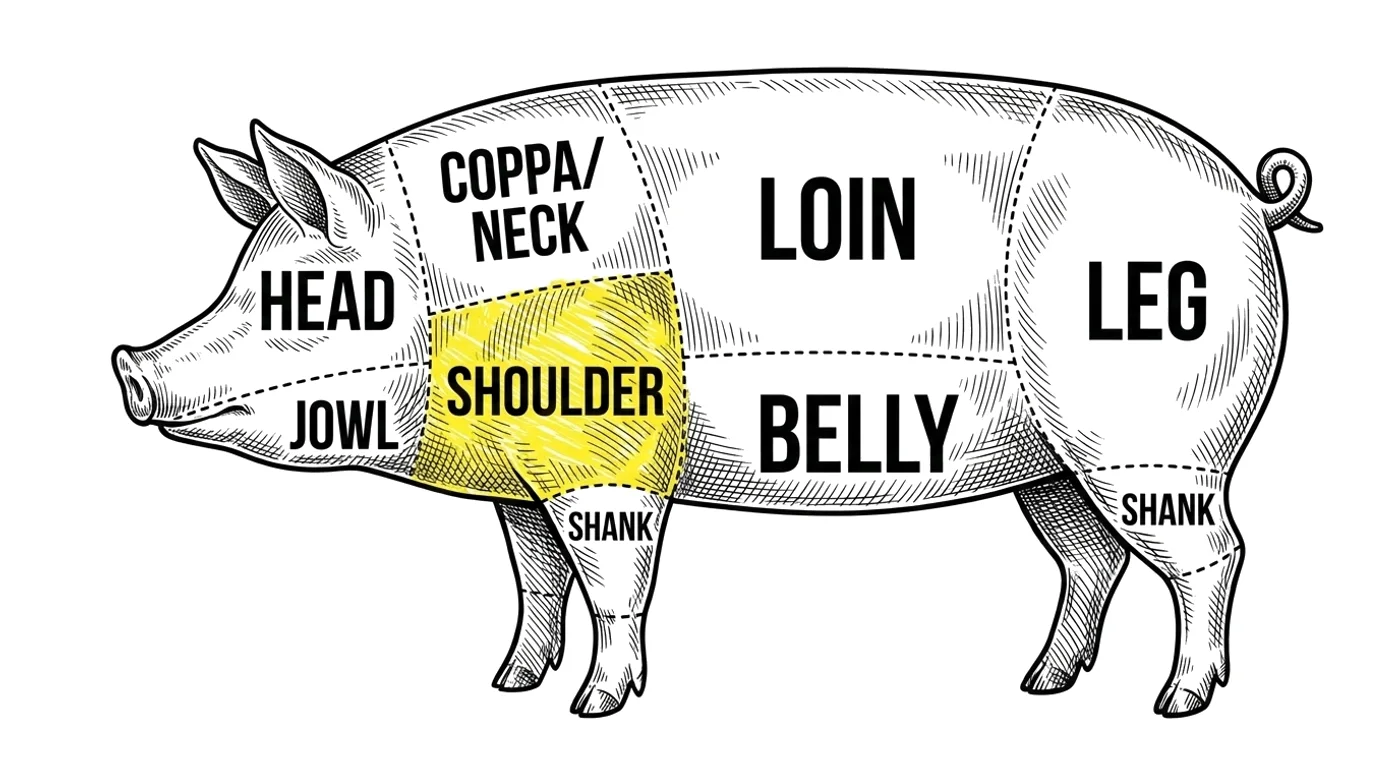
How to recognise it
A long horseshoe or loop with a pale pink-brown interior, clear fat and aromas of pepper, cinnamon, anise and garlic. Shape and size: Long, thin, coiled. Lean colour: Red. Fat and marbling: Flecked. Casing or exterior: Hog or sheep casing, 22 to 32 mm. Surface: Possible. The form is long, thin, coiled. the lean is red. the fat or marbling is flecked. and the exterior uses hog or sheep casing, 22 to 32 mm. Grease smear, hollow pockets, case hardening, a wet centre, rancidity or uncontrolled dark mould is a production fault.
- Shape and size
- Long, thin, coiled
- Lean colour
- Red
- Fat and marbling
- Flecked
- Casing
- Hog or sheep casing, 22 to 32 mm
- Surface bloom
- Possible
Origins and history
Longaniza de Aragón belongs to the long, thin longaniza family made across Aragón in north-eastern Spain. What sets it apart from chorizo is the absence of pimentón, so it keeps the pale colour of the meat rather than turning red, and it leans instead on black pepper lifted by sweet spices such as cinnamon, clove, nutmeg and anise. It has long been a farmhouse and matanza product, a way of turning the year's pig into a sausage that keeps. The same base is worked either as a softer semi-dry sausage for cooking or matured further into a firm, fully dried one.
Long, looped sausages were a practical result of the Aragonese matanza. Without pimentón, the meat retains a pale natural colour, while the spice profile reflects historic trade and the region's preference for aromatic but not red sausage. Aragon protects the recognised quality form through the regional C’Alial guarantee mark and a specific technical regulation rather than an EU geographical indication.
Name. Longaniza, a long thin sausage, from the Latin lucanica.
- Production today
- Producers across Aragon.
- Protection
- Not EU-protected as a general name.
- Tradition vs modern
- Peppery-anise seasoning.
- Seasonality
- Traditionally the winter matanza.
Serving and cultural significance
In its semi-dry form it is usually fried or grilled and eaten hot, often alongside eggs, potatoes or beans, and it is a common addition to stews and rice dishes. Taken further and fully dried, it firms up enough to slice and serve cold as a snack or tapa. The warm-spice and pepper character, with its quiet note of anise, is what marks it out from a paprika-led chorizo at the table.
Recipe and cure
This is not a finished recipe. It is a window into how this meat is traditionally cured. Before you follow any process, please run it through one of our curing calculators, so the salt, cure and timings are right and safe for your own batch.
Make this — the measured Curesmith version →The cure below is the traditional reference. “Make this” opens the measured Curesmith home recipe, scaled to your batch.
Traditional or protected production
Longaniza de Aragón is covered by the regional C’Alial quality mark and its technical regulation. It is a pale, paprika-free pork sausage seasoned with pepper and characteristic sweet spices such as cinnamon, clove, nutmeg and anise.
The reference process can be summarised as follows: Use the meat and fat balance and authorised seasoning in the C’Alial technical regulation, stuff into the recognised long casing and present fresh, semi-dry or dry according to the approved category.
- Meat
- pork
- Salt (%)
- 2.8
- Curing salt
- Not included in the base recipe below
- Fermented
- Yes
- Target pH
- 4.9
- Starter or mould
- Natural surface mould
- Smoked
- No
- Target aW or weight loss
- ~30% weight loss
- Temperature (°C)
- ferment 22 to 24, then dry 13 to 15
- Humidity (%)
- ferment ~90, then 75 to 80
- Maturation
- 2 to 5 weeks
- Basis
- per 1000 g green meat
- Style
- Traditional fermented and dried sausage
Ingredients
- pork, lean (base)100% · 1000 g/kg
- back fat13.33% · 133 g/kg
- pork belly20% · 200 g/kg
- sugar0.3% · 3 g/kg
- pepper0.2% · 2 g/kg
- nutmeg0.05% · 0 g/kg
- star anise, ground0.03% · 0 g/kg
- cloves0.03% · 0 g/kg
- cinnamon0.1% · 1 g/kg
- oregano, dry0.2% · 2 g/kg
- garlic0.7% · 7 g/kg
Method
- Mince pork and fat and mix with all ingredients to green meat weight.
- Stuff into casing.
- Ferment to the target pH.
- Dry to the target weight loss.
Notes
- This traditional recipe uses no nitrite. For safety we recommend adding Cure #2: in a low-oxygen, slow-dried product nitrite is the specific guard against Clostridium botulinum, while salt, acidity and drying control Salmonella, E. coli, Listeria and Staphylococcus.
In the Codex
What this product teaches, and where to read more.
Temple. Roof, Water Activity