
Morcilla blanca
Also known as Morcilla Blanca
Nationwide, Spain
A bloodless white morcilla.
Overview
Morcilla Blanca is a historical naming paradox: it belongs to the morcilla family but contains no blood. Lean pork, soft fat, egg, cream and warm spice produce a pale cooked sausage related in structure to boudin blanc and Catalan Botifarra Blanca.
Where it's from
The cut
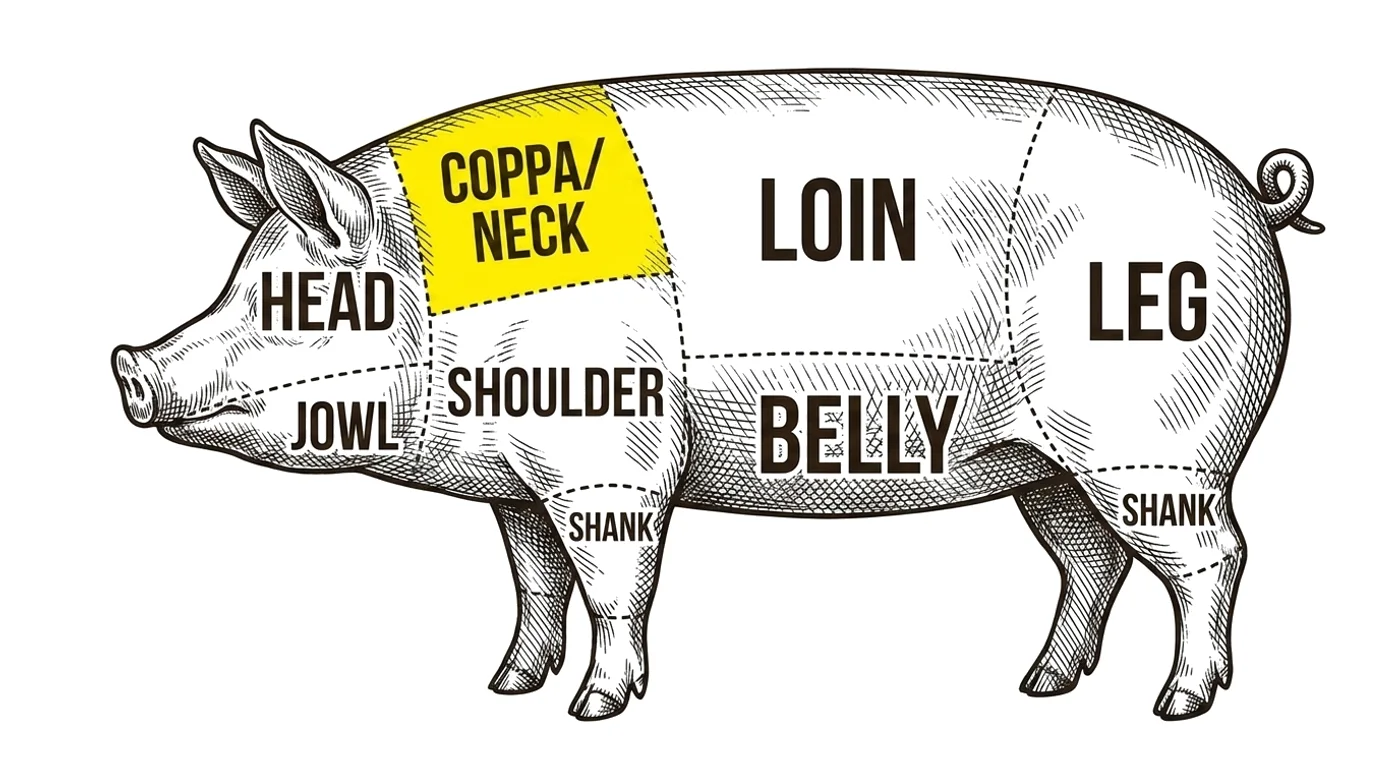
Traditional, protected or commercial production
No national specification controls the name. Regional methods combine lean pork and fat with egg, dairy, onion or offal, season the mixture and poach it in casing.
Variations
Named formulas within this product rather than separate ones. Quantities are per 1000 g of the meat block.
Morcilla Blanca - Cream and Onion Cooked Branch
- Lean pork shoulder625 g
- Firm pork back fat or skinless jowl375 g
- Double cream250 g
- Fine salt22.5 g
- Ground white pepper4 g
- Ground cinnamon1.5 g
- Ground cloves0.6 g
- Ground nutmeg1.5 g
- Whole egg, beaten62.5 g
- Onion, finely chopped75 g
- Fresh flat-leaf parsley, chopped10 g
Morcilla Blanca Provenzal - Parsley and Cream Branch
- Lean pork shoulder706 g
- Firm pork back fat294 g
- Double cream176.5 g
- Fine salt18 g
- Ground white pepper3.5 g
- Ground cinnamon1 g
- Ground cloves1 g
- Ground nutmeg1 g
- Egg white77.5 g
- Fresh flat-leaf parsley, finely chopped9.5 g
- Onion, finely diced70.5 g
- Unsalted pork fat or neutral oil for sweating onion6 g
How to recognise it
The slice is ivory to pale beige, fine or lightly coarse, with a tender set and a gentle aroma of white pepper, nutmeg and cinnamon. It should be moist without leaking fat. A rubbery texture or uncooked centre indicates excessive heat or inadequate cooking.
- Casing
- Hog casing, 32 to 36 mm
Origins and history
The name shows how regional sausage families are organised by custom rather than modern technical categories. A white morcilla could fill the same place in the slaughter-day sequence and use the same casings and kettle as black pudding, even though blood was omitted. Recipes differ widely, with some using liver or offal, others onion and egg, and richer versions cream or saffron. The bloodless form was especially useful for households that wanted a milder sausage or had already assigned the available blood to darker morcillas, while still making full use of fatty pork and perishable organs.
- Protection
- Unprotected.
- Seasonality
- The winter matanza.
Serving and cultural significance
Serve cold in slices, brown it gently in a pan, or add it to soups and festive mixed charcuterie. It pairs particularly well with mustard, pickles, apples and crusty bread. Because the texture is delicate, use moderate heat so the casing colours without squeezing out the fat or turning the egg-and-cream bind rubbery.
Recipe and cure
This is not a finished recipe. It is a window into how this meat is traditionally cured. Before you follow any process, please run it through one of our curing calculators, so the salt, cure and timings are right and safe for your own batch.
Make this — the measured Curesmith version →“Make this” opens the same cure as a measured recipe, scaled to your batch.
- Meat
- Pork
- Cut
- Collar, belly and jowl with rice and onion
- Salt (%)
- 1.8
- Fermented
- No
- Smoked
- No
- Maturation
- cook and set
- Basis
- per 1000 g green meat
- Style
- White morcilla (no blood)
Ingredients
- Lean pork100% · 1000 g
- Back fat60% · 600 g
- White pepper0.19% · 3 g
- Cinnamon0.06% · 1 g
- Cloves, ground0% · 0 g
- Nutmeg0.06% · 1 g
- Onion, chopped3.8% · 60 g
- Cream25% · 400 g
Notes
- This is a cooked product. Cook thoroughly to a safe internal temperature and cool promptly; cooking does not kill botulinum spores, so keep the warm-holding window short and refrigerate.
In the Codex
What this product teaches, and where to read more.
Temple. Pillar, Hygiene Control