
'Nduja di Spilinga
en-DOO-yah
Spilinga (Vibo Valentia), Calabria, Italy
Soft, fiery and spreadable, carried by fat and the heat of Calabrian peperoncino.
Overview
'Nduja is a soft, fiery Calabrian salume built from pork fat, fatty meat and a large measure of local red chilli. The mixture is finely worked, stuffed into a broad casing, lightly smoked and matured while remaining spreadable. Spilinga is its recognised cultural centre, but the name does not currently carry an EU PDO or PGI registration.
Where it's from
Climate. Spilinga on the Monte Poro highlands of Calabria, near the coast.
Altitude. Calabrian highland village
The cut
How to recognise it
A mature 'Nduja is deep brick red to crimson, glossy from soft fat and spreadable at cool room temperature. Chilli aroma leads, followed by smoke and pork. The paste should be smooth enough to spread but not oily or separated. Grey pockets, rancid fat, gas, sourness outside the intended ferment, or uncontrolled black and green mould are faults.
- Shape and size
- Soft, spreadable paste in a casing, deep red
- Lean colour
- Homogeneous deep red paste
- Fat and marbling
- High fat, fully blended
- Casing
- Natural pork gut: hog casing, bung, or the blind cap
- Surface bloom
- None
Origins and history
The sausage grew from the Calabrian pig slaughter, where every edible part of the animal had to earn its place. Fatty trimmings and less prestigious cuts could be transformed by salt, smoke and the region's abundant chilli into a food that kept and flavoured many meals. The name is often linked with the French andouille family of sausage words, although its exact linguistic path is debated. As modern production improved, makers shifted away from the old offal-heavy image toward selected pork and clean fat. Spilinga made the product a civic symbol, establishing an annual festival in 1975. Restaurant chefs later discovered that a spoonful could season pizza, pasta, beans and sauces, carrying 'Nduja far beyond Calabria while also making protection of the Spilinga name more urgent.
Name. Likely from the French andouille, in turn from the Latin inductilia, 'things led in'.
- Production today
- Made by Calabrian producers, with Spilinga central to the product's traditional identity; the name is not currently protected at EU level.
- Protection
- No current EU registration or published application was located in the July 2026 audit. This is an audit finding, not proof that no other local or commercial recognition exists.
- Tradition vs modern
- Traditionally a household product; now made commercially across Calabria, which is why the Spilinga origin is contested.
- Seasonality
- Traditionally tied to the winter pig slaughter.
Compare with. Sobrasada de Mallorca
Serving and cultural significance
Warm bread is the simplest service because it softens the fat and releases the chilli. 'Nduja can also be melted into tomato sauce, stirred through beans, spread beneath pizza toppings, folded into eggs or paired with fresh ricotta and semi-aged cheese. It is a seasoning as much as a sliced salume.
Recipe and cure
This is not a finished recipe. It is a window into how this meat is traditionally cured. Before you follow any process, please run it through one of our curing calculators, so the salt, cure and timings are right and safe for your own batch.
Make this — the measured Curesmith version →The cure below is the traditional reference. “Make this” opens the measured Curesmith home recipe, scaled to your batch.
Traditional or protected production
There is no registered EU specification for the generic name. Spilinga practice uses a high-fat pork block with abundant sweet and hot Calabrian chilli, salt, natural casing, smoke and maturation. Historic formulas vary widely, which is one reason commercial products differ in heat, fat and texture. The protected-style claim must therefore be cultural and geographical, not legal.
- Meat
- pork
- Cut
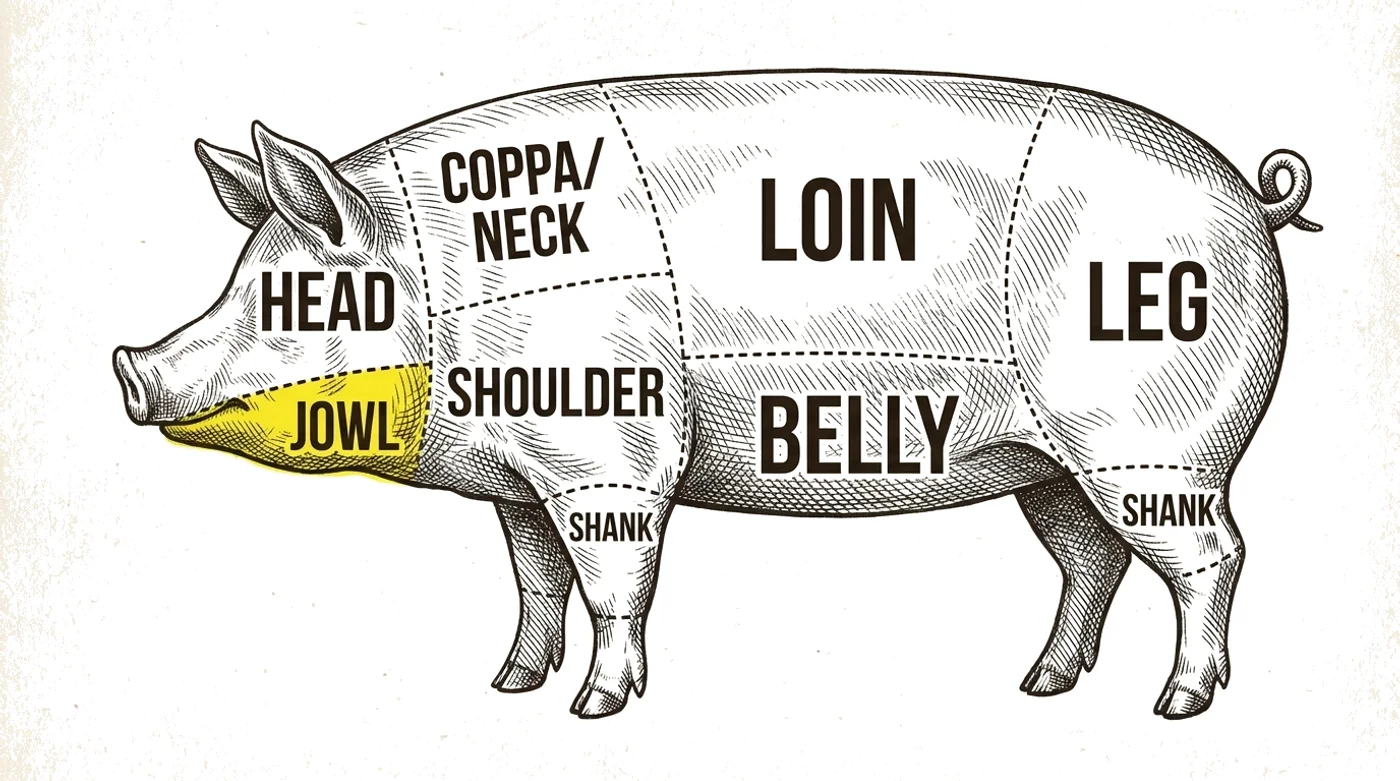
- fatty cuts including cheek and belly
- Salt (%)
- 3
- Curing salt
- Not included in the base recipe below
- Other agents
- a large proportion of Calabrian chilli
- Fermented
- Yes
- Target pH
- 4.9
- Starter or mould
- Natural
- Smoked
- Yes
- Target aW or weight loss
- kept soft, limited drying
- Temperature (°C)
- ferment then cure 12 to 15
- Humidity (%)
- 75 to 85
- Maturation
- a few months
- Basis
- per 1000 g green meat
- Style
- Traditional fermented, high-fat, spreadable
Ingredients
- Pork back fat, belly and jowl (base)100% · 1000 g/kg
- Pork shoulder, ham or loin42.86% · 429 g/kg
- Red peperoncino, hot, powdered5% · 50 g/kg
- Red peperoncino, sweet, powdered5% · 50 g/kg
Method
- Blend fatty pork with a heavy dose of Calabrian chilli and salt to green weight.
- Stuff into casing.
- Ferment to the target pH.
- Cure cool, kept soft and spreadable.
Notes
- This traditional recipe uses no nitrite. For safety we recommend adding Cure #2: in a low-oxygen, slow-dried product nitrite is the specific guard against Clostridium botulinum, while salt, acidity and drying control Salmonella, E. coli, Listeria and Staphylococcus.
Safety. Soft, high-fat and fermented, so one of the higher-risk products here. A dependable ferment to pH and cold storage are essential. Verify before serving.
In the Codex
What this product teaches, and where to read more.
Temple. Pillar, Microbial Control