
Pancetta Piacentina
Piacenza, Emilia-Romagna, Italy
Sweet, spiced and marbled, showing a neat spiral when sliced, good raw or rendered in cooking.
Overview
Pancetta Piacentina is a seasoned pork belly rolled tightly into a cylinder and matured until the slice displays a clean spiral of red lean and white fat. Its texture is soft and sweet rather than heavily smoked or aggressively salty.
Where it's from
Climate. The Piacenza hills of Emilia.
Altitude. Emilian hills
The cut
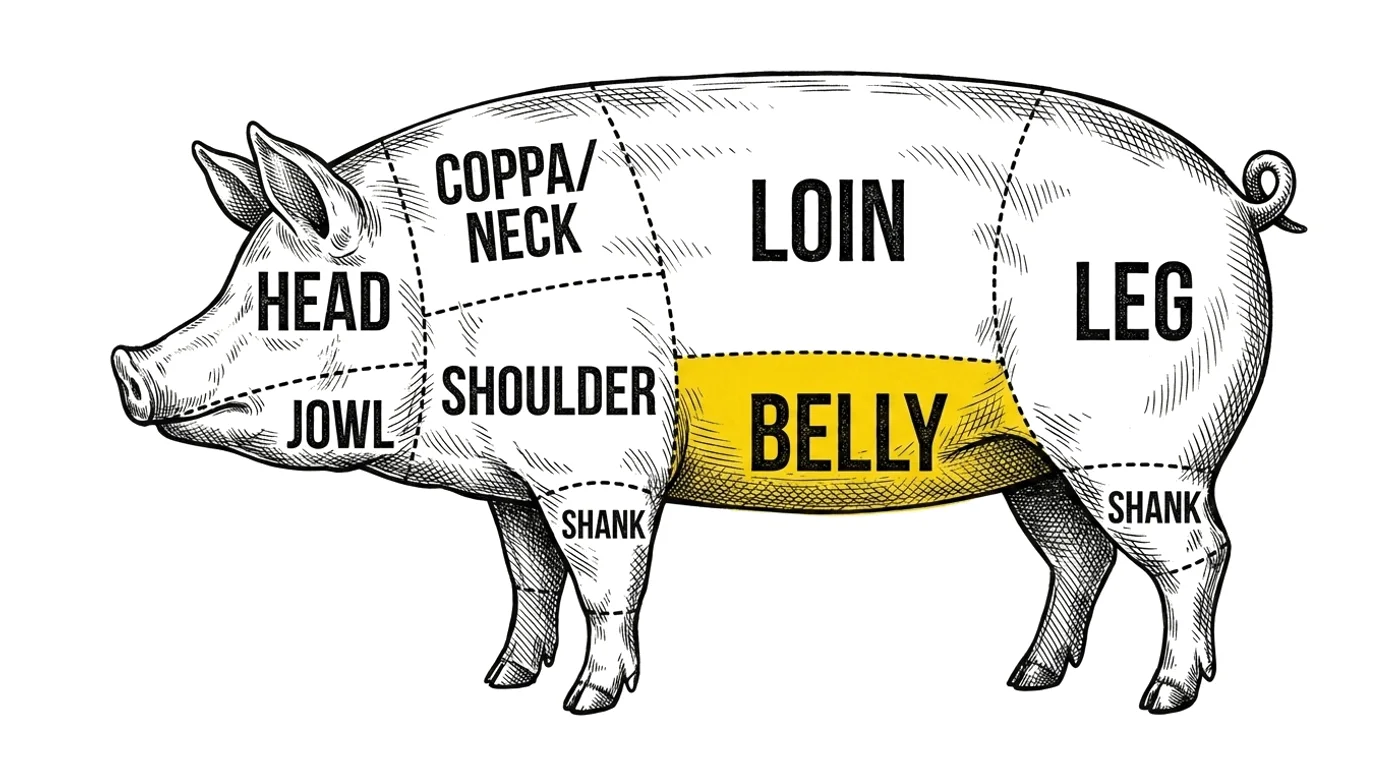
How to recognise it
The whole piece is a compact tied cylinder. The cut face shows a neat spiral of white fat and pink-red lean, with pepper and warm spice visible at the edge. The fat should remain sweet and clean. Loose rolling, internal gaps, yellow rancidity, sourness or a dry outer shell are defects.
- Shape and size
- Rolled and tied cylinder of streaky belly
- Lean colour
- Red streaks
- Fat and marbling
- White layers
- Casing
- Natural casing
- Surface bloom
- Light mould possible
Origins and history
Piacenza's rolled pancetta belongs to the same long pork tradition as the province's coppa and salame. Belly was valuable both as meat and fat, and rolling it transformed a flat slab into a compact piece that matured slowly and produced a striking spiral when cut. Rural slaughter imagery appears in the medieval mosaic at the Abbey of San Colombano in Bobbio, while archaeological evidence indicates much older pig keeping in the area. The rolled form became closely associated with Piacenza's butchers and hill-cellar maturation. Modern PDO rules preserve the province's distinction as the only Italian territory holding three protected salumi of this class.
Name. Pancetta, from pancia, 'belly'.
- Production today
- Consortium producers in Piacenza.
- Protection
- DOP.
- Tradition vs modern
- Traditional dry-cure and roll.
- Seasonality
- Year-round.
Compare with. Pancetta di Calabria
Serving and cultural significance
Serve thin slices at cool room temperature with fried bread, polenta, pickled vegetables or young cheese. It is also excellent rendered slowly in soups, beans and pasta, where the spice and pork fat season the dish.
Recipe and cure
This is not a finished recipe. It is a window into how this meat is traditionally cured. Before you follow any process, please run it through one of our curing calculators, so the salt, cure and timings are right and safe for your own batch.
Curesmith home adaptation — not designation-compliant
Make this — the measured Curesmith version →The cure below is the traditional reference. “Make this” opens the measured Curesmith home recipe, scaled to your batch.
Traditional or protected production
Pancetta Piacentina is a dry-salted belly seasoned with pepper and warm spices, rolled tightly, cased and matured into its characteristic spiral. The protected production and maturation occur within the Piacenza area.
- Meat
- pork
- Salt (%)
- 2.8
- Curing salt
- Cure #2 at 2.5 g/kg (0.25%)
- Fermented
- No
- Smoked
- No
- Target aW or weight loss
- ~ weight loss
- Temperature (°C)
- 12 to 15
- Humidity (%)
- 70 to 80
- Maturation
- 6 to 10 weeks
- Basis
- percentage of green meat weight
- Style
- Traditional dry salting
Ingredients
- sea salt2.8% · 28 g/kg
- black pepper0.4% · 4 g/kg
- clove0.03% · 0.3 g/kg
- nutmeg0.05% · 0.5 g/kg
- garlic0.2% · 2 g/kg
Method
- Salt and season the cut and rest cold.
- Rest so the cure draws through.
- Roll or hang as the style requires.
- Dry and age to the target loss.
Notes
- The official protected specification controls the named product. Any Curesmith EQ, starter-culture, curing-salt or home-scale adaptation is a separate method and must not be presented as designation-compliant.
- A more efficient way of curing this product is using the EQ Method. No more than 2.5% salt to meat weight is required. To follow the EQ method, please use our whole-muscle EQ curing calculator to work out proper ratios and curing times.
In the Codex
What this product teaches, and where to read more.
Temple. Foundation, Time